CRM for Real Estate Agents: Stop Losing Leads to Rivals | Leadrat
BTS: The Lead that Got Away
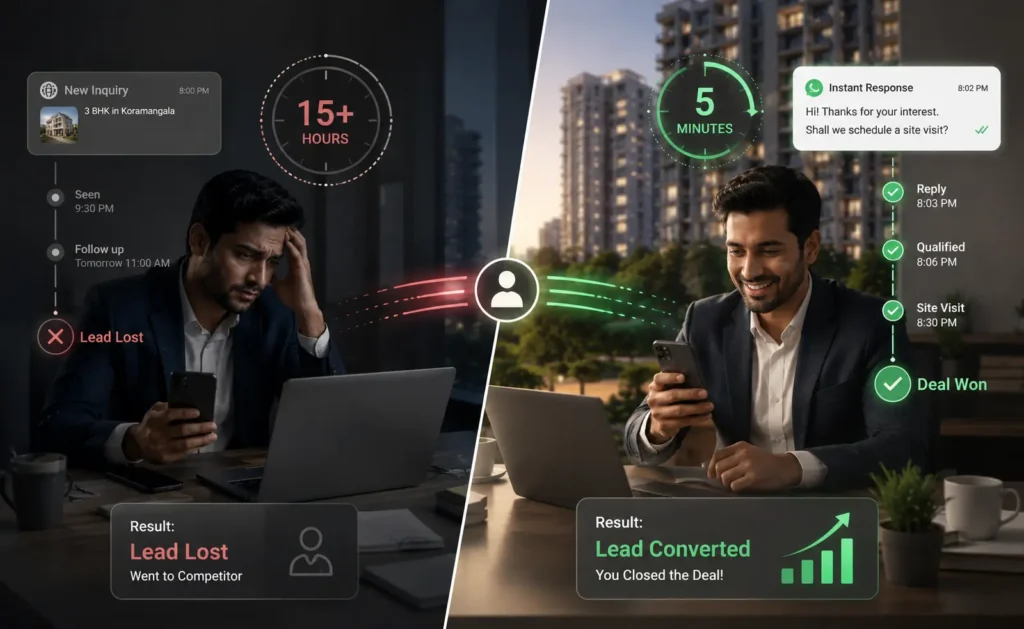
It’s 8 PM on Tuesday in Bengaluru. A homebuyer submits an inquiry on 99acres for a 3 BHK apartment in a prime locality, carefully views your premium listing with photos and details, and continues browsing other options.
Within minutes, a competitor spots the fresh lead and sends a personalized WhatsApp message. By 9:25 PM, the buyer replies. By 9:40 PM, they have already scheduled a site visit with your competitor.
You never even knew the lead existed; another missed opportunity in a highly competitive market.
This scenario plays out daily for real estate agents across India.
Let’s Talk Facts
According to Inmans 2025 Real Estate Technology Survey, the average agent takes 917 minutes, over 15 hours, to respond to a new inquiry. Meanwhile, data from Real Trends shows that agents who respond within 5 minutes are 21 times more likely to qualify for a lead than those who wait just 30 minutes.
The problem is not your marketing budget or the quality of leads coming in. It is the absence of a reliable, automated system to handle them effectively.
That is exactly where a real estate CRM changes everything. Not a generic pipeline tool, but one purpose built for the Indian market to capture, nurture, and convert real estate agent leads with the speed and precision today’s buyers and sellers expect.
See our complete guide to real estate CRM for a full breakdown of what that looks like in practice.
With integrated tools for local portals and communication preferences like WhatsApp, it levels the playing field against faster competitors.
What are Real Estate Agent Leads, really?
A real estate agent lead is any person who has shown genuine interest in buying, renting, or selling property through a phone inquiry, a website form, a WhatsApp message, a property portal listing like 99acres or MagicBricks, or a referral from a past client.
But here is what most agents miss: not all leads are equal and treating them the same way is costing you valuable deals and wasted time. Understanding the different types helps you allocate your efforts wisely.
The Three Lead Tiers every Agent Should Know
Cold Leads have not committed to anything yet.
They are browsing listings, comparing options across cities, or maybe just curious about market prices. With the right nurturing sequence, including educational emails, regular market updates, and timely check ins, many of these can eventually convert into serious prospects.
Warm Leads have engaged meaningfully.
They have responded to a message, attended a site visit, or asked a specific question about amenities or financing. These leads need consistent, personalized follow-up to move them toward a decision.
Hot Leads are ready to act.
They are asking detailed questions about pricing, timelines, possession dates, and availability. Delay here can be damaging. Your CRM should surface these first every single time so you can respond immediately.
Quick Stat: 73 percent of top producing agents use a CRM to manage leads compared to just 41 percent of non-top agents. The system gap between average and top performers is real and directly impacts closing rates.
Why Most Real Estate Agents Lose Leads Before They Even Start
Here is a hard truth: your lead problem probably is not your lead source. It is your follow-up system.
Consider this example from a real estate coaching case study: an agent was spending 1,50,000 rupees per month on leads and closing just one deal every four months. He assumed the leads were bad.
When his CRM data was reviewed, it showed 73 leads in 90 days, an average first response time of over 4 hours, and an average follow up attempt count of just 1.8 before giving up.
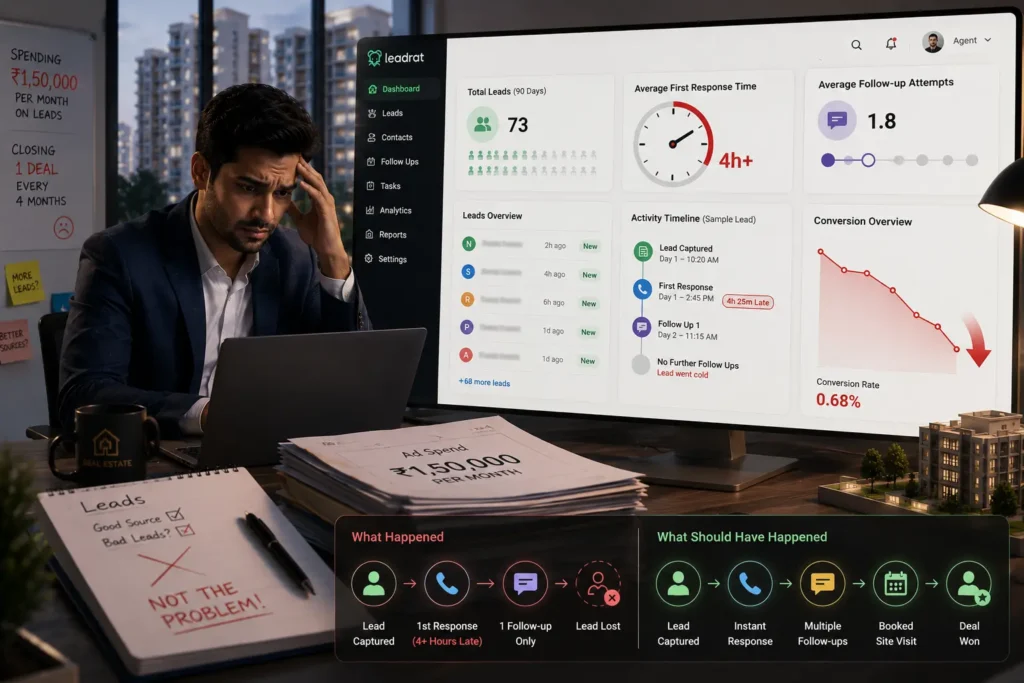
Nothing about his lead source changed. But after cutting response time to under 5 minutes and building a 14 touch follow up cadence, he closed four deals from the same pipeline in the next 90 days.
The leads were not the problem. The system was.
Here is why the numbers work against agents who do not have a structured process:
78 percent of homebuyers work with the first agent who responds (NAR 2025).
Leads who receive 6 or more contact attempts convert 70 percent higher than those who get fewer touches.
“55 percent of agents report conversion rates above 20 percent when using a CRM versus those who do not.”
Most agents give up after 1 or 2 attempts. But persistence, done respectfully and systematically through automated tools, is what closes deals in today’s fast paced market.
How a CRM for Real Estate Agents Fixes the Conversion Gap
1. Centralised Lead Capture Across Every Source
Whether your leads come from 99acres, MagicBricks, your website, Instagram DMs, or a referral, a real estate CRM pulls them all into one place. No more checking three different apps and a spreadsheet. No more leads falling through the cracks because they arrived on a holiday or late evening. Leadrat, for instance, integrates with all major Indian property portals, so every inquiry, wherever it originates, gets logged, assigned, and tracked automatically.
This centralized approach is exactly what a real estate CRM is built to do end-to-end — see our complete guide to real estate CRM for the full picture
2. Speed to Lead Automation
The first five minutes after a lead comes in are the most valuable. A CRM with automated lead response can send an instant WhatsApp or SMS acknowledgement while you are on another call or in a site visit, keeping the lead warm until you can personally connect.
The goal: respond in under 5 minutes. Set up instant mobile alerts, pre-built SMS templates, and automatic lead to agent assignment so no inquiry waits longer than it should. This speed directly impacts your conversion rate and is now table stakes for competitive agents.
3. Automated Follow Up Sequences That Do Not Sound Robotic
The average buyer takes 3 to 6 months to make a purchase decision. Most agents give up in week two. A CRM powered drip sequence keeps your name in front of warm leads with personalised, timely touchpoints, without you manually remembering to send each one.
The key is personalisation. A sequence that references the specific property type a lead enquired about, or follows up on a site visit they attended, feels relevant rather than spammy. That distinction matters enormously for building rapport.
Also read: What Is a Lead? Definition, Types, and How CRMs Qualify Them.
4.Lead Nurturing by Stage and Timeline
Not every lead is ready to buy today, and that is fine. A good CRM segment leads by their buying timeline, so you are sending the right message to the right person at the right time.
6 or more months away: Educational content, market trends, neighbourhood guides, investment tips.
1 to 3 months: Property comparisons, site visit invitations, pricing updates
Ready now: Direct follow-up, personalized property shortlists, urgency-based communication.
This structured approach builds trust and keeps you top of mind when the lead is finally ready to commit.
Generating More Real Estate Agent Leads Worth Having
A CRM can only do so much with bad leads. The best results come when strong lead generation feeds a strong follow up system.
- Referrals Still Win, But You Need a System to Capture Them
Word of mouth remains the highest converting lead source in real estate, with referral leads converting at up to 14 percent compared to 1 to 3 percent for cold paid traffic. But most agents rely on referrals happening organically, without a systematic way to ask for or track them. A CRM can automate post transaction follow ups, a simple check in message 30 days after closing, that keeps past clients engaged and prime them to refer friends and family.
- Inbound Digital Marketing for Real Estate Lead Generation
SEO optimised property pages, localised blog content, and targeted Google Ads bring in leads with active intent. These are people searching right now. They are closer to a decision than someone who saw your Instagram post.
For Indian real estate specifically, ranking for searches like 3 BHK flat in [city] or commercial property investment [area] brings in highly targeted traffic that converts at higher rates.
- Social Media Ads for Awareness and Retargeting
Facebook and Instagram ads average 2,100 to 2,500 rupees per lead in the current market, but the conversion rate depends almost entirely on what happens after lead capture.
Without a CRM, most of this spend evaporates. With one, every lead from a social ad enters a nurture sequence immediately, making the spend far more efficient and improving overall ROI.
The Speed to Lead Problem: What the Numbers Say
This deserves its own section because it is that important.
|
Response Time |
Likelihood of Qualifying the Lead |
|
Under 5 minutes |
21× higher than waiting 30 minutes |
|
Under 10 minutes |
90% increase in conversion chances |
|
5 minutes |
44% convert when followed up this fast |
|
Average agent |
917 minutes (15+ hours) |
The opportunity here is enormous. If you can consistently respond in under 5 minutes, you are outperforming the vast majority of your competition without changing anything else. Modern real estate CRM platforms prioritize speed to lead features like instant alerts, auto assignment, and pre-written response templates as core functionality.
The Art of Converting Real Estate Leads into Clients
A CRM does not replace good salesmanship. It amplifies it.
Ask Better Questions, Faster
The consultative approach, understanding what a client actually needs rather than pitching the first available listing, builds the kind of trust that leads to referrals and repeat business. Use your CRM to log preferences, note objections, and track what you have discussed, so every conversation picks up exactly where the last one left off.
Use Task Management to Stay Relentlessly Consistent
Top agents are not necessarily more talented. They are more organized. CRM task management ensures that every promised follow up happens: a call after the site visit, a message on the day a client said they would think about it, or a check in three months after a deal falls through. Consistency builds trust. Trust closes deals.
Closing With Data, Not Guesswork
When you know a leads engagement history, every email they opened, every property they viewed, every call they answered, you can time your closing conversation with precision. A lead who has just opened three property comparison emails is in a very different state of mind than one who has not engaged in a week. CRM data makes these moments visible and actionable.
Also read: Lead qualification, for the framework behind deciding which leads are worth your time.
Measuring What is Actually Working
Generating and managing leads is only half the equation. The agents who consistently outperform are not just working harder. They are tracking their numbers and adjusting strategies accordingly.
These same principles – tracking every stage instead of guessing – apply to your whole sales process, not just lead follow-up.
See our guide on how a CRM optimizes your complete sales process.
The Six Metrics Every Agent Should Watch
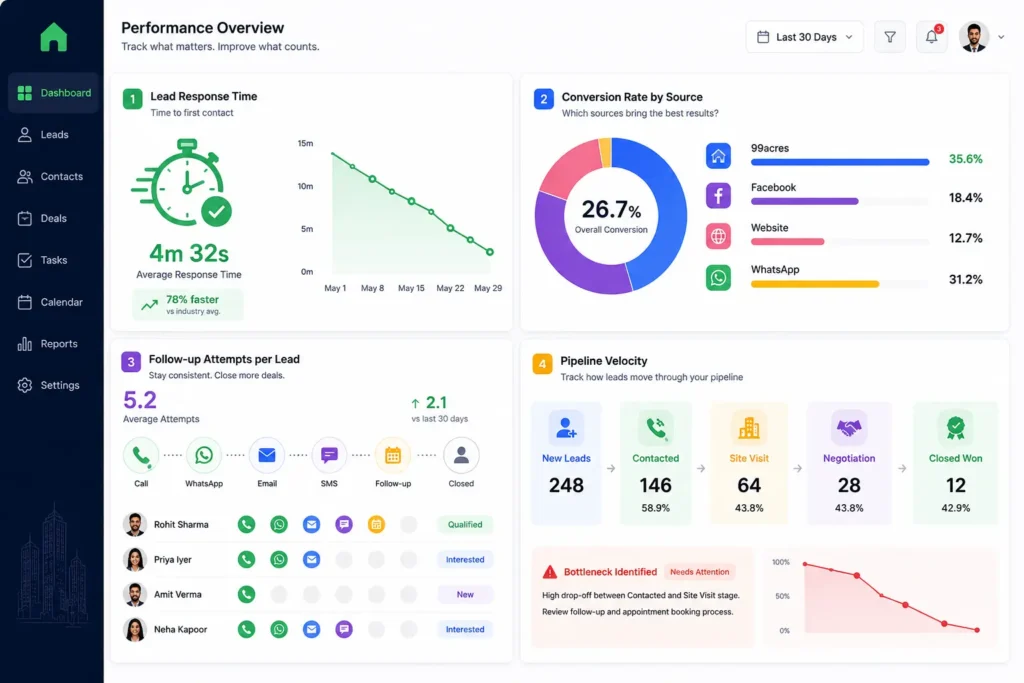
- Lead Response Time: How many minutes between a lead arriving and your first contact attempt?
- Target under 5 minutes: Even under 10 is significantly better than the average.
- Conversion Rate by Source: Are your 99acres leads converting better than Facebook leads? Your CRM should tell you this. Allocate budget toward what actually converts.
- Follow up Attempts per Lead: Most deals close after 5 or more touches. If your average is 1.8, you are leaving money on the table.
- Pipeline Velocity: How long does it take for a lead to move from capture to close? Identify where leads are stalling and fix that stage.
- A B Testing Your Outreach: Small changes in message timing, content, or format can significantly impact response rates. Test sending a follow up at 24 hours versus 48 hours. Test a WhatsApp message versus an email. Test a personalized video message versus a property brochure. Your CRM is the only place where you can see which of these is working and refine your approach over time.
This is exactly the gap a dedicated real estate CRM closes that a generic one usually can’t- we break down the difference in our real estate CRM vs generic CRM comparison.
Data Privacy and Ethical Lead Management
As real estate marketing becomes more digital, handling client data responsibly is not just legally required. It is a competitive differentiator. Clients trust agents who communicate transparently, respect their preferences, and do not overwhelm them with irrelevant outreach.
A compliant CRM ensures all communications are consent based; DND preferences are respected, and data is stored securely. For agents working across India and the UAE, this matters both for regulatory compliance and for building the kind of reputation that generates long term referrals.
Bottom Line
If you have read this far, you already know the real issue is not lead quality, portal pricing, or your marketing budget. It is the system, or gap, between a lead arriving and a deal closing. The agents converting at 3 to 5 percent and above are not working with better leads.
They have faster response times, more consistent follow up, cleaner data, and a CRM that makes all of this happen automatically even when they are in a site visit, on a call, or asleep. The gap is closeable. And it starts with the right tools.
Ready to stop losing leads to slower competitors? Book a free demo with Leadrat and see what your conversion rate looks like with the right system behind it.
Frequently Asked Questions
What is the best CRM for real estate agents in India?
The best real estate CRM for Indian agents is one that integrates with local portals like 99acres and MagicBricks, supports WhatsApp follow up automation, and offers lead scoring tailored to buyer timelines. Leadrat is purpose built for this market.
See our full comparison of real estate CRM vs generic CRM for why a generic tool falls short.
How long should I follow up with a real estate lead?
Industry data suggests following up for at least 6 months before marking a lead as inactive. Leads contacted 6 or more times convert 70 percent more often than those contacted only once or twice. A CRM automates this so it does not rely on memory.
What is a good lead conversion rate in real estate?
The national average sits between 0.4 percent and 1.2 percent. Top producing agents convert at 3 to 5 percent. Elite teams working on high intent platforms can reach 7 to 9 percent. Improving your response time and follow up system is the single fastest way to move up this scale.
Why do real estate agents lose leads?
The most common reasons are slow response time (average agent: 15 plus hours), giving up after 1 or 2 attempts, no structured nurturing system, and treating all leads the same regardless of readiness.
How does a CRM help with real estate lead generation?
A CRM does not generate leads itself, but it maximises the value of every lead you do generate by ensuring fast follow up, consistent nurturing, and data driven decisions about where to invest your marketing spend.