
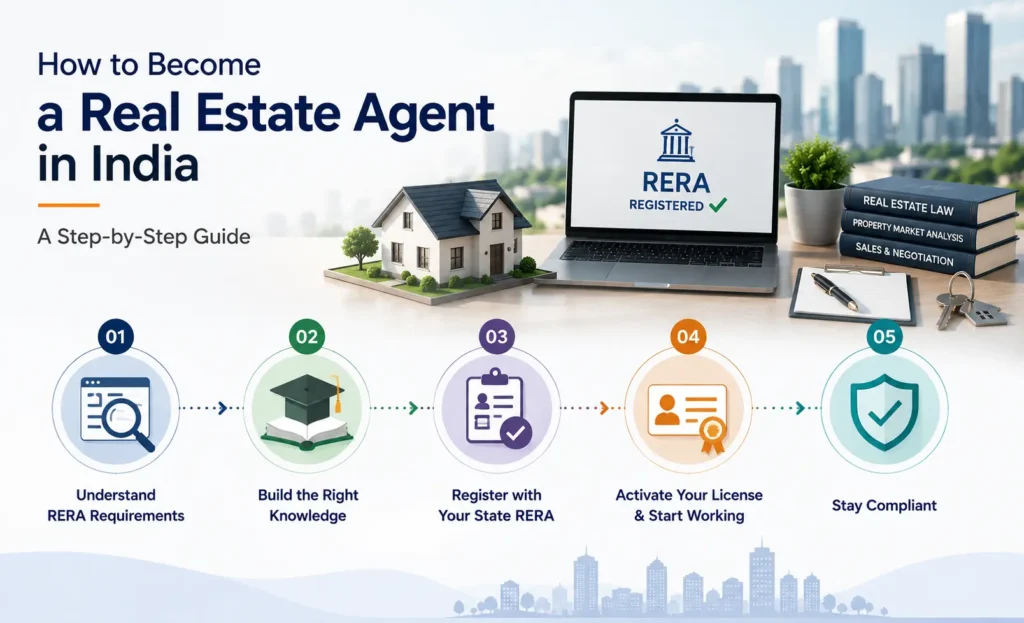
Once you meet the basic eligibility requirements, the process is fairly easy.
Here’s what your journey typically looks like.
Step 1: Understand Your State’s RERA Requirements
Real estate is regulated at the state level, so the registration process isn’t exactly the same everywhere.
Before you do anything else, visit your state’s RERA website and check:
- Registration fees
- Required documents
- Application process
- License validity and renewal timeline
Getting these details right from the beginning can save you a lot of time later.
Step 2: Build the Right Knowledge
You don’t need a formal degree to become a real estate agent. However, understanding how the market works will give you a significant advantage.
If you’re completely new to the industry, consider learning the basics of:
- Property laws and RERA regulations
- Sales and negotiation
- Real estate finance
- Local property markets
Remember, certifications improve your knowledge, but experience is what builds your reputation.
Step 3: Register with Your State RERA
To work legally as a real estate agent, you’ll need to register with your state’s Real Estate Regulatory Authority (RERA).
The process usually involves:
- Filling out the online application
- Submitting identity, address, and PAN proof (along with any state-specific documents)
- Paying the prescribed registration fee
Many states process applications within a few weeks, although timelines can vary.
For example, Maharashtra requires applicants to complete the MahaRERA training programme and pass an assessment before registration.
Step 4: Activate Your License and Start Working
Once your application is approved, your name is added to your state’s RERA register, allowing you to legally operate as a real estate agent.
At this stage, many new agents choose to work with an established brokerage. It offers practical exposure, mentorship, and access to leads while you build your own network.
Step 5: Stay Compliant
Getting registered is only the beginning.
To keep your license active, you’ll need to:
- Renew your registration within your state’s prescribed timeline
- Follow RERA guidelines and professional standards
- Stay updated with changes in regulations and market practices
A successful real estate career isn’t built by getting licensed; it’s built by continuously learning, staying compliant, and earning your clients’ trust.
RERA Registration Process for Real Estate Agents
Here’s where most beginners get confused. India doesn’t have a “real estate license” like the US or UK. What you need is RERA registration.
The entire RERA registration process is online now, in every state. You don’t need to visit an office or stand in a queue.
Under Section 9 of the RERA Act, 2016, anyone who helps sell, market, or book a property in a RERA-registered project must register as an agent with their state’s RERA authority. Skip this step, and you’re breaking the law. Section 62 of the Act allows a fine of ₹10,000 for every day you work without registration.
That fine can cumulatively go up to 5% of the property’s total cost. Most good builders won’t even work with you if you don’t have a RERA number.
One more thing to know is that RERA mainly covers sale and purchase deals on properties over 500 square metres, or projects with more than eight units. If you only handle rentals, some states don’t require RERA registration. But the moment you touch a sale, you need it.
Every state runs its own portal. The steps are mostly the same, but fees and wait times differ.
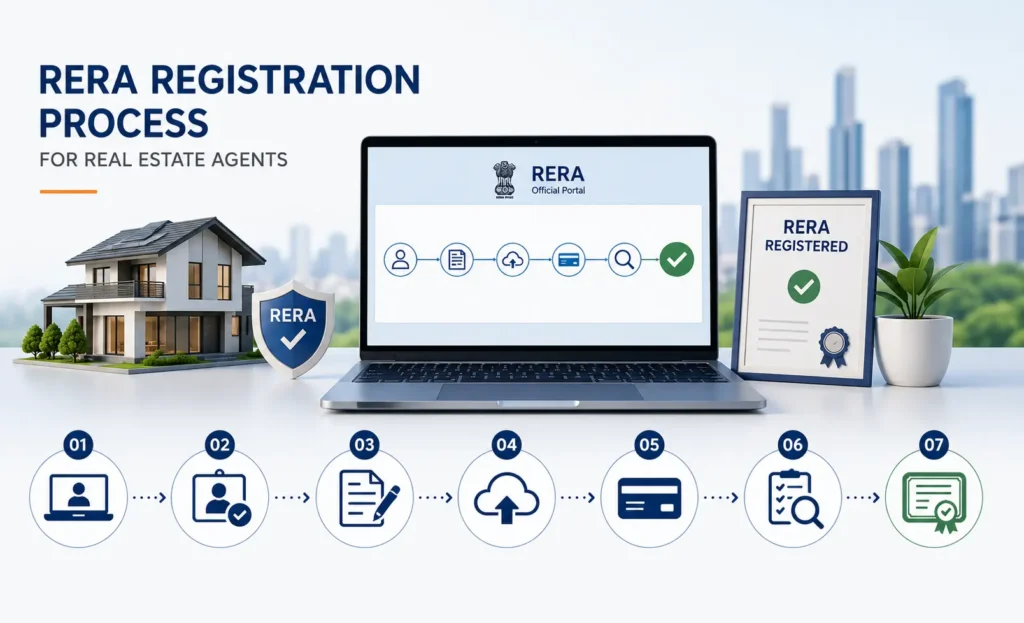
Here’s how it usually goes:
- Create an account on your state’s RERA portal. Maharashtra’s is maharera.mahaonline.gov.in, Karnataka’s is rera.karnataka.gov.in.
- Choose your user type (individual agent or agency) and fill in your basic details.
- Fill out the agent registration form. Add your personal details, office address, and firm details if you have one.
- Upload your documents (full list below).
- Pay the registration fee online. UPI, net banking, or card all work.
- Track your application. Use the reference number you get after payment. Most states finish processing in 15 to 30 working days.
Once approved, you get a certificate and a unique RERA number. By law, you must show this number on every ad, listing, and brochure you use. Your registration stays valid for 5 years, after which you renew it.
Documents Required for RERA Agent Registration
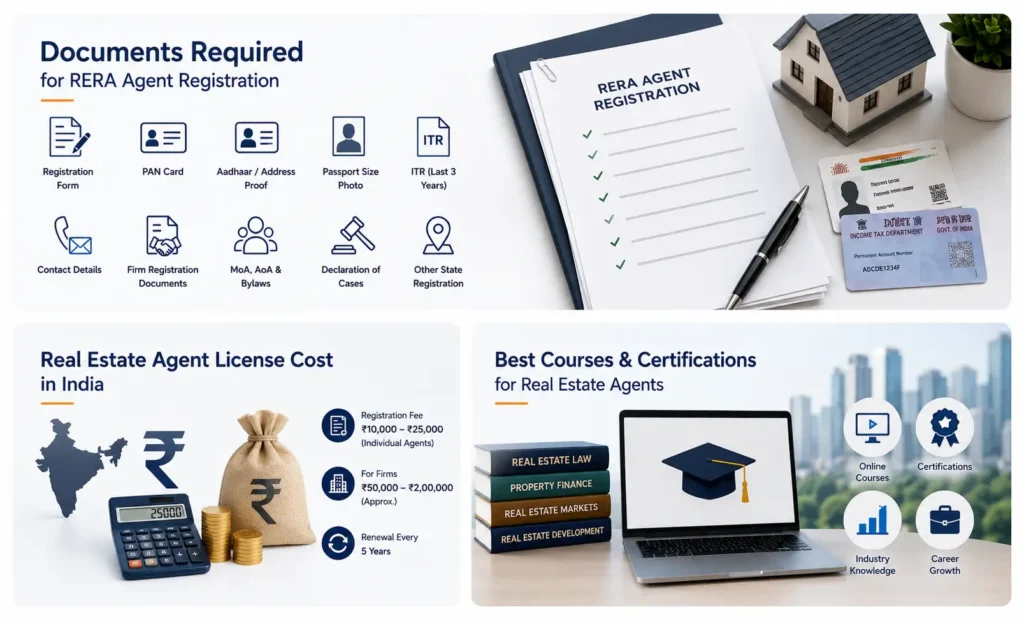
Keep these ready before you start your application. Missing documents are the single biggest reason applications get delayed.
- A completed RERA agent registration form
- PAN card (mandatory)
- Aadhaar card or another valid address proof
- A recent passport-sized photograph
- Income tax returns for the last three years, if you have them
- Contact details: active phone number and email ID
- For firms: certificate of incorporation, partnership deed, or LLP agreement
- For firms: Memorandum of Association (MoA), Articles of Association (AoA), and bylaws
- A declaration of any pending civil or criminal cases against you or your business
- Registration details from any other state, if you’re already registered elsewhere
If any of this feels overwhelming, it isn’t. Most of them are documents that you already have. The only one people forget is the three years of ITRs, so dig that out early.
Real Estate Agent License Cost in India (State-Wise Fees)
RERA registration isn’t free, but it’s not expensive either, especially compared to other professional licenses.
Rough fee ranges for individual agents:
- Most states: ₹10,000 to ₹25,000
- Gujarat sits on the lower end, closer to ₹10,000
- Karnataka and Haryana sit higher, often near ₹25,000
For firms and companies, fees run higher, usually somewhere between ₹50,000 and ₹2,00,000, depending on the state and business size.
A few extra costs worth budgeting for:
- Renewal fee every 5 years, usually a few thousand rupees
- GST registration, mandatory only if your annual income crosses ₹20 lakh (₹10 lakh in a few special category states)
- Optional costs: A course, office setup, or a basic CRM tool, if you choose to invest in these early
City matters a lot here:
- Mumbai and Delhi NCR: The highest-paying markets. Even a standard commission on a high-value property translates to a large payout, since property prices themselves are so high. In New Delhi, gross salaries run about 4% above the national average (ERI SalaryExpert, New Delhi).
- Bengaluru: Strong earning potential, especially in IT corridor localities where both residential and commercial demand stay steady. Gross salaries here run roughly 13% above the national average (ERI SalaryExpert, Bengaluru).
- Pune and Chennai: Commission per deal is usually lower than in Mumbai, but a higher volume of transactions keeps income steady.
- Tier-2 cities: Lower per-deal commission, but often more frequent, end-user-driven deals with less competition from established brokers.
Always check your own state’s RERA site before you pay anything. These numbers get revised, and third-party sites often quote outdated figures.
Best Real Estate Courses and Certifications in India
You don’t need a certificate to start working. But the right course can save you months of learning things the hard way. Here are the ones worth your time:
- MahaRERA Agent Training Programme: Increasingly a soft requirement in Maharashtra. It covers the law, agent duties, and real transaction cases.
- Real Estate Financial Modeling (Coursera): Teaches you how to read a project’s numbers, not just its brochure.
- Urban Land Economics and Real Estate Market Dynamics (Coursera): Good for understanding why land prices move the way they do.
- Real Estate Development: Building Value in Your Community (University of Michigan, via Coursera) is also helpful if you want to eventually work with developers, not just buyers.
- Introduction to Real Estate Principles (Udemy): A solid, no-frills starting point for total beginners.
- NAR India Certified Real Estate Agent Course: Useful if you want a credential recognised by brokerages and builders across cities, not just one state.
Others include;
REMI, REPA, IREED, and more.
Skills You Need to Succeed as a Real Estate Broker
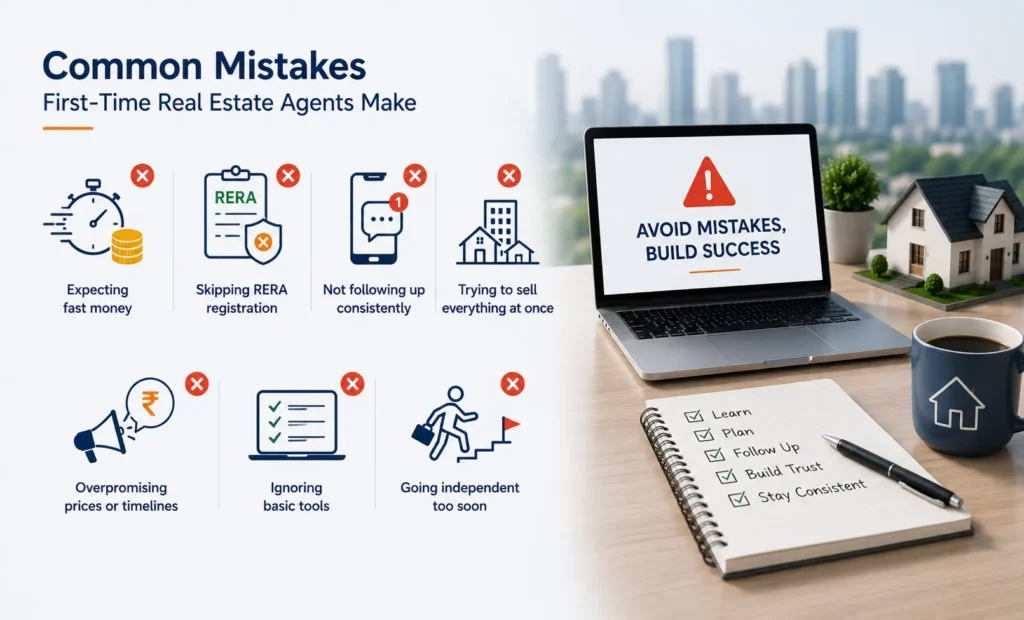
Every successful agent has made a few mistakes along the way. The good news? Most of the common ones are completely avoidable once you know what to look out for.
Expecting fast money.
Real estate rewards consistency more than speed. Your first deal may take weeks or even months, to close, and that’s completely normal. Focus on building relationships instead of chasing quick commissions.
Skipping RERA registration to save time or money.
It might seem like an easy shortcut, but it can cost you much more in the long run. Most reputed builders won’t work with unregistered agents, and operating without registration can attract significant penalties.
Not following up consistently.
Just because a buyer goes quiet doesn’t mean they’ve lost interest. Purchasing a property is a big decision, and many buyers need time before they’re ready to move forward. A timely follow-up often makes the difference between a lost lead and a closed deal.
Trying to sell everything at once.
Residential, commercial, plotted developments, rentals—trying to cover every segment too early can spread you too thin. Start by becoming known for one niche, then expand as your experience and network grow.
Overpromising prices or timelines.
It might help close a deal faster, but unrealistic promises usually lead to disappointed clients and fewer referrals. Honest expectations build stronger, long-term relationships.
Ignoring basic tools.
Managing a handful of leads from memory or WhatsApp might work initially, but it quickly becomes difficult as your pipeline grows. A simple CRM or lead management system can help you stay organised and avoid missing valuable follow-ups.
Going independent too soon.
Working with an experienced brokerage in your early days gives you access to mentorship, market insights, and practical learning that are hard to replace. Building that foundation can save you months of trial and error later.