You just received 50 new leads this week. Some came from MagicBricks, a few from 99acres, and others through Google Ads and WhatsApp inquiries.
But honestly, how many of them turned into site visits or bookings?
For most real estate brokers, agents, and developers in India, this is their daily reality. Leads become chilly. Missed follow-ups become a ritual. Details get lost between different apps and spreadsheets.
And the generic CRM you’re using doesn’t quite understand the unique flow of real estate deals.
I’ve spoken with hundreds of professionals who felt exactly the same frustration. They were managing with general tools until they realized those tools were quietly costing them money and opportunities
What is a Real Estate CRM?
A real estate CRM is a specialized system that helps agents, brokers, and developers manage leads, client relationships, property inventory, and transactions in one place. Unlike basic contact managers, it’s designed around the long sales cycles and specific needs of property buying and selling.
For a complete walkthrough of features, setup, and choosing the right CRM for your business type, see our complete guide to real estate CRM.
How Has CRM Technology Evolved in 2026?
In 2026, CRMs have become intelligent platforms. They predict buyer behavior, automate messages across WhatsApp, email, and SMS, and deliver real-time insights.
Generic CRMs try to serve every industry, while real estate CRMs like Leadrat are built for Indian market realities; portal integrations, field team management, and complex project inventory.
Real Estate CRM vs Generic CRM: Key Differences
Aspect | Generic CRM | Leadrat (Real Estate CRM) |
Property and Inventory Management | Manual entries or basic custom fields | Full native module with availability tracking, smart matching, project setup, and microsites |
Lead Capture from Portals and Ads | Limited native support | Seamless auto-capture from 99acres, MagicBricks, Housing.com, OLX, Google and Meta Ads |
Lead Assignment and Routing | Basic rules | Advanced rule-based routing, project-wise distribution, auto + manual options |
Re-enquired and History Leads | Often loses context | Dedicated re-enquiry bucket with full history retention |
Lead Leakage Prevention | Very limited | Smart alerts, duplicate detection, and centralized controls |
Site Visit Management | Basic scheduling | Geo-verified visits, geofencing, clock-in/out for field teams |
Mobile Experience for Agents | Average | Built for field use with themes, font size adjustment, and fast navigation |
Communication Tools | Basic integrations | Deep WhatsApp Business API, threaded emails, call tracking and templates |
Workflow Automation | Simple workflows | Drip campaigns, smart reminders, testable rules with activity logs |
Analytics and Reporting | General sales numbers | Real estate focused – conversion funnels, campaign ROI, agent performance |
Field Team Accountability | Limited tracking | Geo-verification, attendance reports, and policy enforcement |
Generic CRMs can feel affordable and flexible in the beginning. But most real estate teams eventually get tired of workarounds, scattered data, and missed opportunities.
For builders and large real estate businesses, the conversation often extends beyond CRM. Read our complete comparison of Real Estate ERP vs CRM to understand which solution best fits your operations and sales process.
Why Real Estate Professionals Are Switching from Generic CRMs
One of our Pune clients was earlier using a popular generic CRM. They were getting leads but struggling with follow-ups and property matching. After switching to Leadrat, their team started responding within minutes, site visits became trackable, and his conversion rate more than doubled in just four months. No missing leads, system glitches, full ROI visibility, and clear pipeline.
“Before Leadrat, we were losing 5–6 hours every week just on admin leads were slipping, and we had no visibility into what was happening. Within 12 weeks we saw real ROI, and 30 months later we’re still using it. Follow-ups are 50% faster, and the re-enquiry feature alone has quietly recovered deals we would have lost forever. The support team is genuinely helpful that’s the first thing I’d tell anyone on the fence.”
— CG Infrastructure, Real Estate
This mirrors a pattern we cover in depth separately: real estate agents struggling to convert leads because follow-ups and property matching fall through the cracks.
Key Benefits of Using a Specialized Real Estate CRM
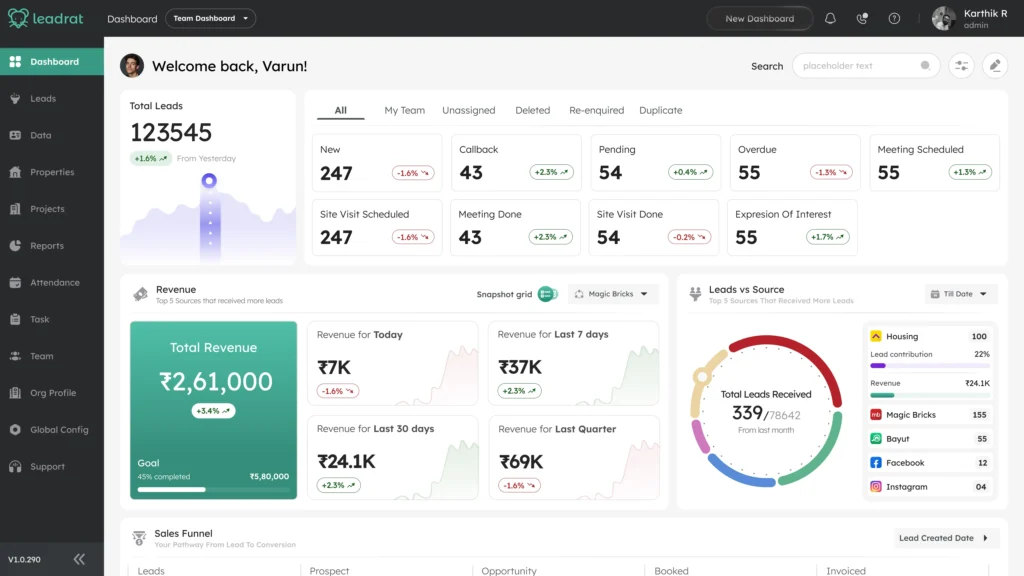
Smarter Lead Management
Leads are captured instantly, scored intelligently, and never fall through the cracks. You maintain complete history even when leads are reassigned.
Communication That Actually Connects
Send timely, relevant messages across WhatsApp, SMS, or email. A first-time buyer gets different nurturing compared to an investor automatically.
Real Productivity Gains
Teams using Leadrat save significant time every week because inventory checks, tasks, and communication all happen in one place.
Strong Field Execution
Agents can schedule visits, get geo-verified when they reach the site, and update everything on their phone. Managers finally get reliable visibility.
Actionable Insights and Better ROI
Understand which lead sources are profitable, how your pipeline is moving, and which agents are performing best with real estate-specific metrics.
Must-Have Features in a Real Estate CRM in 2026
In 2026, a real estate CRM is no longer just a lead tracker; it needs to function as a full sales execution platform for brokers, developers, and field teams.
The most effective systems combine automation, mobile workflows, and instant communication in one place.
Here are the must-have features buyers are prioritizing:
- Strong property portal integrations so leads from platforms like 99acres, MagicBricks, Housing, Facebook, and Google Ads flow directly into the CRM automatically.
- WhatsApp automation for instant lead response, follow-ups, reminders, and conversation tracking. Fast response time has become a major conversion advantage in real estate sales. This is what’s known as speed to lead, and it’s one of the single biggest levers on conversion rate.
- Geo-verified site visits to ensure field activity is authentic, track attendance, and improve sales accountability.
- Smart property matching that helps sales teams recommend relevant inventory based on buyer budget, location, and preferences.
- Mobile-first design because most real estate teams work in the field, not at desks. Mobile workflows, instant updates, and on-the-go follow-ups are now essential.
- Automated lead assignments and reminders to reduce missed opportunities and improve speed-to-lead.
- Integrated analytics and reporting for tracking lead sources, conversion ratios, team performance, and site visit outcomes.
- Third-party integrations and APIs to connect with marketing tools, calendars, WhatsApp systems, and workflow automations.
Leadrat delivers these capabilities out of the box with built-in portal integrations, mobile-first workflows, property management tools, mobile CRM access, automated lead handling, and Real-Estate-Specific reporting designed for brokers and developers
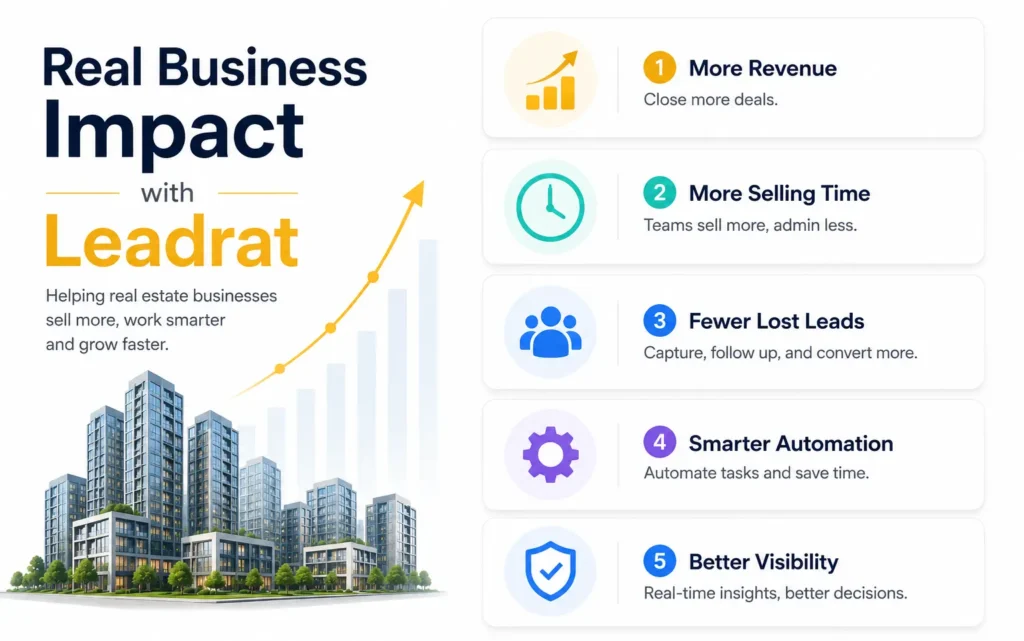
Real Business Impact with Leadrat
The Smart Choice for 2026 and Beyond
Generic CRMs still work for very basic needs.
But in today’s competitive market, a purpose-built real estate CRM gives you faster responses, fewer lost leads, better team accountability, and stronger conversions.
At Leadrat, we’ve helped over 1700+ real estate businesses in India and Dubai change this story. Leadrat is a purpose-built real estate CRM designed specifically for brokers, developers, and field sales teams. It brings lead capture, property inventory, site visits, and pipeline management into one powerful web and mobile platform.
Leads flow in automatically from major portals and ads, smart automation handles repetitive work, and geo-verified site visits keep your team accountable. The result? Less leakage, better productivity, and more closed deals.
Stop working around your tools. Start using tools built for your work.
Also read: our roundup of the top 17 real estate CRMs in India for specific platform comparisons.
See the difference for yourself: If you’re tired of losing good leads or spending too much time on manual work, we’d love to show you what Leadrat can do for your business.
Frequently Asked Questions (FAQs)
1. What is the main difference between a generic CRM and a real estate CRM?
Generic CRMs offer broad features for any industry, while a real estate CRM like Leadrat includes built-in property inventory management, portal integrations, geo-verified site visits, and automation designed specifically for long real estate sales cycles.
2. Is Leadrat suitable for small teams or individual agents?
Yes. Leadrat works equally well for solo agents, small brokerages, and large developers. Our pricing and plans are flexible according to team size.
3. How much does Leadrat cost?
Pricing starts from ₹1,499 per user/month and goes up to ₹2,299 per user/month depending on the number of users and features required.
4. Does Leadrat integrate with property portals and WhatsApp?
Yes. It has seamless integrations with 99acres, MagicBricks, Housing.com, OLX, Google Ads, Meta Ads, and full WhatsApp Business API support with ready real estate templates.
5. How long does it take to see results after switching?
Most teams notice better lead handling, reduced leakage, and improved productivity within the first 2 to 4 weeks of implementation.
6. Is it difficult to switch from another CRM to Leadrat?
Not at all. We provide full support for data migration, team training, and onboarding so you can switch smoothly with minimum disruption.