Your marketing team just generated a red-hot inbound lead. The prospect visited your pricing page, downloaded a case study, and filled out a demo request.
Then… nothing. For 30 hours.
By the time your SDR follows up, that prospect has already booked a demo with your competitor; the one who responded in four minutes.
That’s the speed-to-lead problem. And the truth is: companies that respond within five minutes close at nearly 2.5x the rate of those that wait 24 hours. On 500 monthly leads, that gap quietly costs you tens of closed deals every single month.
The companies winning in 2026 aren’t out-spending you on demand gen. They’re just faster.
The real question isn’t “Are we following up?” It’s “Are we following up before the window closes?“
Well, let’s dig in to understand better.
Speed to Lead Meaning
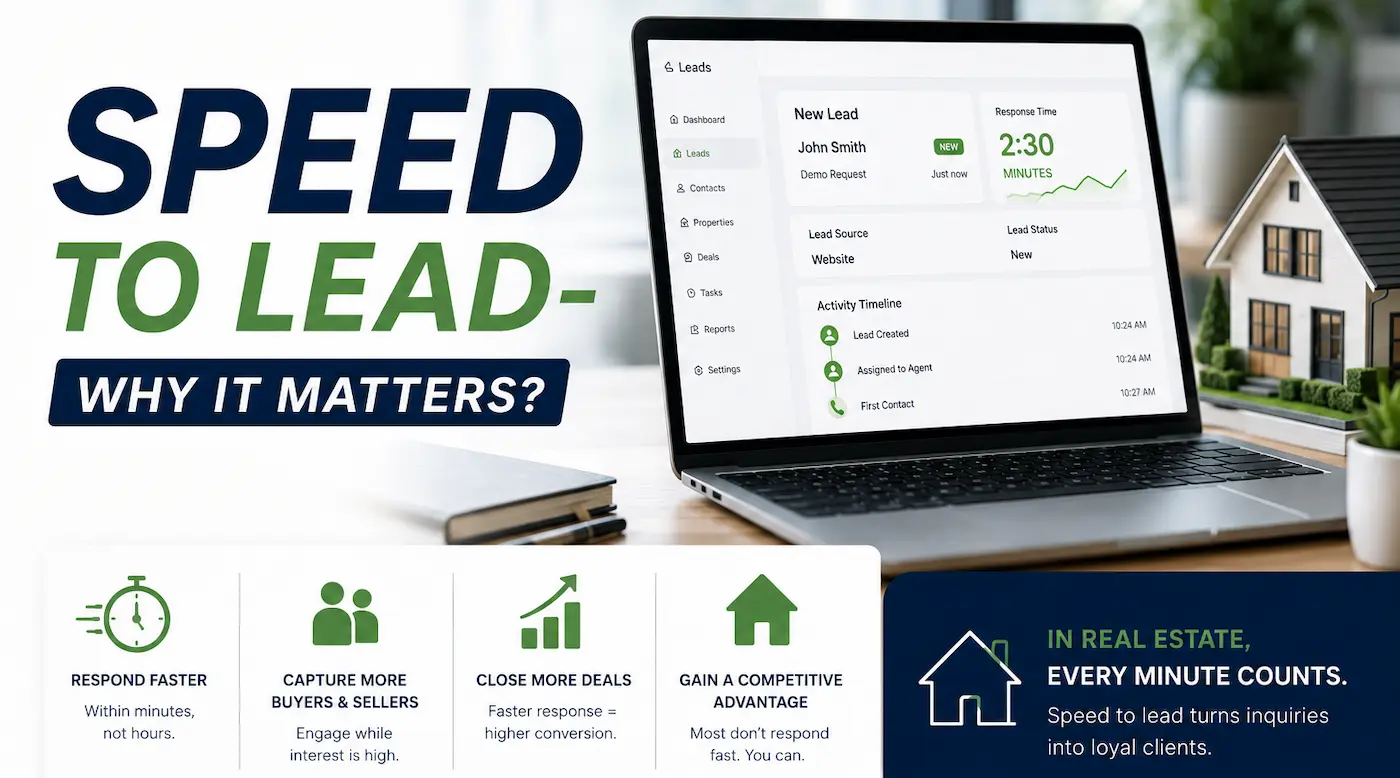
Speed to lead is the time between the moment a prospect fills out a form sharing their information and expressing interest. And the moment a sales rep first reaches out to contact them.
The clock starts the second; a lead enters your CRM. Everything after that is response time.
The ideal window is under five minutes, as cited in a study, and in high-intent scenarios, as fast as 30 to 60 seconds.

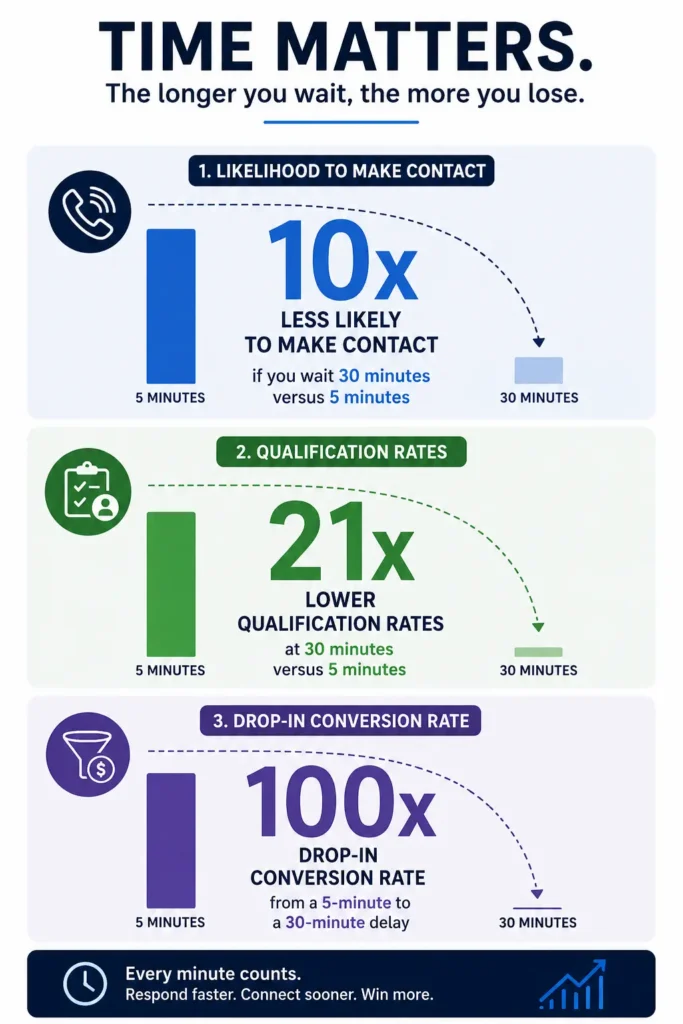
Most companies, however, respond in hours or days. The data shows exactly how costly that is:
What Slows Down Lead Response
Understanding the problem starts with knowing where the friction lives.
Manual processes and lack of automation. When lead distribution or data entry is handled by hand, immediate engagement becomes impossible by design.
Sales and marketing misalignment. Disagreements over lead quality lead to slow follow-up, ignored MQLs, and missed opportunities at the top of the funnel.
Missing real-time alerts. When sales reps are not notified at the moment a lead arrives, delays become structural, not incidental.
Ineffective routing and shared inboxes. Without defined ownership or automated assignment, leads in shared inboxes get misplaced or go uncontacted entirely.
Limited team coverage. On evenings, weekends, and holidays, most companies have no response capability or a dramatically slower one.
Poor data quality and weak lead qualification. Chasing unqualified leads wastes time and slows down response to the prospects.
Excessive form fields. Overly long intake forms create friction at the point of submission, delaying both the inquiry and the first contact.
These same breakdowns in process and ownership are a big part of why real estate agents struggle to convert the leads they already have
Moving ahead..
Why Speed to Lead Is a Revenue-Critical Metric
Speed to lead isn’t just a sales metric; it’s the moment where marketing investment either pays off or quietly walks out the door.
Urgency drives conversions. Prospects in an active buying cycle do not wait long. Responding within five minutes can increase conversion rates up to 100x compared to a 30-minute delay. The business that reaches out first does not just get a head start; it gets the deal.
Buying intent is highest at the moment of enquiry. When a prospect submits a form, their interest is at its peak. That window is short. Other priorities take over; competing vendors reach out, and the moment passes. Reaching out immediately captures that intent before it fades.
Fast response is a competitive advantage most businesses ignore. The average B2B lead response time is over 40 hours. Businesses that respond within five minutes are operating in a space most competitors have left wide open. That gap between what the industry does and what the data recommends is one of the biggest untapped opportunities in sales today.
First contact sets the tone for the entire relationship. A fast, well-timed response signals professionalism, reliability, and genuine interest. That first impression shapes how the conversation develops, how quickly trust is built, and how long the customer stays.
Every hour of delay reduces the value of a lead. An uncontacted lead never waits to get cold. The chance of making contact drops sharply after 60 minutes and keeps falling. By the time most sales teams follow up, the prospect has often already spoken to a competitor, and the opportunity has narrowed significantly.
High-intent leads deserve a faster, dedicated response. A prospect who has visited the pricing page, filled out a form, or requested a callback is already showing clear buying intent. Treating them the same way as a cold enquiry wastes the highest-value leads in the pipeline.
Speed sends a message before the conversation even starts. In industries where purchases are significant, response time tells a prospect a great deal about the business its attentiveness, organisation, and respect for their time.
Also read: our guide to lead routing for a simple look at how the right lead gets to the right rep.
That impression is made before any pitch, before any product demonstration, and before the sales process formally begins.
The data is consistent, and the opportunity is clear. The only variable left is whether your team acts on it.
Read More: Real Estate CRM vs Generic CRM: Benefits You’re Missing Out On in 2026
Lead to Speed: Effect on Sales Results
Increased probability of contact. Reaching out within five minutes makes you 10x more likely to get a response compared to waiting 30 minutes.
Increased lead value. Faster engagement leads to more productive conversations with the decision-makers who matter most.
Here’s how the numbers break down:
Response Time | Benchmark Standard | Impact on Conversion | Effect on Lead Quality |
Under 1 minute | New ideal standard (2026) | 391% increase in conversions | Highest intent window — prospect is still engaged |
Under 5 minutes | “Golden window” for qualification | 21x higher qualification rate vs. waiting 30 minutes | Decision-makers are reachable and context is fresh |
Under 30 minutes | Acceptable but declining | Qualification rate drops from 21x to 1x | Lead interest and availability drops sharply |
Over 1 hour | Below competitive threshold | Likelihood of conversion drops dramatically | Lead has likely moved on or contacted a competitor |
Industry average | 40+ hours (B2B) | Majority of leads lost before first contact | Pipeline quality undermined before the sales team engages |
Read further: https://hbr.org/2011/03/the-short-life-of-online-sales-leads
Best Practices to Master Speed to Lead
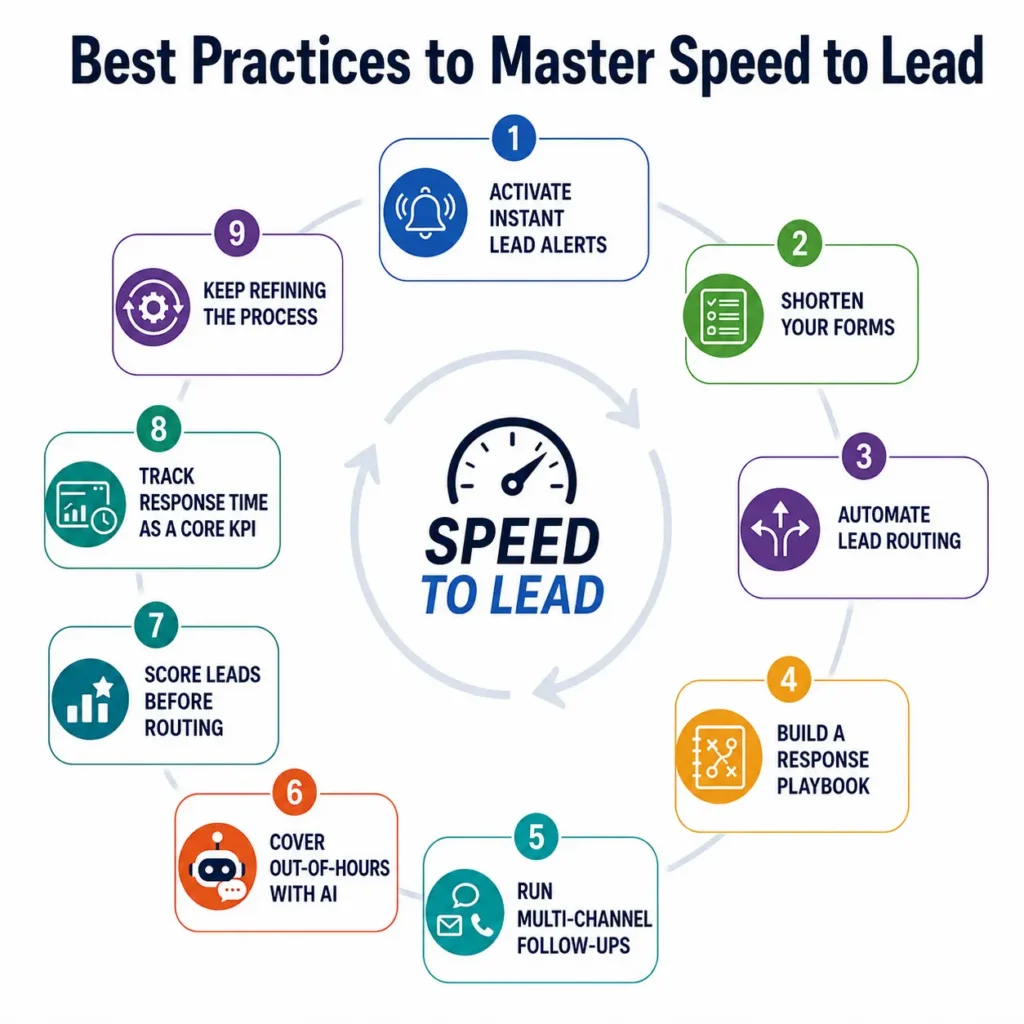
Knowing the benchmarks is one thing. Building the infrastructure to consistently hit them is another. These practices close the gap between intent and execution.
- Activate instant lead alerts. The moment a form is submitted, the right rep should know about it via CRM, mobile, or team chat. No queues, no delays.
- Shorten your forms. Every extra field is friction. Keep it to five questions or fewer and let enrichment tools fill the gaps. Capture enough to start a conversation, not complete a profile.
- Automate lead routing. Manual assignment kills response time. Route leads instantly based on territory, availability, or lead source the right rep should have it within seconds.
- Build a response playbook. Speed without process creates inconsistency. Define response time targets, preferred channels, follow-up sequences, and escalation rules for uncontacted leads.
- Run multi-channel follow-ups. One unanswered call is not a dead end. Follow up with an SMS within two minutes, an email within five minutes, and a second call shortly after. Prospects respond at different times across different channels.
- Cover out-of-hours with AI. Leads don’t arrive on schedule. Conversational AI can initiate a relevant response when a form is submitted, keeping intent warm until a rep is available.
- Score leads before routing. A pricing page visitor is not the same as a guide downloader. Build intent scoring into your routing, so the highest value leads always move fastest.
- Track response time as a core KPI. It belongs to the sales dashboard, broken down by rep, source, and time of day. What gets measured gets managed.
- Keep refining the process. Lead behaviour shifts. Review the data regularly, test follow-up sequences, and update routing rules accordingly. Speed to lead is an ongoing discipline, not a one-time fix.
The problem is clear. The fix is operational.
Pair these practices with the campaign-tracking ideas in our real estate marketing guide to see exactly which lead sources deserve your fastest response.
How Leadrat helps Fix your Speed to Lead Problem
These practices share one common thread: infrastructure. The systems, workflows, and tools that determine how fast intent turns into contact.
That is precisely what Leadrat Real Estate CRM is built for. Instant lead capture, CRM sends notification within milliseconds, automated lead rotation and alerts, multi-channel follow-up, and real-time response analytics giving real estate sales teams the operational foundation to respond faster, engage smarter, and convert more of the leads they have already earned.
Knowing the ‘5-minute rule’ is one thing. Executing it consistently across every lead, every source, and every working hour is where most teams fall short. Leadrat is built specifically to close that gap.
The moment a prospect submits a form, Leadrat captures it instantly and routes it to the right agent without manual intervention. Automated alerts ensure no lead sits unattended, and built-in follow-up sequences trigger calls, SMS, and emails within minutes if the first attempt goes unanswered.
In a sales environment where 78% of buyers go with the first company that responds and where unstructured teams average a 5 to 12% contact rate compared to 25 to 40% for those with the right setup, the difference is not marginal. It is the pipeline itself.
See for yourself!
Frequently Asked Questions
What is Speed to Lead?
It’s how fast you follow up after someone shows interest. The quicker you respond, the higher your chances of closing.
How important is it?
Massively. Studies show responding within 5 minutes makes you 9x more likely to convert than waiting even 30 minutes.
How do you measure it?
Simple,track the time between a lead coming in and your first contact. Most CRMs do this automatically.
How does CRM help?
CRM auto-assigns leads, sends instant alerts, and even triggers automated follow-ups, so no lead goes cold.
Does response time affect lead conversion rates?
Yes, the first vendor to respond wins 35–50% of sales. Speed isn’t just a metric; it’s a competitive advantage.