
You ran three campaigns last month. Google Ads. A housing portal listing. A Facebook lead form. Leads came in. A few converted. But when your sales head asked which campaign drove the best closures, you had to guess.
That is the real problem with real estate marketing today. Teams are spending money. But they cannot tell which rupee is working and which is being wasted. Without a system that connects every lead back to its source, your marketing budget is flying blind.
A real estate CRM fixes this. It does not just store contact details. It ties every campaign to every conversion. It gives you a clear picture of what is actually driving bookings.
11 Real Estate Marketing Campaigns
Here are 11 ways a real estate CRM helps you run smarter marketing campaigns that you can impact better;
1. Lead Segmentation: Stop Sending the Right Message to the Wrong Person
Most real estate teams treat their entire lead database as one audience. They send the same launch announcement to first-time homebuyers, seasoned investors, and cold inquiries from six months ago. The result is low open rates, high unsubscribes, and leads who stop paying attention.
Segmentation fixes this fast.
A CRM lets you group leads by location preference, budget range, property type, purchase intent, and funnel stage. Awareness. Consideration. Ready to book a site visit.
Once you segment, your campaigns speak directly to each group.
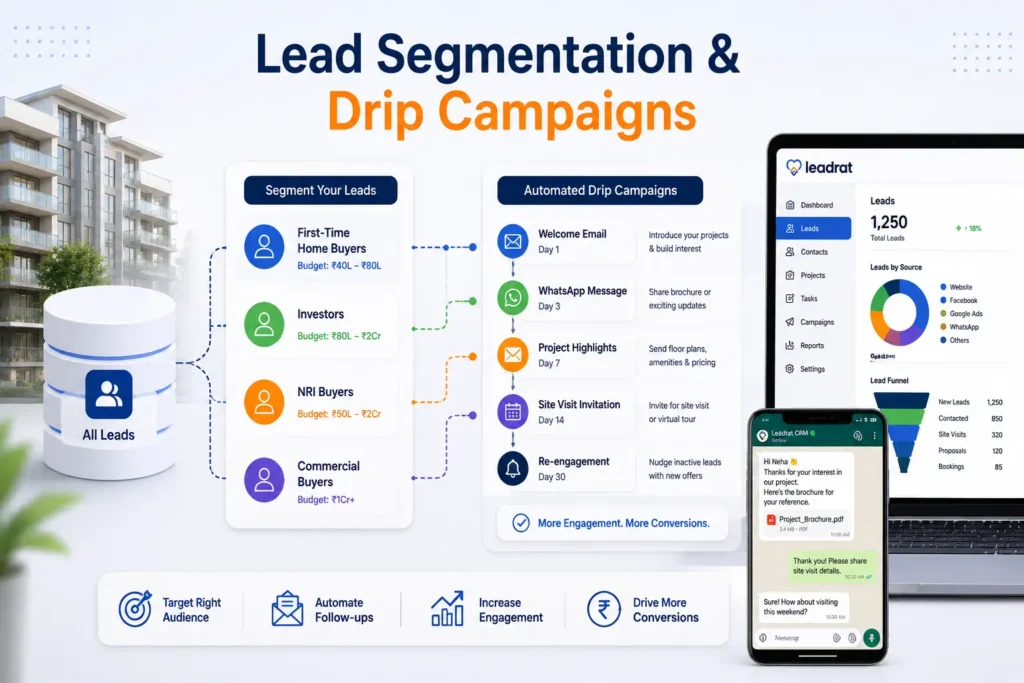
A first-time buyer looking at apartments in the 60 to 80 lakh range needs a very different message than an NRI investor evaluating commercial units. The CRM makes sure the right message reaches the right person. It also tells you which segment converts best, so you know where to focus next.
2. Drip Campaigns: Stay in Front of Buyers During the Long Research Phase
A real estate purchase does not happen overnight. Most buyers research for three to six months before they commit. If you are not in front of them during that time, a competitor will be.
Drip campaigns are automated sequences of emails, WhatsApp messages, or SMS sent based on what a lead does. They keep your brand visible without exhausting your sales team.
Here is how it works in practice. A lead downloads a brochure. They get a floor plan follow-up two days later. Someone attends a site visit but does not book. They receive a testimonial message the following week. A lead goes cold after three touchpoints. The CRM adds them to a re-engagement sequence after 30 days.
The timing is what makes drip campaigns so effective.
A salesperson chasing 200 leads manually cannot get this right every time. The CRM can. It sends the right nudge at the right moment, every time, without fail.
3. Real Estate Marketing Automation: Do More Without Hiring More People
When a real estate team wants to scale out campaigns, the first instinct is to hire more people. Marketing automation changes that logic entirely.
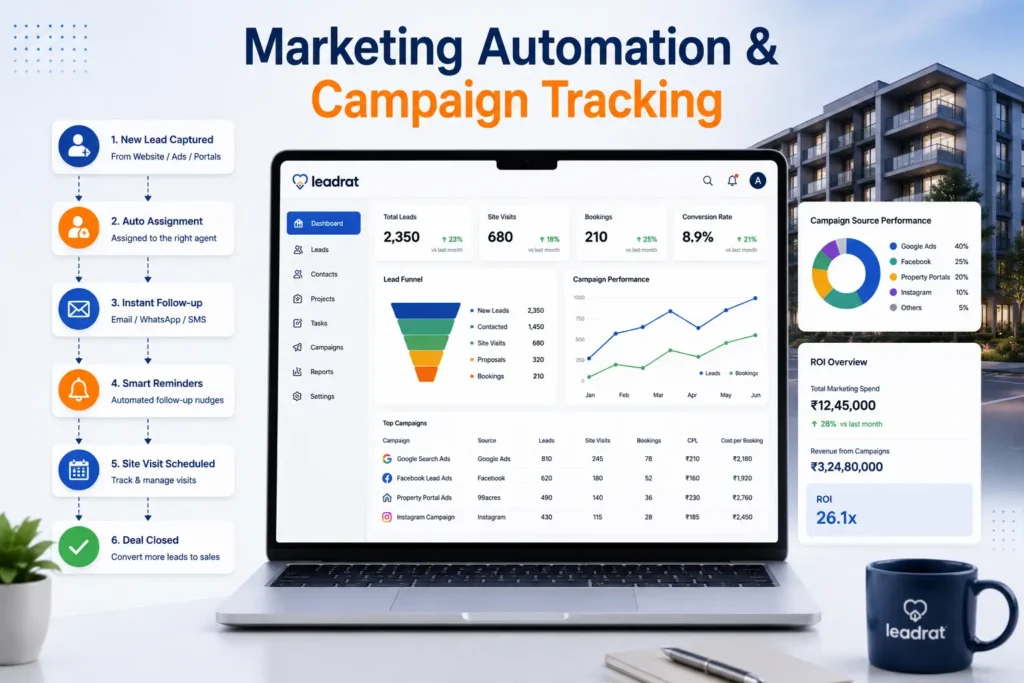
A CRM handles the tasks that eat into your team’s day. It assigns new leads to the right agent based on location or project. It sends an instant reply when someone fills out a form on your website. It flags high-intent leads for same-day follow-up. It updates lead status automatically as buyers move through the funnel.
This is one of the clearest examples of why a purpose-built real estate CRM outperforms a generic one – see our full comparison for the fuller picture.
Your team can manage a much larger lead volume without losing quality. In real estate, speed matters more than most industries. A missed follow-up can mean losing one crore booking to a competitor who simply called faster. Automation makes sure that does not happen.
4. Social Media Campaign Tracking: Find Out Which Platform Actually Closes Deals
Most developers run campaigns on Facebook, Instagram, Google Search, and property portals at the same time. Every platform gives you its own numbers. Impressions. Clicks. Leads. But none of them tell you which leads became buyers.
A CRM with campaign source tracking closes this gap.
When a lead comes in from a Facebook form, the CRM tags that source and keeps it tied to the lead through every stage. Site visit. Follow-up. Negotiation. Booking. Months later, when the deal closes, you can trace it back to the exact campaign that started it.
This changes how you measure campaigns. You stop looking at cost per lead. You start looking at cost per closure. That is a much more honest way to evaluate where your money is going.
Teams that track sources this way often discover a surprising truth. Their biggest lead source is rarely their best conversion source. A portal might send hundreds of inquiries that go nowhere. A focused Google Search campaign might send fewer leads that close at a much higher rate. You cannot see this without a CRM connecting the dots.
5. Data-Driven Decisions: Use Real Numbers, Not Gut Feel
The four tips above produce something very valuable. Clean, connected data. Which segments convert fastest. Which drip sequences lead to site visits. Which campaigns close deals and which ones only generate clicks.
A CRM pulls all of this into one dashboard. Not five spreadsheets from five platforms. One view. Your marketing team sees which campaigns are producing real ROI. Your sales team sees which touchpoints moved a buyer toward a decision.
Each new campaign becomes smarter than the one before. You are not starting from scratch. You are building on what your own data has already taught you.
6. Demand Generation: Create Interest Before Buyers Even Start Looking
Most real estate marketing chases people who are already searching. Demand generation does something different. It creates interest in buyers who are not actively looking yet.
This is where events, influencer marketing, roadshows, and community-building come in.
Property expos and launch events are one of the most effective demand generation tools in real estate. A well-run launch event creates urgency, builds social proof, and puts your project in front of a large room of pre-qualified prospects in one afternoon.
Smaller formats work too. Homebuyer workshops, neighbourhood walkthrough sessions, and invite-only previews for premium projects all generate serious interest. These formats attract people who are curious but not yet committed.
Virtual events have become just as powerful. A live project walkthrough on YouTube or Instagram, a Q and A session with your architect, or a virtual launch with early booking offers can pull in leads from across the country without anyone leaving their home.
The CRM is what turns event attendance into a trackable pipeline.
Every person who registers for your event is captured as a lead. Their source is tagged as the event. Their follow-up sequence is triggered automatically after the event ends. Event becomes the first touchpoint that started the journey.
7. WhatsApp and Omnichannel Follow-Up: Reach Buyers Where They Actually Respond
Email open rates in real estate have been dropping for years. WhatsApp messages in India see open rates above 90 percent. Buyers are on their phones. They respond to WhatsApp far faster than to an email sitting in an inbox they check twice a week. This same urgency is why speed to lead matters so much in real estate – the CRM that automates your WhatsApp follow-up is also the one that gets you responding in minutes, not hours
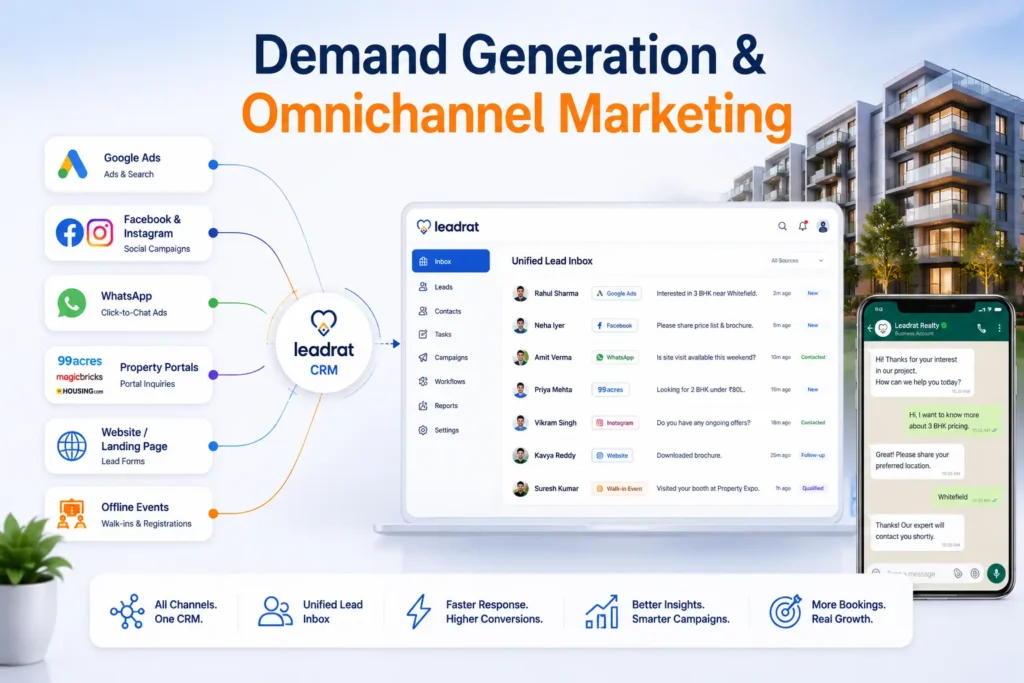
A CRM with omnichannel capability lets your team reach leads through WhatsApp, SMS, email, and phone. Everything is tracked in one place.
From a campaign standpoint, this is powerful. You can track which channel each type of buyer responds to. Some leads engage well with email updates about project milestones. Others only respond when they receive a WhatsApp video of the property.
The CRM shows you the pattern, and your campaigns adjust to match it.
8. Property Portal Integration: One Inbox for All Your Listing Inquiries
Most real estate businesses list on 99acres, MagicBricks, Housing.com, and NoBroker at the same time. Add their own website. Add paid social. The result is inquiries arriving through five different channels, landing in five different places, and getting followed up at five different speeds.
A CRM that connects with property portals fixes this immediately.
Every inquiry from every portal flows into a single inbox. The moment a lead submits a form anywhere, it is captured, tagged with its source, assigned to the right agent, and dropped into the correct follow-up workflow. No delay. No confusion. No lead sitting unseen in a portal notification email.
It also gives you clean comparison data. Portal A versus Portal B versus Google Ads, all measured the same way. By closures. Not just by how many inquiries each one sent.
9. Content and SEO Tracking: Find Out Which Blog Posts Generate Real Leads
Content is becoming one of the most consistent sources of inbound real estate leads. A well-written blog or a useful video can bring in qualified inquiries for months after it is published.
But most real estate teams have no idea which content is actually generating leads. They publish, hope, and move on.
A CRM connected to your website forms and landing pages tracks the full path. A buyer reads your article on the best residential projects in Whitefield and then fills out a contact form. That path is recorded. Over time, you see clearly which topics, formats, and keywords attract people who go on to book, not just people who browse and leave.
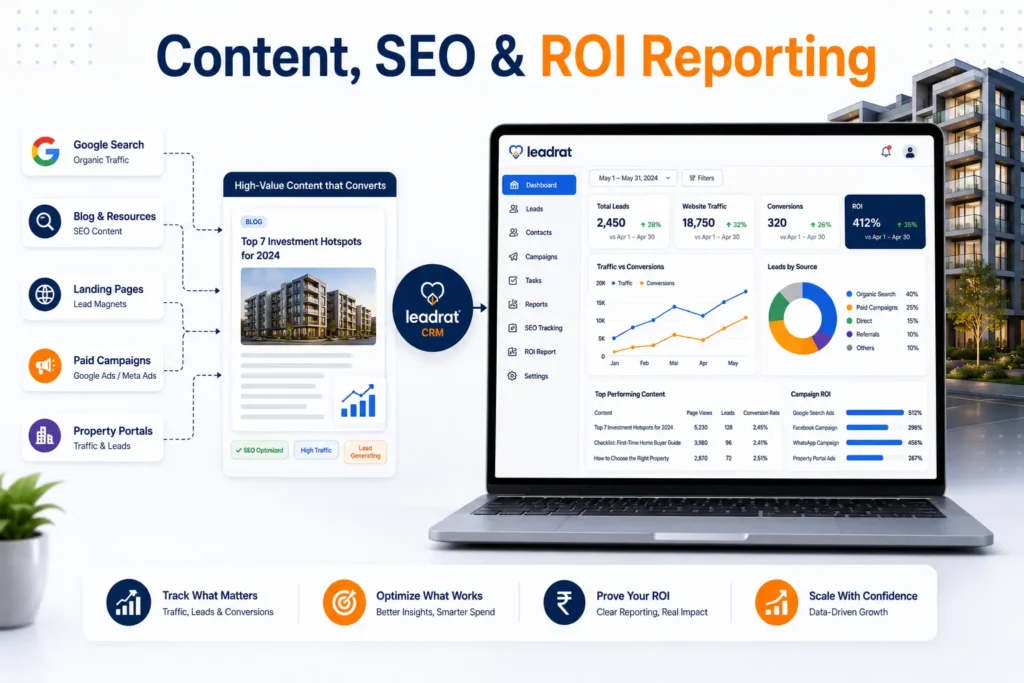
Your content strategy stops being a creative exercise and starts being a data-driven one. You invest in what works and stop wasting time on what does not.
10. Campaign ROI Reporting: Show Your Stakeholders Exactly What Marketing Delivers
This is the step most real estate marketing teams skip. And it is often the reason marketing budgets stay flat or get cut.
When you cannot connect campaign spend directly to revenue, you end up defending your work with cost-per-lead numbers. Those numbers rarely tell the full story. A CRM with end-to-end reporting changes the conversation entirely.
You can show exactly how much was spent on each campaign. How many leads it generated. How many reached a site visit. How many converted. What the total booking value was. Every rupee of spend has a traceable outcome.
Conversation with management shifts. Instead of saying you generated X leads this month, you can say you closed Y bookings worth Z crore, all tied to specific campaigns. That is the kind of clarity that gets budgets approved and teams respected.
11. Client Engagement and Referral Programs: Turn Happy Buyers into Your Best Campaign
Most real estate teams focus entirely on finding new leads. They pour budget into ads, portals, and events but ignore the most cost-effective lead source sitting right in front of them. Their existing clients.
A buyer who had a good experience with you will talk about it. A buyer who had a great experience will actively refer people. The difference between the two is whether you have a system that makes referring easy, rewarding, and trackable.
Referrals convert better than cold leads because people trust recommendations. Learn how to make the most of every lead in our guide to converting real estate agent leads.
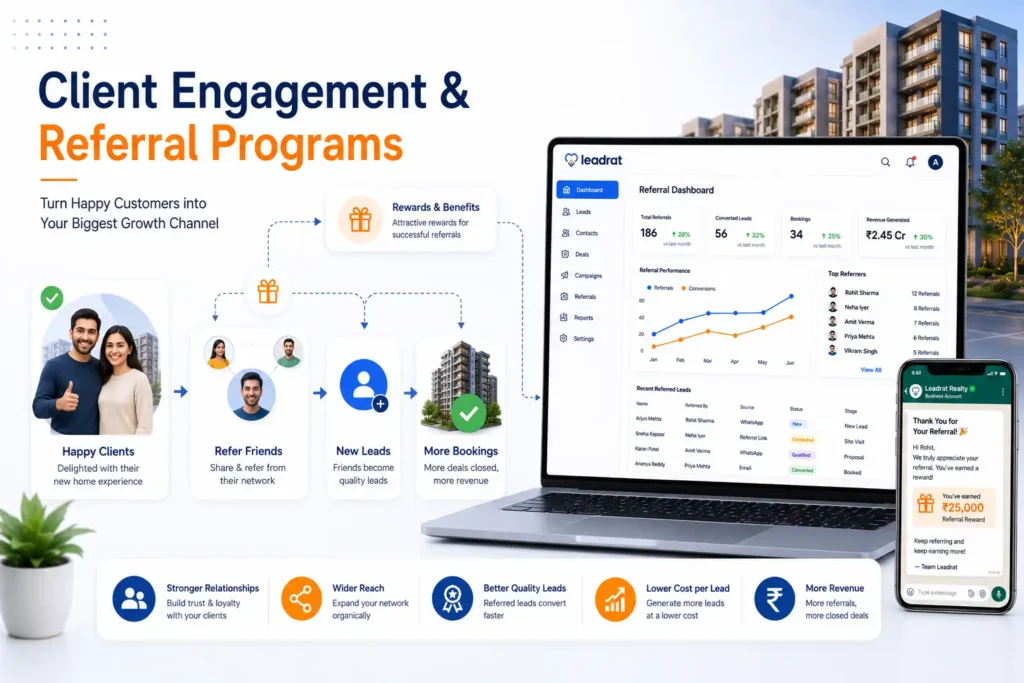
A CRM is what turns client relationships into a measurable marketing channel. Every referral is logged. Every post-sale touchpoint is automated. Every milestone message is sent at the right moment without anyone on your team having to remember. Here is what that looks like in practice.