
McKinsey estimates that more than 30% of sales activities can be automated with today’s technology. In real estate, it’s easy to see why.
A lead enquires at 11:47 PM and waits until morning. Another calls while the agent is at a site visit. Meanwhile, someone else has been waiting three days for a callback.
Still, it’s a normal day in real estate sales, and that’s the problem.
Between “I’m interested” and a signed deal are dozens of tasks, from lead assignment and follow-ups to site visits, reminders and reporting. Multiply that across hundreds of leads, and sales teams spend too much time managing the process instead of moving deals forward.
Sales automation takes that repetitive work off their plate. As a result, agents get more time to understand buyers, build relationships and close.
So, what exactly is sales automation, how does it work, and where can real estate businesses use it? Let’s break it down.
Key Takeaways
- Over 30% of sales activities can be automated with today’s technology (McKinsey).
- In real estate, speed matters. A delayed response can mean losing the lead to another broker.
- Sales automation runs on a simple Trigger → Condition → Action workflow.
- The biggest wins come from automating lead capture, assignment, follow-ups, site visits, pipeline updates and reporting.
- Early adopters report 10–15% efficiency gains and up to 10% sales uplift.
- Automation doesn’t replace agents. Instead, it frees them to focus on relationships and closing.
- A connected CRM like Leadrat keeps leads, WhatsApp conversations, follow-ups and pipeline data in one place.
What is Sales Automation?
Sales automation is the use of software and technology to automate repetitive tasks across the sales process.
Instead of asking salespeople to manually perform every step, businesses can create predefined workflows where one action triggers the next.
For example:
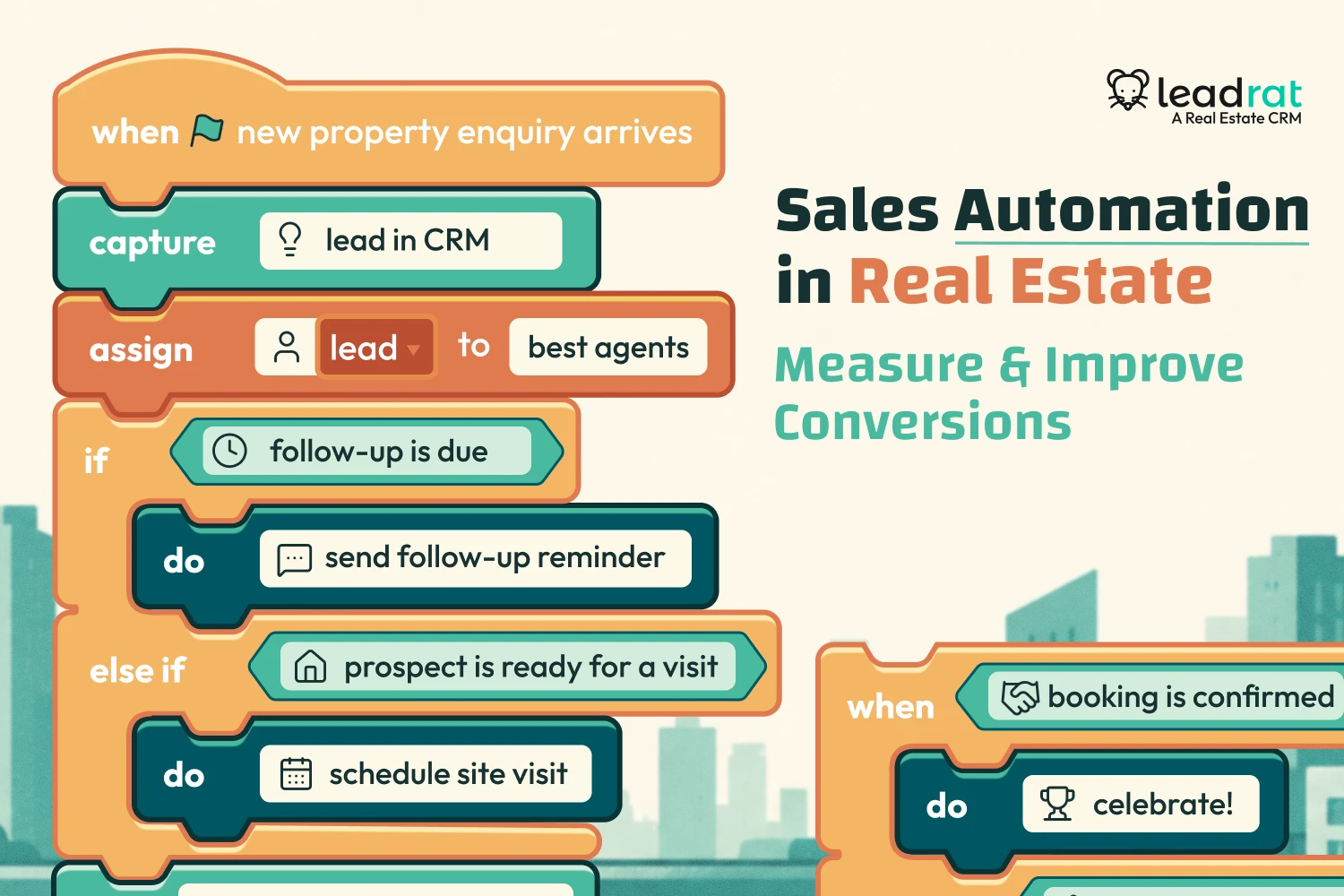
New property enquiry → Lead captured → Lead assigned → Follow-up reminder → Call logged → Site visit scheduled → Follow-up triggered → Deal updated
Without automation, every one of these steps could require manual intervention.
With automation, however, the system handles much of the operational work while the salesperson focuses on the conversation that requires a human.
Modern sales automation can include CRM workflows, automated lead distribution, follow-up reminders, messaging, data capture, reporting and pipeline updates.
IBM also describes modern sales automation as increasingly combining workflow automation with technologies such as AI, machine learning, generative AI and robotic process automation.
However, the idea is not to replace the salesperson.
Instead, it is to stop making the salesperson behave like a human reminder app.
McKinsey’s research found that early adopters of sales automation reported 10–15% efficiency improvements and potential sales uplift of up to 10%.
Significance of Sales Automation in Real Estate
Real estate sales have one very unforgiving characteristic: timing matters.
A prospect enquiring about a property today could be talking to several other brokers tomorrow. A delayed response can mean losing attention. Even worse, a forgotten follow-up can mean losing the opportunity altogether.
Sales automation helps address this by taking care of the operational gaps that often appear between one sales activity and the next.
1. Faster lead response
Leads can automatically enter the CRM as soon as they arrive from websites, property portals, advertising platforms, or other sources.
The system can then trigger an assignment or follow-up workflow instead of waiting for someone to manually enter the lead.
Leadrat does intelligent lead capture, lead routing, smart distribution, follow-up, property matching, marketing and etc to boost sales performance and improve the bottom line of the business.
2. Fewer missed follow-ups
Not every prospect is ready to buy immediately.
Some need another call. Others want to compare properties. A few need to speak to their families. And many simply say, “I’ll get back to you.”
Automation can remind salespeople when a lead needs attention, based on its stage, previous interaction, or next required action.
3. Better lead distribution
Imagine a manager manually assigning hundreds of enquiries every day.
It works until it doesn’t.
With automated lead distribution, however, predefined rules can determine who receives an enquiry based on factors such as location, project, availability, agent workload or other business requirements.
As a result, there is less manual coordination and fewer leads sitting untouched.
4. Better sales visibility
Automation also solves a problem that doesn’t always get enough attention: knowing what is happening with your leads.
When lead activity, follow-ups, stages and outcomes are recorded consistently, managers don’t have to chase individual agents for updates.
Instead, they can see the pipeline as it is.
5. More selling time
McKinsey found that high-performing sales representatives spend 20–25% more time with customers than lower-performing representatives. Therefore, automating administrative and non-customer-facing activities can help sales teams redirect that time towards prospect interactions, opportunity identification and negotiations.
In real estate, that could mean less time updating spreadsheets and more time on calls, site visits and closing conversations.
| Automate the Work. Accelerate the Closures. Let Leadrat automate your leads, follow-ups and sales pipeline, so your team can spend less time managing and more time closing. See Leadrat in action → |
|---|
How Does Sales Automation Work? Examples for Real Estate
Sales automation usually works through three simple components:
Trigger → Condition → Action
First, a trigger starts the workflow.
Next, a condition determines what should happen.
Finally, an action executes it.
For example:
Trigger: New lead enters the CRM
Condition: Lead is interested in a specific project
Action: Assign the lead to the relevant agent and trigger a follow-up
In fact, that basic logic can automate a surprising amount of the real estate sales process.
1. Automated Lead Capture
Real estate leads can come from websites, property portals, social media campaigns, landing pages and other sources.
Instead of manually copying these enquiries into a CRM, automation can bring them directly into the system.
The lead record can also include information such as contact details, lead source, property interest and location, giving the salesperson context before the first conversation.
2. Automated Lead Assignment
Once a lead enters the system, it can automatically be assigned according to predefined rules.
For example:
- Leads for Project A → Project A sales team
- Dubai leads → Dubai team
- Leads from a particular location → Relevant location team
- Leads during a specific shift → Available agents
This reduces manual distribution and also helps ensure enquiries do not sit unattended.
3. Automated Follow-Ups
Follow-up is one of the biggest areas where automation can make a difference.
A CRM can create reminders based on lead stage, previous interaction or the next required action.
For example:
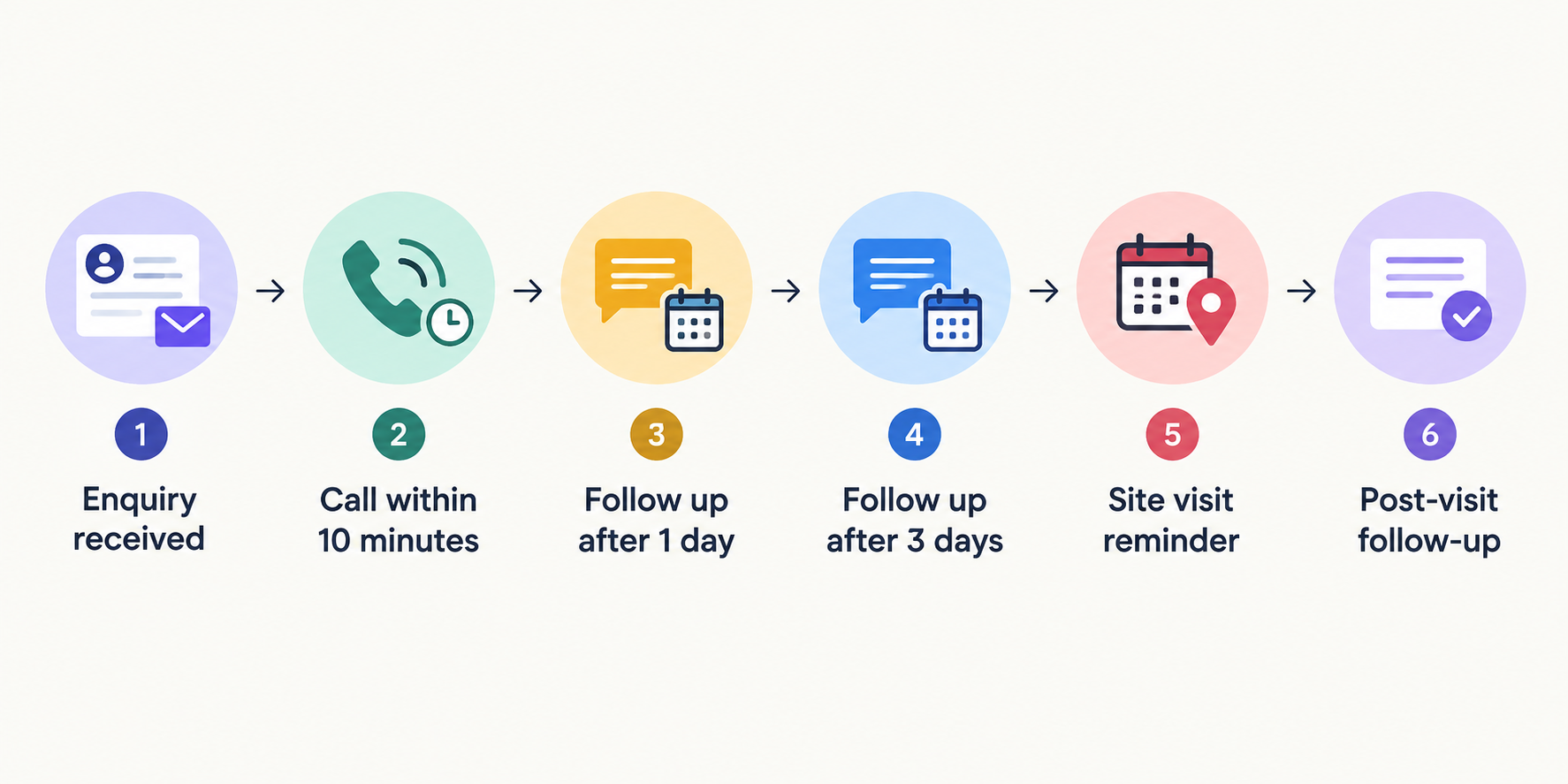
Leadrat notes that sales automation can handle repetitive interactions such as follow-up communication while reducing the amount of manual data entry salespeople need to perform.
However, the important part is not simply sending more messages.
Instead, it is making sure the right action happens at the right time.
4. Automated Property Enquiry Responses
A prospect enquiring about a property often wants basic information first.
Price. Location. Floor plans. Amenities. Availability. Brochure.
Automation can trigger responses containing relevant information while the salesperson prepares for the next conversation.
Leadrat ensures automated property enquiry responses and inspection-booking workflows as practical applications for real estate businesses.
5. Site Visit Automation
A site visit can be the moment when an enquiry starts looking like a serious opportunity.
But getting someone from “I’m interested” to actually showing up requires coordination.

So instead of relying on separate calendars, chats, and spreadsheets, the activity stays connected to the lead.
6. Pipeline Automation
A sales pipeline tells you where every opportunity stands.
Automation can help move opportunities through predefined stages based on sales activity.
For example:
New Lead → Contacted → Qualified → Site Visit → Negotiation → Booking → Won/Lost
As a result, managers get a much clearer picture of where opportunities are moving and, more importantly, where they are getting stuck.
7. Automated Reports
If a sales manager needs three WhatsApp messages, two spreadsheets, and a Monday morning meeting to understand the pipeline, something is probably broken.
Automated reporting, on the other hand, brings sales information together without making the sales team spend hours preparing it.
Reports can cover lead sources, agent activity, conversions, site visits, bookings, and pipeline movement.
That is why a CRM should combine sales automation with automated reporting, so relevant sales information is available for faster decision-making.
8. Post-Sale Automation
The sales journey doesn’t necessarily end when the booking is done.
Real estate businesses can automate post-sale communication, document workflows, feedback requests, referral campaigns, and future follow-ups.
After all, today’s buyer can become tomorrow’s referral.
How Leadrat Helps Automate Your Sales
Sales automation works best when it is connected to the entire sales journey, rather than being a collection of disconnected tools.
That’s where a real estate CRM like Leadrat becomes useful.
Leadrat brings lead management, sales workflows, communication and pipeline visibility into one real estate-focused CRM ecosystem.
Instead of managing leads across spreadsheets, WhatsApp conversations, property portals and separate follow-up systems, teams can bring these activities into one place and automate important actions around them.
Capture leads automatically
Leadrat can bring leads from multiple sources into one system, helping sales teams avoid manually collecting enquiries from different platforms.
This creates a centralized lead database where teams can track the source, status, and journey of every enquiry.
Automate lead distribution
Leadrat’s lead rotation capabilities help businesses distribute leads according to predefined business rules.
Whether the requirement is based on project, location, availability, agent performance, or other criteria, automated distribution reduces dependency on manual allocation.
Automate follow-ups
A lead shouldn’t disappear simply because an agent forgot to call back.
Leadrat helps teams manage tasks, reminders, deadlines and follow-up activities, so salespeople know what needs attention next.
However, the point isn’t to make agents follow a robotic process.
Rather, it is to make sure good opportunities don’t fall through the cracks because someone missed a reminder.
Bring WhatsApp into the sales process
For real estate teams, WhatsApp is already part of the sales conversation.
Leadrat connects WhatsApp communication with the sales workflow, helping teams manage conversations without completely separating them from the lead record.
As a result, the salesperson has more context, while managers retain better visibility into customer interactions.
Manage the pipeline in one place
Leadrat lets teams structure their sales journey around custom stages and statuses.
So instead of asking agents for individual updates, managers can see where leads are moving, which opportunities are stuck, and which stages are contributing to conversions.
Schedule and track site visits
Site visits are often the bridge between an interested lead and a serious opportunity.
Leadrat helps teams manage site-visit scheduling and capture visit-related information, keeping this activity connected to the lead journey.
Identify sales gaps
Automation becomes truly useful when it helps answer better business questions.
For example:
- Which lead sources generate better opportunities?
- Which agents are handling the highest number of leads?
- Where are leads dropping out?
- How many leads reach site visits?
- How many site visits turn into bookings?
- Which follow-ups are overdue?
In short, the objective is simple:
Turn sales activity into actionable visibility.
Benefits of Sales Automation for Real Estate
The value of sales automation isn’t limited to saving a few hours of administrative work.
Done properly, it can influence the entire sales operation. So, moving further, let’s look into the real benefits of sales automation.
- Faster sales cycles: When leads are captured, assigned, and followed up without unnecessary delays, opportunities can move through the funnel faster.
- Higher sales productivity: Agents spend less time entering data, preparing reports and remembering follow-ups, and more time speaking with prospects.
- Better customer experience: Automation creates consistency. As a result, prospects receive timely responses and relevant communication instead of waiting for someone to remember the next step.
- Fewer lost leads: Automated assignments, reminders, and workflows reduce the chances of leads getting forgotten or left unattended.
- Better forecasting: When sales activities are consistently recorded, managers get better visibility into pipeline movement and potential revenue.
- Easier scaling: A manual process that works with 10 agents can become chaotic with 100. Automation, however, allows businesses to standardize processes, so teams can grow without multiplying administrative work at the same rate.
Leadrat similarly identifies consistency, tracking and forecasting among the key benefits of sales automation. More importantly, automation creates something every growing real estate sales team needs: a repeatable sales process.
Because when the business grows, you don’t want the process to become more complicated.
Instead, you want the system to become smarter.
Conclusion
Sales automation in real estate isn’t about removing people from the sales process.
After all, real estate remains a relationship-driven business. Buyers still want conversations, property recommendations, negotiations and guidance from people they trust.
Instead, automation simply takes care of the work surrounding those conversations.
For real estate businesses, the opportunity is practical:
Capture every enquiry. Respond faster. Follow up consistently. Keep the pipeline moving. Give salespeople more time to close.
In other words, the future isn’t humans versus automation.
It is sales teams powered by automation, with technology handling the repetitive work and people handling the work that actually wins the deal.
And that is ultimately what good sales automation should do: make the sales process less busy, more consistent and a lot better at turning opportunities into revenue.
FAQs
What is sales automation?
Sales automation uses software to automate repetitive sales tasks such as lead capture, lead assignment, follow-ups, pipeline updates, reporting and customer communication.
How does sales automation work in real estate?
Sales automation connects different stages of the real estate sales process, from capturing and assigning leads to scheduling follow-ups, managing site visits, updating pipelines and tracking conversions.
What are the benefits of sales automation for real estate businesses?
Sales automation helps real estate teams respond faster, reduce missed follow-ups, improve lead management, save time on manual tasks and gain better visibility into their sales pipeline.
What are sales automation tools?
Sales automation tools are software solutions that automate repetitive sales activities such as lead management, follow-ups, communication, task reminders, reporting and pipeline management.
How does a sales automation CRM help real estate teams?
A sales automation CRM like Leadrat brings leads, conversations, follow-ups, sales activities and pipeline data into one place. As a result, teams can manage more opportunities without relying on spreadsheets or manual tracking.
What is sales process automation?
Sales process automation uses predefined workflows to move leads through different stages of the sales journey automatically, reducing manual work and ensuring important actions happen on time.