
Buying property in Dubai starts with a search that takes about ten seconds. Open any portal and thousands of listings appear. Finding the right one is a different story.
Most buyers don’t regret buying in Dubai. They regret buying the wrong unit. The tower with service charges they never checked. The off-plan launch that didn’t match their timeline. The “great deal” that turned out to be 45 minutes from the office in rush-hour traffic.
So this guide works the other way round. Instead of starting with listings, it starts with you: your budget, your needs and your plans. Then it walks through costs, the buying process and the mistakes to avoid. At the end, you’ll see how good brokers match buyers with the right property, and how Leadrat helps them do it in minutes instead of days.
Key Takeaways
- Start with your requirements, not the listings. A clear brief saves weeks of wasted viewings.
- Budget for the full cost. Fees usually add 6% to 8% on top of the price, before your down payment.
- Expat residents typically need a 20% down payment on a first home under AED 5 million.
- Foreigners can buy freehold property in designated areas, and a purchase of AED 2 million or more can qualify you for a Golden Visa.
- Brokers who capture requirements properly and match them to live inventory find the right property far faster.
Can Foreigners Buy Property in Dubai?
Yes. Foreigners can buy freehold property in Dubai’s designated freehold areas, with full ownership and a title deed in their own name. You don’t need to live in the UAE to buy, although residents usually get better mortgage terms.
The Dubai Land Department has a useful first-time home buyer overview if you want the official starting point.
Start With Your Requirements, Not the Listings
Here’s the trap most buyers fall into. They open a portal, fall for a sea view and work backwards. Within a week, they’ve seen 12 properties, liked none of them and lost track of what they actually wanted.
A better way is to write a short brief before you look at anything. It takes 20 minutes and it changes the whole search.
| Requirement | Questions to answer | Why it matters |
|---|---|---|
| Total budget | What can I spend, including fees and furnishing? | The price is never the full cost |
| Purpose | Am I living in it, renting it out or both? | Changes the right area, size and building |
| Property type | Apartment, townhouse or villa? How many bedrooms? | Filters out most of the market instantly |
| Ready or off-plan | Do I need to move in now, or can I wait? | Decides your payment plan and timeline |
| Location | Where are work, schools and the people I visit? | Commute time shapes daily life |
| Must-haves | What can’t I live without? What’s just nice? | Stops you trading essentials for extras |
| Financing | Cash or mortgage? Am I pre-approved? | Sets your real price ceiling |
| Timeline | When do I need the keys? | Some deals simply won’t work in time |
Be honest with the “must-haves” column. A balcony might be lovely. A second bathroom might be essential with two kids. Write down the difference.
How Much Money Do You Need to Buy Property in Dubai?
This is the most-asked question about buying in Dubai, and the answer is always more than the listing price. Here’s a worked example for an expat resident buying a ready AED 1.5 million apartment with a mortgage.
| Cost | How it’s calculated | Amount (AED) |
|---|---|---|
| Down payment | 20% of the price | 300,000 |
| DLD transfer fee | 4% of the price | 60,000 |
| DLD admin fee | Fixed | 580 |
| Trustee office fee | For properties of AED 500,000 and above, including VAT | 4,200 |
| Agency commission | 2% plus 5% VAT | 31,500 |
| Mortgage registration | 0.25% of the AED 1.2 million loan, plus AED 290 | 3,290 |
| Bank valuation | Typically AED 2,500 to 3,500 | About 3,000 |
| Bank processing fee | Up to 1% of the loan | Up to 12,000 |
| Total upfront | About 414,570 |
That’s roughly AED 114,570 in fees on top of the down payment, or about 7.6% of the price. Then add moving, furnishing and the first year of service charges. Many buyers set their search ceiling without doing this maths, and end up stretching for the last 5%.
Down Payments at a Glance
- Expat residents: at least 20% for a first home up to AED 5 million, and 30% above that.
- UAE nationals: from 15% for a first home up to AED 5 million.
- Second or investment homes: banks ask for a larger deposit, often around 40%.
- Non-residents: usually need a bigger deposit and face stricter checks.
One more reason buyers aim for AED 2 million: a property worth AED 2 million or more can make you eligible for the UAE’s 10-year Golden Visa. Just make sure the visa doesn’t push you into a home that doesn’t fit your other needs.
Ready Property or Off-Plan?
This is one of the biggest decisions in your brief, and it shouldn’t be made on price alone.
| Factor | Ready property | Off-plan property |
|---|---|---|
| Move-in or rent | Straight away | After handover, often years away |
| Payment | Down payment plus mortgage | Staged developer payment plan |
| What you see | The actual unit | Plans, renders and a show unit |
| Mortgage | Up to 80% financing for expat first homes | Banks usually lend less before completion |
| Main risk | Paying more upfront | Delays and changes before handover |
If off-plan suits you, read our guide to off-plan property in Dubai first. It covers payment plans, escrow protection and Oqood registration.
Choosing the Right Area: Questions Beat Rankings
Every year someone publishes a list of the “best areas to buy in Dubai”. The trouble is, the best area for a family with school-age children is rarely the best area for an investor chasing rental demand.
Instead of chasing rankings, test each area against your brief:
- Commute: how long does the drive take at 8 AM, not at midnight?
- Daily life: are schools, clinics, groceries and a gym close by?
- Service charges: what does the building really cost each year? Our guide to Mollak and service charges shows how to check.
- Rental demand: if you’re investing, how quickly do similar units rent?
- Future supply: how many new towers are coming nearby? A lot of new stock can hold prices back.
Broadly, buyers tend to look at a few kinds of area. Villa communities such as Arabian Ranches and Dubai Hills appeal to families who want space. City areas like Downtown, Business Bay and Dubai Marina suit buyers who want to be near work and nightlife. Value-focused areas such as Jumeirah Village Circle attract first-time buyers and investors watching their budget. Your brief should decide which group you belong to.
Is It Still Worth Buying Property in Dubai?
It’s a fair question, and it’s one of the top searches around this topic. The honest answer: it depends on your plans, your timeline and the specific property. Here’s both sides.
The Case For Buying
- Tax: the UAE doesn’t charge individuals income tax on rent or capital gains tax on a sale.
- Demand: the market is deep. In 2025, Dubai recorded around 132,000 off-plan and 71,000 secondary residential deals, according to Betterhomes’ annual report.
- Ownership rights: freehold areas give foreigners full ownership and a title deed in their own name.
- Residency: qualifying purchases can support a long-term Golden Visa.
The Case for Caution
- New supply: large numbers of new homes are due over the next few years, which can slow price growth in some areas.
- Running costs: service charges vary widely and can eat into rental returns.
- Interest rates: most mortgages track EIBOR, so monthly payments can rise.
- Buying costs: with fees of 6% to 8%, a quick resale rarely makes sense.
Our view? Dubai rewards buyers who buy for a clear reason and hold for several years. It punishes buyers who chase hype, stretch their budget or buy a unit that doesn’t fit their life. That’s exactly why the brief at the start of this guide matters so much.
Buying Property in Dubai: Step by Step
Step 1: Get Mortgage Pre-Approval
If you need a mortgage, get pre-approved before you view anything. It tells you your real budget and shows sellers you’re serious.
Step 2: Brief a RERA-Registered Broker
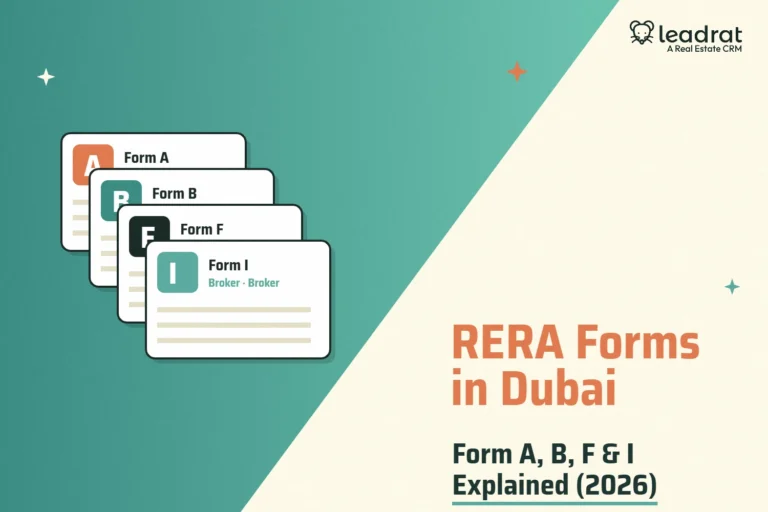
Share your written brief, including budget, area, property type, timeline and must-haves. You’ll usually sign Form B, the buyer agreement, with your broker. A good broker should come back with a short, relevant list, not 40 random links.
Step 3: Shortlist and View
View your top three to five options. Go at the times you’d actually use the place: check the morning traffic and the evening noise.
Step 4: Make an Offer and Sign Form F
When you agree a price, buyer and seller sign Form F, the Memorandum of Understanding. You usually pay a deposit, commonly around 10%, which the broker holds until transfer.
Step 5: Finalise the Mortgage
The bank values the property and issues a final offer. Leave enough time in Form F for this. It’s the step that most often delays a deal.
Step 6: The Seller Gets the NOC
The seller obtains a No Objection Certificate from the developer, confirming there are no unpaid dues. You can see the full seller side in our guide to selling property in Dubai.
Step 7: Transfer at the Trustee Office
Everyone meets at a DLD-approved trustee office. You hand over the manager’s cheques, the fees are paid and the DLD issues a new title deed in your name.
Step 8: Move In or Rent It Out
Set up DEWA, get your keys and, if you’re letting it, register the lease. Our guide to the tenancy contract in Dubai explains the basics.
What Buyers Say Is the Worst Part
For this exact search, one of the results on Google’s first page isn’t a guide at all. It’s a Reddit thread where people share the worst parts of buying property in Dubai. It’s worth reading before you start:
Whatever the individual complaints, one frustration comes up again and again when we talk to Dubai brokerages and their clients: being shown properties that simply don’t fit. The wrong budget. The wrong area. A villa when the buyer asked for an apartment. It wastes the buyer’s weekends and the broker’s credibility.
That’s not a market problem. It’s a matching problem, and it’s fixable.
Mistakes That Cost Buyers Money
- Searching before setting a full budget. Fees and deposits catch buyers out more than prices do.
- Ignoring service charges. Two similar flats can cost very different amounts to own each year.
- Choosing an area by reputation alone. Test it against your commute and daily life.
- Skipping mortgage pre-approval. Losing a good unit while the bank catches up is painful.
- Working with a broker who doesn’t ask questions. If they don’t know your must-haves, they can’t find them.
Why the Right Property Is Hard to Find, Even for Good Brokers
Let’s look at it from the broker’s side. A busy Dubai agent might be working with 150 active buyers at once. Each one has a budget, preferred areas, a property type, a timeline and a list of must-haves. Most of that sits in WhatsApp chats, call notes and the agent’s memory.
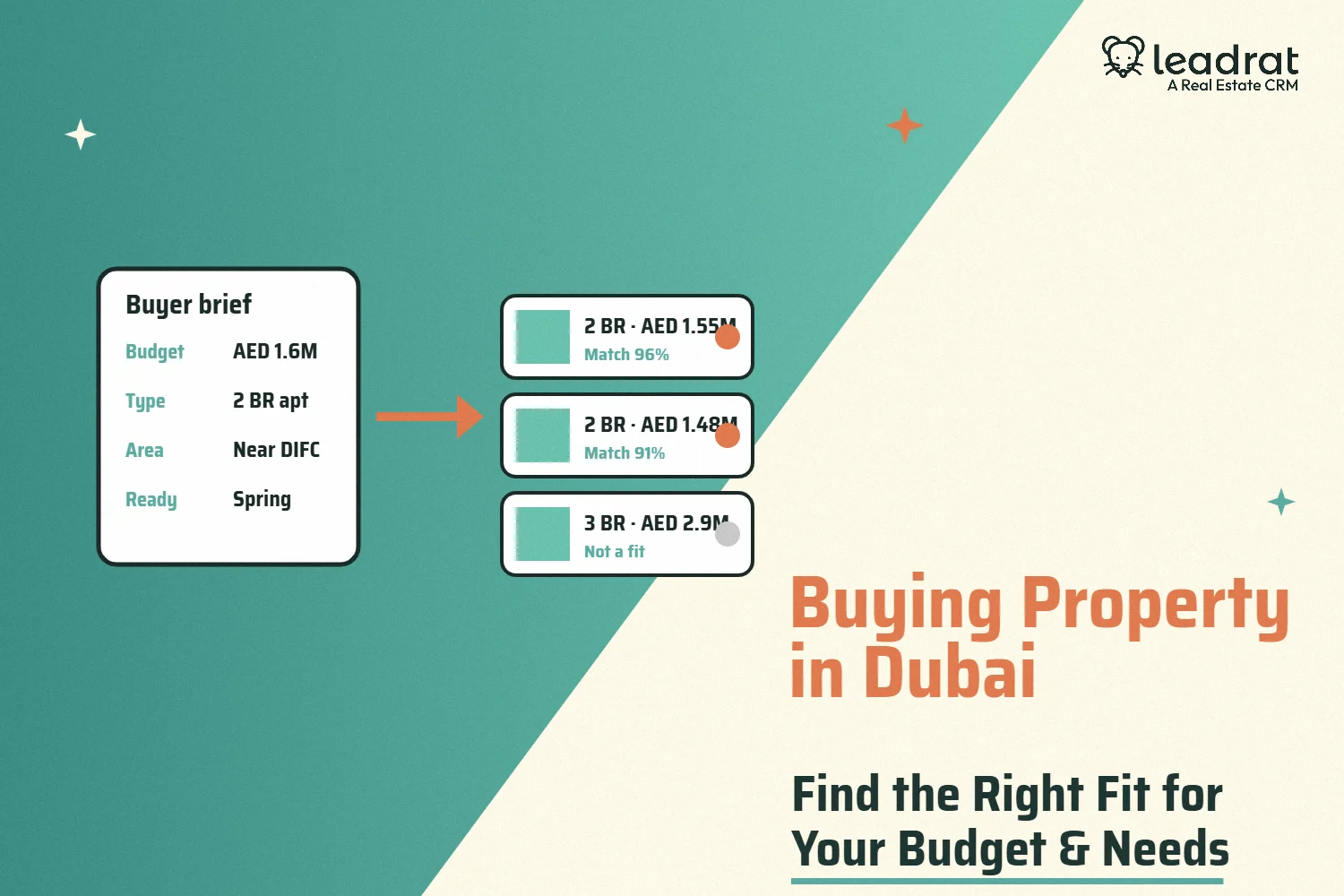
Meanwhile, new listings arrive every day. Say a buyer wants a two-bedroom apartment under AED 1.6 million, ready by spring, within 25 minutes of DIFC. On Tuesday, exactly that unit comes onto the market. Will the agent remember that buyer out of 150? Often, they won’t. By Friday, another brokerage has sold it.
Multiply that across a team of 20 agents and thousands of listings, and you see why so many good matches never happen. It’s also why brokerages are moving from spreadsheets to a proper real estate CRM.
Stop losing deals to forgotten matches. See how Leadrat connects every buyer’s requirements with the right listings, automatically. Book a free Leadrat demo.
How Leadrat Matches Buyers With the Right Properties
Leadrat is a real estate CRM used by more than 38,000 agents across 1,200+ companies in India and the UAE. Its matching tools turn a buyer’s brief into a shortlist, and a new listing into a list of buyers to call.
Capture Budgets, Preferences and Requirements
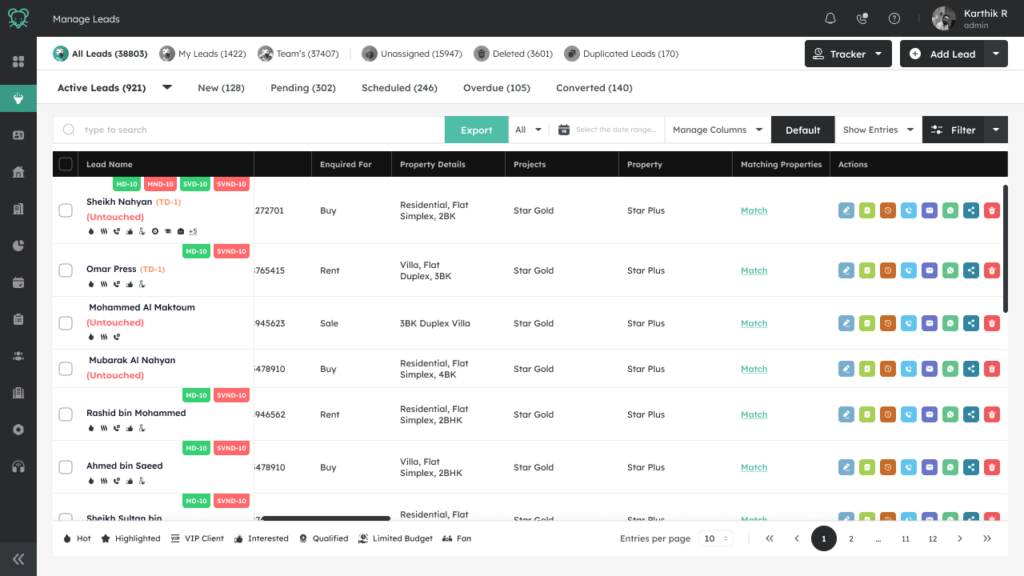
Every lead in Leadrat holds the buyer’s real brief: budget range, preferred locations, property type, bedrooms, purpose and timeline. Statuses and sub-statuses show exactly where they are in the journey. Nothing lives only in a WhatsApp chat or an agent’s head.
Matching Properties: From Buyer to Shortlist
Open a buyer, and Leadrat shows the properties in your inventory that fit their requirements. Instead of scrolling through hundreds of listings, the agent starts with a relevant shortlist and refines it.
Matching Leads: From Listing to Buyers
Most tools stop at the first direction. Leadrat works both ways. Open a listing, and Leadrat shows every buyer whose requirements match it. Remember the Tuesday listing that matched a forgotten buyer? With Matching Leads, the agent sees that buyer the moment the unit goes live.
Search Inventory With 100+ Filters
When a buyer changes their mind, or adds a new must-have, agents can search by budget, area, type, bedrooms, status and much more. More than 100 filters mean the right options surface in seconds.
Listings That Stay Accurate
Leadrat’s listing management keeps every unit, price and status in one place, linked to Bayut, Property Finder and Dubizzle. Agents don’t pitch units that have already sold, which protects their credibility with buyers.
Off-Plan Projects in Context
For off-plan buyers, project data sits alongside inventory, and the off-plan satellite view shows each project in its real location. That helps agents answer the “where exactly is it?” question before a buyer drives out.
Share the Shortlist on WhatsApp
Through EngageTo, agents send matched options, floor plans and location pins on WhatsApp, using ready templates. Every message stays on the lead record, so the whole team knows what the buyer has already seen.
Re-Match Old Buyers When New Stock Arrives
Buyers who went quiet aren’t lost. When new listings or a new phase come in, Leadrat helps agents find past buyers who match and bring them back into the conversation.
From Requirement to Shortlist: A Real Workflow
- 10:05 AM: A Property Finder enquiry arrives. Leadrat assigns it to an agent in seconds.
- 10:12 AM: On the first call, the agent records the brief: 2 bedrooms, under AED 1.6 million, ready, near DIFC.
- 10:15 AM: Matching Properties shows five suitable units. The agent shares three on WhatsApp.
- Next Tuesday: A new listing fits perfectly. Matching Leads flags this buyer, and two others, straight away.
- Saturday: The buyer views the new unit first, before it reaches the wider market.
That’s the difference between remembering buyers and matching them. Comparing tools? Read our guide to the best real estate CRM in Dubai.
The Bottom Line
Buying property in Dubai is easier than most markets in many ways: clear rules, freehold ownership for foreigners and a fast transfer process. The hard part is choosing well. Write your brief first, budget for the full cost, test areas against your real life and work with a broker who listens.
For brokers, the lesson is simple. The buyer’s requirements are the most valuable data you have. Capture them properly, match them to live inventory and you’ll find the right property before your competitors do.
The best property isn’t the one with the nicest photos. It’s the one that fits.
Match every buyer with the right property, faster. Get a Leadrat walkthrough built around your listings, portals and team. Get your free demo today.
Frequently Asked Questions
Can foreigners buy property in Dubai?
Yes. Foreigners can buy freehold property in designated areas of Dubai and receive a title deed in their own name. You don’t need UAE residency to buy.
How much money do I need to buy property in Dubai?
Plan for the down payment plus fees of about 6% to 8% of the price. For a AED 1.5 million home with a mortgage, expats may need around AED 415,000 upfront.
What is the minimum down payment for expats in Dubai?
Expat residents usually need at least 20% for a first home up to AED 5 million, and 30% for homes above that. Second homes need a larger deposit.
What fees do buyers pay in Dubai?
Typical fees include the 4% DLD transfer fee, a AED 580 admin fee, trustee office fees, 2% agency commission plus VAT and, with a mortgage, registration, valuation and bank fees.
Does buying property in Dubai give you a visa?
A property worth AED 2 million or more can make you eligible for the UAE’s 10-year Golden Visa, subject to the official criteria.
Is it still worth buying property in Dubai?
It can be, for buyers with a clear purpose who plan to hold for several years. Weigh the tax benefits and strong demand against new supply, service charges and rate changes.
Is it better to buy ready or off-plan property in Dubai?
Ready property suits buyers who want to move in or earn rent now. Off-plan suits buyers who can wait and prefer staged payments.
How long does it take to buy property in Dubai?
After signing Form F, a cash purchase can transfer in about 30 days. A mortgage purchase usually takes longer, often six to eight weeks.
How do brokers match buyers with the right properties?
Good brokers record each buyer’s budget, areas, property type and timeline, then search live inventory against it. A CRM like Leadrat does this automatically with Matching Leads and Matching Properties.