
In a study of 1.25 million sales leads across 2,241 companies, Harvard Business Review found that the average firm took 42 hours to respond to a new enquiry. Nearly a quarter never responded at all.
Real estate is no exception. Every month, developers and brokers pay for enquiries through portals, ads and channel partners. A share of those enquiries becomes bookings. The rest disappears somewhere between the first call and the site visit. The ratio between the two is your lead-to-booking conversion rate, and it’s the most honest number in the business.
This guide shows how to define it correctly, measure it without fooling yourself, break it into stages, read what each stage is telling you and improve it using what research actually says.
Key Takeaways
- Lead-to-booking conversion measures how many unique buyers who enquired went on to pay a booking amount.
- Most teams get the number wrong before they calculate it, by counting duplicate enquiries and using calendar months instead of cohorts.
- Overall conversion is the product of stage conversions, so improving the weakest stage lifts bookings in direct proportion.
- Research consistently shows response speed is the biggest single lever at the top of the funnel.
- Track cost per booking, not cost per lead. It’s the only figure that connects marketing to revenue.
What Is Lead-to-Booking Conversion?
Lead-to-booking conversion rate is the percentage of unique leads from a given period that went on to pay a booking or token amount within a fixed window.
Formula: (bookings from a lead cohort ÷ unique leads in that cohort) × 100
Fix the Definitions Before You Measure
Most conversion numbers are wrong before anyone opens a spreadsheet. Three definitions decide whether your figure means anything.
1. What Counts as a Lead
Count unique buyers, not enquiries. A buyer who enquires on three portals and fills in your website form is one person, not four. If you count every enquiry, you inflate your denominator and your conversion rate looks worse than it is. Worse, it hides which source actually brought the buyer first.
2. What Counts as a Booking
Use one definition across the team: a booking amount or token received. Then subtract bookings cancelled within your cancellation period. A booking that’s cancelled three weeks later isn’t revenue, and it shouldn’t flatter your rate.
3. The Measurement Window
Property decisions take time, so you need a fixed window: for example, all bookings within 90 days of the first enquiry. The next section explains how to choose it.
Measure by Cohort, Not by Calendar
The most common mistake is dividing this month’s bookings by this month’s leads. Many of this month’s bookings came from leads that arrived two or three months ago, so the two numbers don’t belong together.
The cohort method fixes this. Take every unique lead that arrived in September, then count how many of those same buyers booked within your window. You compare one group of buyers from start to finish.
How to Choose Your Window
Look at your past bookings and measure the gap between each buyer’s first enquiry and their booking date. Then plot how much of your total bookings happens within each period. Here’s an illustrative pattern:
| Days from first enquiry | Share of eventual bookings | Cumulative share |
|---|---|---|
| 0 to 30 | 35% | 35% |
| 31 to 60 | 30% | 65% |
| 61 to 90 | 20% | 85% |
| 91 to 180 | 15% | 100% |
In this example, a 90-day window captures about 85% of bookings, which is a sensible balance between accuracy and speed of reporting. Your own curve might look very different, especially for under-construction launches, so build it from your data. Report cohorts only once their window has fully closed.
Why Cost per Booking Beats Every Other Number
Lead-to-booking conversion matters because it turns marketing spend into a unit cost you can compare with revenue.
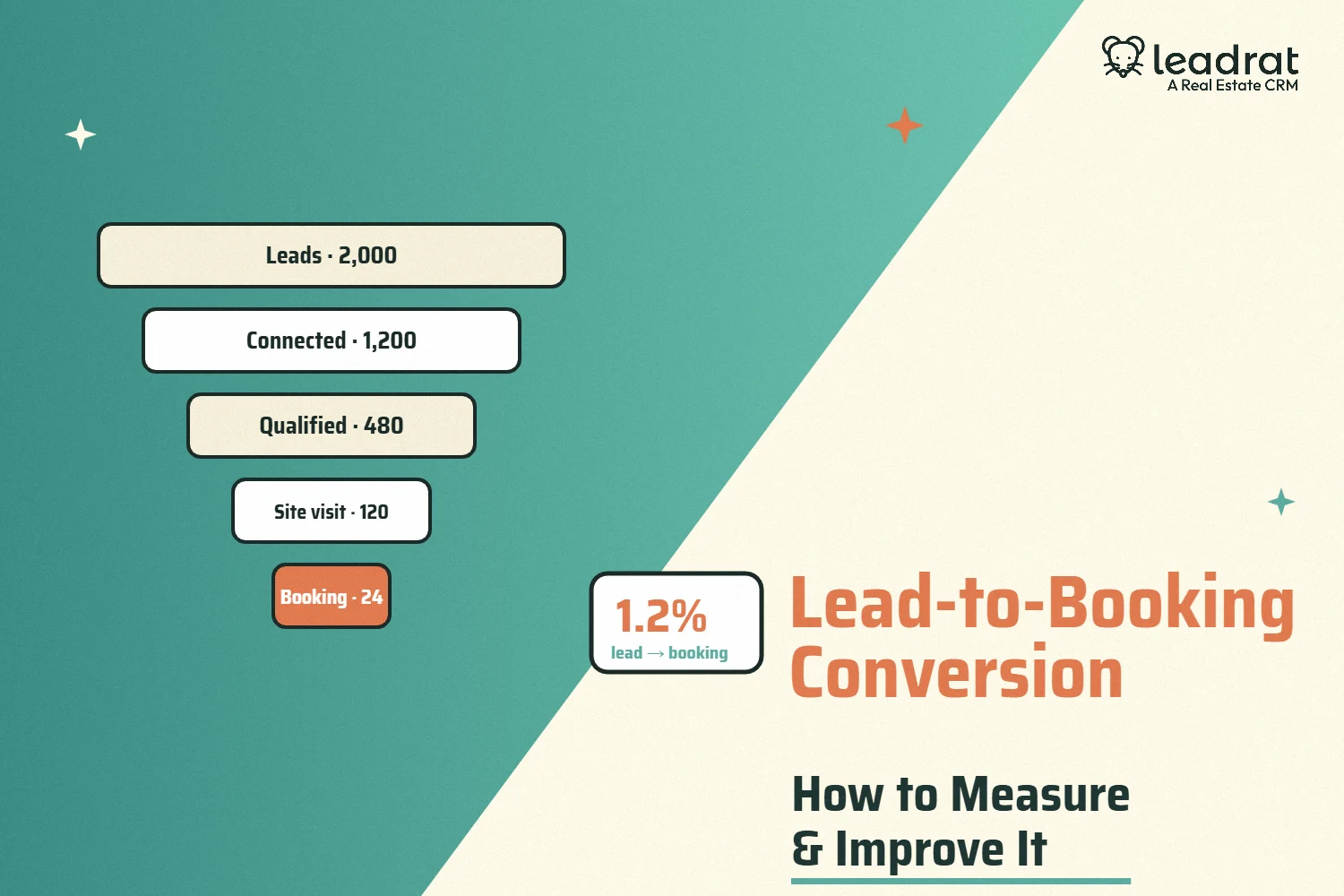
Say a developer spends ₹10 lakh in a month, gets 2,000 unique leads and books 24 units. The conversion rate is 1.2%, and the cost per booking is about ₹41,667.
Now put that next to the revenue. For a broker earning 2% on an ₹80 lakh unit, the brokerage is ₹1.6 lakh, so marketing is consuming about 26% of every commission. For a developer selling the same unit, marketing costs around 0.5% of the sale value. Either way, you now know exactly what each booking costs and whether a campaign is worth repeating.
Cost per lead can’t tell you that. A cheap lead that never books is the most expensive lead you’ll ever buy.
What the Research Says Drives Conversion
A great deal of opinion surrounds lead conversion. A few findings, however, come from large studies that others have since repeated.
- Speed of first response. The Lead Response Management Study led by Dr James Oldroyd with InsideSales.com found that the odds of contacting a lead were 100 times higher when the first call came within five minutes rather than after 30 minutes. The odds of qualifying the lead were 21 times higher.
- The first hour. The Harvard Business Review study found that companies responding within an hour were about seven times more likely to qualify a lead than those that waited longer, and about 60 times more likely than those that waited 24 hours or more.
- Most companies respond slowly. In the same HBR data, the average response time was 42 hours, and 23% of companies never responded.
Neither study looked only at real estate, and conversion rates themselves vary by industry. But the direction is consistent and the mechanism is obvious to anyone who has worked a portal lead: buyers enquire with several sellers at once, and the first useful conversation shapes everything that follows.
The Benchmark Trap
When teams search for an average, they usually find figures like those from Ruler Analytics, which reports that real estate websites convert about 2.8% of visitors into qualified leads. It’s sound data, but it measures website visitor to lead. It tells you nothing about lead to booking.
Lead-to-booking rates depend on price point, location, project stage, lead source and the strength of your sales process. A ready-to-move project in an established suburb behaves very differently from an under-construction luxury launch. That’s why there’s no reliable public benchmark for Indian real estate. Your own cohorts are the benchmark. Measure them consistently and beat them.
Break the Ratio Into Stages
The overall rate tells you there’s a problem. Stage ratios tell you where. Here’s the same ₹10 lakh campaign, broken down:
| Stage | Buyers | Stage conversion |
|---|---|---|
| Unique leads | 2,000 | n/a |
| Connected (a real conversation) | 1,200 | 60% |
| Qualified (budget, decision-maker, need, timeline) | 480 | 40% |
| Site visit done | 120 | 25% |
| Booking | 24 | 20% |
Why Small Stage Gains Matter So Much
Overall conversion is the product of the stage rates: 60% × 40% × 25% × 20% = 1.2%. That multiplication is the most useful fact in this guide. Improve any single stage by a quarter and total bookings rise by a quarter too.
- Lift site visit to booking from 20% to 25%, and bookings rise from 24 to 30. Cost per booking falls to about ₹33,333.
- Lift the connect rate from 60% to 75%, and bookings again reach 30.
- Reaching 30 bookings by buying volume instead would take about 500 more leads, or ₹2.5 lakh of extra spend at the same cost per lead.
Fixing a stage is almost always cheaper than buying more leads. For more on how stages fit together, see our guide to the sales funnel.
See your stage-by-stage conversion without spreadsheets. Leadrat tracks every stage from enquiry to booking, by source, project and agent. Book a free Leadrat demo.
Segment the Number, and Watch for Mix Shift
A single company-wide rate hides more than it shows. Cut it four ways:
| Segment | What it reveals | Decision it supports |
|---|---|---|
| Source | Which portals, campaigns and partners produce bookings, not just leads | Where next quarter’s budget goes |
| Project | Which projects convert, and which struggle despite good leads | Pricing, positioning or site experience fixes |
| Agent | Who turns conversations into visits, and visits into bookings | Coaching, territory and lead allocation |
| Response time | How booking rates differ by time to first call | The response-time standard your team must hit |
The Mix-Shift Trap
Segmenting also protects you from a common misreading. Say that last month a portal sent 1,000 leads and converted at 2.0%, while social ads sent 1,000 leads and converted at 0.4%. That’s 24 bookings, or 1.2%. This month both channels improve, to 2.2% and 0.5%, but you shift budget so the portal sends 800 leads and social sends 2,000. Bookings rise to about 28. Yet the overall rate falls to about 1%, because low-intent leads now make up most of the total.
Without segmentation, that looks like a sales problem. It’s actually a mix change. Always read the overall rate next to the source split.
Data Problems That Distort the Ratio
| Problem | How it distorts the number | Fix |
|---|---|---|
| Duplicate enquiries counted as separate leads | Inflates leads and understates conversion | Merge duplicates and re-enquiries into one buyer record |
| Bookings not linked to the original lead | The booking appears under the wrong source, or none | Record bookings against the existing lead, not a new entry |
| Walk-ins and phone enquiries not logged | Offline sources look worthless | Log every enquiry, whatever the channel |
| Channel partner leads entered twice | Inflated volume and disputed attribution | One owner per buyer, with partner details recorded |
| Cancellations left in | Overstates real bookings | Net out cancellations within the agreed period |
Reading the Drops: A Diagnosis Table
| Weak stage | Most likely cause | First fix to test |
|---|---|---|
| Lead to connected | Slow first calls, unassigned leads, office-hours-only calling | Instant assignment, automatic reassignment and weekend cover |
| Connected to qualified | Low-intent sources or a loose qualification process | Review sources and use a fixed set of qualification questions |
| Qualified to site visit | Visits booked but not confirmed, or the wrong project pitched | Confirm visits the day before and on the morning, and match projects to needs |
| Site visit to booking | Slow follow-up, unclear pricing, unresolved objections | A written summary and price sheet within 24 hours, with named next steps |
| Booking to registration | Financing delays or buyer’s remorse | Loan support and regular contact until the agreement is signed |
How to Improve Lead-to-Booking Conversion
- Set a response standard in minutes, not hours. The research above is unambiguous. Assign leads automatically and reassign them if they aren’t called in time. Our guide to speed to lead covers how to build this.
- Qualify on the same four points every time. Budget, decision-maker, need and timeline. Consistency makes your stage data comparable. Our guide to presales in real estate explains the framework.
- Protect the site visit. Confirm it twice, share location details and make sure every decision-maker attends.
- Pitch the right inventory. Shortlist units that match the buyer’s brief before the visit, so the visit narrows a decision rather than starting one.
- Hand over context. Whoever hosts the visit should already know the buyer’s requirements and concerns.
- Follow up within 24 hours of every visit. Send the summary, the price sheet and a specific next step.
- Recycle, don’t discard. Buyers who went quiet often return when you release a new phase or price. Our guide to lead nurturing shows how to stay relevant without spamming.
For the agent-level habits behind these steps, read our guide on converting real estate agent leads.
A Review Rhythm That Works
- Weekly: connect rate, response times and site visits confirmed versus done.
- Monthly: cohort conversion for the most recent cohort whose window has closed.
- Quarterly: cost per booking by source and project, used to set the next budget.
Our Take: Lead Volume Is a Vanity Metric
After working with more than 1,200 real estate teams, our view is blunt. Lead count is the most celebrated and least useful number in most sales meetings.
The teams that grow fastest report cost per booking first. They know their weakest stage, fix it, measure the next cohort and only then increase spend. It’s slower to explain in a meeting than a record lead month. It’s also how marketing budgets start paying for themselves.
How Leadrat Measures Lead-to-Booking Conversion
Measuring this properly needs clean, connected data, which is where spreadsheets usually break down.

- Lead Funnel: shows leads, prospects, opportunities, bookings and invoices, with the conversion rate at each stage, filterable by date, project, property, source and agent.
- Duplicate and re-enquiry detection: merges repeat enquiries into one buyer, so your denominator stays honest.
- Leads vs Source: shows each source’s share of leads and the revenue it brings, so budget follows bookings.
- Speed to Lead and SLA reports: track response times by agent and reassign leads that aren’t called in time.
- Top Closers: ranks agents by bookings, deal value or site visits done.
- Clickable numbers and automated reports: open the leads behind any figure, and receive weekly numbers on WhatsApp or email.
The Bottom Line
Lead-to-booking conversion is the number that tells you whether your marketing spend is working. Define leads and bookings precisely, measure by cohort, break the ratio into stages and segment it by source, project and agent. Then fix the weakest stage first. The research points to the same place every time: respond faster, follow up properly and never let a qualified buyer go cold.
More leads fill the funnel. Better conversion fills the bank.
Turn more of your enquiries into bookings. Get a Leadrat walkthrough of your funnel, sources and team conversion in one place. Get your free demo today.
Frequently Asked Questions
What is lead-to-booking conversion in real estate?
It’s the percentage of unique leads from a given period that paid a booking or token amount within a fixed window, such as 90 days.
How do you calculate lead conversion rate?
Divide the bookings from a cohort of leads by the number of unique leads in that cohort, then multiply by 100. Count duplicates once and remove cancelled bookings.
What is a good lead-to-booking conversion rate?
There’s no reliable public benchmark for real estate, because rates vary by price point, location, project stage and source. Your own past cohorts are the right benchmark.
Why use the cohort method instead of monthly totals?
Buyers take weeks or months to book. The cohort method follows the same group of leads over time, so you don’t divide this month’s bookings by unrelated leads.
How long should the measurement window be?
Choose a window that captures most of your bookings, often 60 to 90 days. Build it from your own data on the time between first enquiry and booking.
Does response time really affect conversion?
Yes. Large studies found that contacting a lead within five minutes, or at least within an hour, sharply increases the chance of contact and qualification.
Why can the overall conversion rate fall when every source improves?
If your lead mix shifts towards lower-intent sources, the overall rate can fall even while each source converts better. Always check the source split.
How does a CRM help track lead-to-booking conversion?
A CRM merges duplicate enquiries, links bookings to the original lead and shows stage conversion by source, project and agent. Leadrat’s Lead Funnel does this automatically.