
Ask a Dubai broker about their worst commission dispute, and the story usually starts the same way: “We didn’t have the form signed.” A buyer viewed a unit with one agent, then bought it through another. A co-broker promised a split over WhatsApp, then disagreed at transfer. Months of work, and nothing on paper to prove it.
RERA’s standard forms exist to stop exactly that. Each one records who agreed to what, at a specific stage of the deal. Get them right and disputes become rare. Skip one, and you’re relying on goodwill.
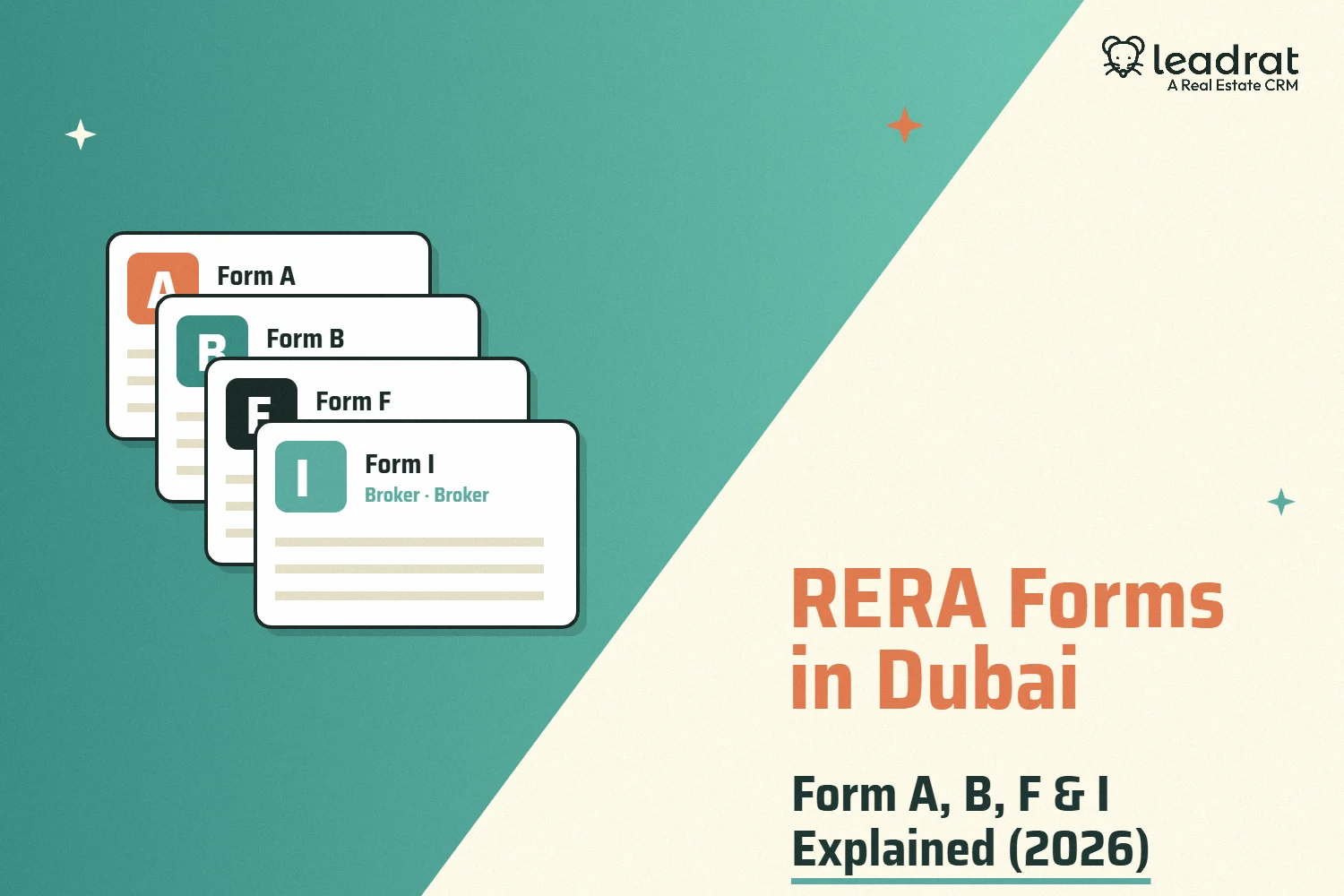
This guide explains the four RERA forms every Dubai broker uses, Forms A, B, F and I, plus Form U, which ends an agreement. You’ll see who signs each one, when, what it should contain and the mistakes that cost brokers money.
Key Takeaways
- Form A is the seller’s listing agreement with a broker. You need it before you can legally advertise a property.
- Form B is the buyer’s agreement with a broker. It protects the buyer’s agent if the buyer later deals with someone else.
- Form F is the sale agreement, or MOU, between buyer and seller. It sets the price, deposit and transfer deadline.
- Form I records how two brokerages split the commission when they work a deal together.
- Forms are now generated through the DLD’s Dubai REST system and signed with UAE PASS, which makes them easy to verify.
What Are RERA Forms?
RERA forms are standard contracts set by Dubai’s Real Estate Regulatory Agency for property sales and leases. They record the agreements between sellers, buyers and brokers at each stage of a deal.
Because every broker uses the same templates, there’s far less room for confusion. Each party knows exactly what they signed, and the regulator has a clear record if anything goes wrong.
RERA Forms at a Glance
| Form | Who signs | When it’s used |
|---|---|---|
| Form A | Seller and broker | Before a property is listed or advertised |
| Form B | Buyer and broker | Before the broker starts searching or arranging viewings |
| Form F | Buyer and seller, witnessed by a broker | When the price is agreed, before transfer |
| Form I | Broker and broker | When two brokerages cooperate on one deal |
| Form U | The party ending an agreement | To formally terminate an earlier form |
Form A: The Seller’s Listing Agreement
Form A appoints a brokerage to market and sell a property on the owner’s behalf. It’s the starting point for every resale listing in Dubai.
What Form A Covers
- The property details and the owner’s information.
- The asking price.
- The commission rate and who pays it.
- Whether the listing is exclusive or non-exclusive.
- How long the agreement lasts.
Why It Matters
Without a signed Form A, a broker can’t get a Trakheesi advertising permit, so the property can’t legally appear on portals. If a property has more than one owner, all owners must sign. An owner can also sign Form A with up to three brokers at the same time.
For the full seller journey, from pricing to transfer, see our guide to selling property in Dubai.
Form B: The Buyer’s Agreement
Form B appoints a broker to find a property for a buyer. It records the buyer’s requirements and the commission the broker will earn if the buyer purchases through them.
What Form B Covers
- The buyer’s details and property requirements, such as budget, area and type.
- The commission terms.
- The length of the agreement.
- How either side can end it.
Why Brokers Shouldn’t Skip It
Many agents treat Form B as optional. That’s a mistake. If a buyer views a property with you and later buys it through another agent, Form B is your evidence that you introduced them. Without it, your claim rests on emails and memory.
A buyer can end Form B by giving written notice and signing Form U. The notice period is usually seven days, so agree the terms clearly at the start.
Form F: The Sale Agreement (MOU)
Form F is the Memorandum of Understanding between buyer and seller. Once both sign it, with a RERA-certified broker as witness, it becomes the binding agreement for the sale.
What Form F Covers
- The agreed sale price.
- The deposit, commonly around 10%, and who holds it until transfer.
- The payment method, including whether the buyer needs a mortgage.
- The deadline for the transfer at a DLD trustee office.
- What happens if either side fails to complete.
Get the Deadline Right
The transfer deadline is where most Form F problems start. A cash deal can close quickly. A mortgage deal needs time for the bank’s valuation and final approval. Promising a short deadline to win a deal, then missing it, is one of the most common causes of disputes.
Buyers can see how Form F fits into the wider process in our guide to buying property in Dubai.
Form I: The Agent-to-Agent Agreement
Brokers use Form I when two brokerages work on one deal, usually one representing the seller and the other the buyer. It sets out how they’ll cooperate and how they’ll split the commission.
What Form I Covers
- Both brokerages and their agents.
- The property and the transaction.
- The commission split, often 50/50 but always negotiable.
- Each side’s responsibilities until transfer.
Why It Prevents So Many Arguments
Under Dubai’s brokerage rules (Article 31 of Bylaw No. 85 of 2006), when several brokers act together on one deal, they share the fee as if they were a single broker. Form I puts that share in writing. Experienced agents sign it as soon as they introduce the buyer, not at the end of the deal when tempers are short.
One practical note: Forms A, B and F are now standard digital contracts in the DLD system. Check with your brokerage how it issues Form I in your current workflow, so you record co-broking agreements properly.
Form U: Ending an Agreement
Form U is the notice of termination. One party uses it to end an earlier agreement, such as a Form A or Form B, before it expires. Using Form U keeps the ending as official as the start, which protects everyone if questions come up later.
How RERA Forms Work Digitally Today
Paper forms are largely a thing of the past. Today, brokers generate these contracts through the DLD’s Dubai REST system, and parties sign them digitally using UAE PASS.
- Faster signing: buyers and sellers can sign from their phones, even from abroad.
- Easy verification: anyone can check a document’s authenticity in Dubai REST, using its number or QR code.
- Better records: signed contracts sit in the official system, not in a drawer.
You can find official services through the Dubai Land Department.
Mistakes That Cost Brokers Money
| Mistake | What goes wrong | How to avoid it |
|---|---|---|
| Advertising without Form A | No Trakheesi permit, and the listing breaks the rules | Sign Form A before any photos go live |
| Skipping Form B | No proof you introduced the buyer | Sign Form B before the first viewing |
| A verbal co-broking split | Disputes over the commission at transfer | Sign Form I when the buyer is introduced |
| An unrealistic Form F deadline | Missed transfer and a broken deal | Allow time for mortgage approval |
| Missing owner signatures | An invalid listing agreement | Get every owner on the title deed to sign |
The Real Problem: Keeping Track of Forms Across Every Deal
Signing one set of forms is easy. Keeping track of hundreds is not. A busy brokerage might have dozens of live listings, each with its own Form A and expiry date, plus buyers on Form B and several co-broking deals on Form I. Each deal also has a Form F deadline counting down.
When those details live in email folders and WhatsApp chats, things slip. A Form A expires and nobody notices. A Form F deadline arrives before the mortgage does. A co-broker’s split can’t be found when it’s needed.
Keep every deal’s paperwork in one place. See how Leadrat helps Dubai brokerages track listings, buyers and deals from Form A to transfer. Book a free Leadrat demo.
A real estate CRM earns its keep here. In Leadrat, each lead and deal stores its own documents, so a Form A, Form B or Form F sits right next to the buyer or seller it belongs to. The deal pipeline shows where every sale stands, and reminders flag deadlines before they’re missed. A tamper-proof audit trail records every action, which helps if a dispute ever comes up.
The Bottom Line
RERA forms aren’t red tape. They’re the reason most Dubai deals close without arguments. Form A lets you list, Form B protects your buyer relationship, Form F locks in the sale and Form I keeps co-broking fair. Sign each one at the right moment, keep the deadlines realistic and store everything where your team can find it. New to the rules? Start with our guide to real estate courses in Dubai.
The best protection against a commission dispute is a signed form, filed before you need it.
Run cleaner deals with less paperwork stress. Get a Leadrat walkthrough built around your listings, portals and team. Get your free demo today.
Frequently Asked Questions
What is Form A in Dubai?
Form A is the listing agreement between a property seller and a broker. It appoints the broker to market the property and is required before the property can be advertised.
What is Form B in Dubai real estate?
Form B is the agreement between a buyer and a broker. It records the buyer’s requirements and the broker’s commission if the buyer purchases through them.
What is Form F in Dubai?
Form F is the Memorandum of Understanding between buyer and seller. It sets the price, deposit, payment terms and the deadline for transfer.
What is Form I in Dubai?
Form I is the agent-to-agent agreement used when two brokerages work on one deal. It records how they cooperate and how they split the commission.
What is Form U?
Form U is a notice of termination. It formally ends an earlier agreement, such as a Form A or Form B.
How many Form A agreements can a seller sign?
A property owner can sign Form A with up to three brokers at the same time.
Are RERA forms signed online?
Yes. Brokers generate the forms through the DLD’s Dubai REST system, and parties sign them digitally with UAE PASS.
How can brokers keep track of RERA forms?
Store each form with the lead or deal it belongs to, track expiry dates and Form F deadlines, and use reminders. A real estate CRM like Leadrat handles this in one place.