
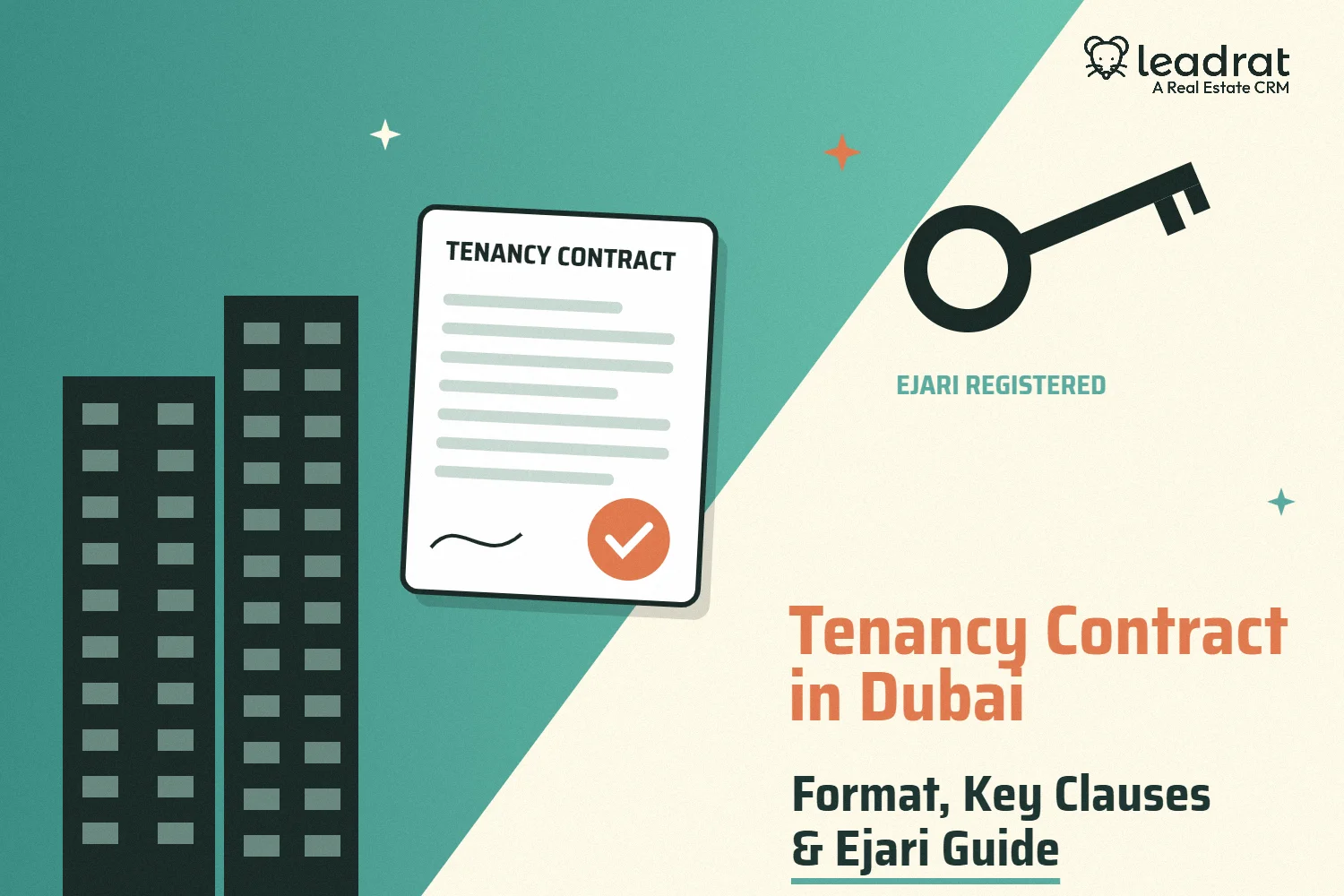
A tenancy contract in Dubai is the written lease between a landlord and a tenant. It uses the Dubai Land Department’s Unified Tenancy Contract, and both sides register it on Ejari. Without registration, the lease is hard to enforce. The tenant cannot connect utilities in their name, and neither side can easily take a dispute to the rental court.
For leasing agents, the contract is where most future problems start or end. A clear rent schedule, a written deposit and the right notice clauses prevent most rental disputes. They keep cases out of the Rental Disputes Centre.
This guide explains the official format, the clauses every contract needs and the laws behind them. It also covers Ejari registration and how renewal works. It ends with a checklist agents can use before every signing.
Key Takeaways
- Dubai leases must use the DLD Unified Tenancy Contract to be registered on Ejari.
- Law No. 26 of 2007, as amended by Law No. 33 of 2008, governs every tenancy in Dubai outside DIFC.
- A contract must state the property, its purpose, the duration and the rent.
- If the tenant stays after expiry with no objection, the contract renews on the same terms.
- Extra terms go in an addendum, as long as they do not break tenancy law.
What Is a Tenancy Contract in Dubai?
A tenancy contract in Dubai is a written lease on the DLD Unified Tenancy Contract. It sets the rent, duration, deposit and duties of both sides, and the parties register it through Ejari.
The contract creates the rights. Ejari records them with the government, so courts, utilities and visa services can rely on them.
Which Laws Govern Tenancy Contracts in Dubai?
Four pieces of law shape every residential and commercial lease in Dubai. The official texts sit on the Dubai Legislation Portal:
| Law | What it covers |
|---|---|
| Law No. 26 of 2007 | The main landlord and tenant law: contracts, rent, maintenance, deposits and eviction |
| Law No. 33 of 2008 | Amends key articles of Law No. 26, including registration, notice and eviction rules |
| Decree No. 43 of 2013 | Caps rent increases at renewal, using the RERA rental index |
| Decree No. 26 of 2013 | Sets up the Rental Disputes Centre, which hears tenancy cases |
The Dubai Land Department (DLD) issues the Unified Tenancy Contract and runs Ejari. The Rental Disputes Centre settles cases when the two sides cannot agree.
What Is the Unified Tenancy Contract Format?
DLD introduced the Unified Tenancy Contract in 2017, in English and Arabic, for residential, commercial and industrial property. It is the only lease format Ejari accepts. The template is free to download from DLD, and typing centres can prepare it for a fee.
The standard form covers the core terms. Anything extra, such as a pet policy or a cheque schedule, goes in a signed addendum. Legal guides note that an addendum is valid only if its terms do not conflict with tenancy law.
Key Clauses Every Dubai Tenancy Contract Needs
Article 4 of Law No. 26 of 2007 requires a written contract that names the property, its purpose, the duration and the rent. In practice, a sound contract covers these clauses:
| Clause | What to include | Why it matters |
|---|---|---|
| Parties | Full names, Emirates ID or passport numbers, contact details | Identifies who holds the rights and obligations |
| Property details | Building, unit number, plot number and DEWA premises number | Ejari and DEWA match the unit through these details |
| Purpose of use | Residential or commercial | Using a home for business can breach the lease |
| Term | Start and end dates, usually one year | Sets the renewal and notice timelines |
| Rent and payment | Annual rent, number of cheques and due dates | Most disputes start with unclear payment terms |
| Security deposit | Amount and refund conditions | Deposit claims are among the most common cases |
| Maintenance | Who handles minor and major repairs | Article 16 makes the landlord responsible unless agreed otherwise |
| Subletting | Allowed only with the landlord’s written consent | Unauthorised subletting is a ground for eviction |
| Renewal and notice | How either side changes terms or ends the lease | Rent changes need 90 days’ written notice |
| Early termination | Notice period and any penalty | Prevents arguments when a tenant leaves early |
Most rental disputes are not about bad tenants or bad landlords. They are about clauses that were never written down.
Keep every lease, renewal date and tenant message in one place. Leadrat tracks tenancy end dates, reminds your team before the 90-day notice window and stores each client’s documents and chats. Book a free Leadrat demo.
How to Register a Tenancy Contract on Ejari
Article 4, as amended by Law No. 33 of 2008, requires the parties to register every tenancy contract, and any change to it, through Ejari. The usual steps are:
- Complete and sign the Unified Tenancy Contract, plus any addendum.
- Gather documents. You usually need the signed contract and the tenant’s Emirates ID. Add property details such as the title deed and DEWA premises number.
- Submit the registration online through DLD’s channels, including the Dubai REST app, or at an authorised typing or trustee centre.
- Pay the registration fee. It varies by channel, so confirm it when you submit.
- Download the Ejari certificate and share it with both parties. The tenant needs it for DEWA and visa services.
How Does Renewal Work?
Under Article 6 of Law No. 26 of 2007, a contract renews automatically if the tenant stays after expiry and the landlord does not object. It renews on the same terms, for the same period or one year, whichever is shorter.
To change any term at renewal, including the rent, the party must give 90 days’ written notice before the contract ends. Any rent increase must also fit the bands set by the RERA rental index. DLD’s Smart Rental Index now rates each building when it sets those limits. Our RERA rental index guide explains the calculation.
Every renewal with changed terms needs a fresh Ejari registration.
Can a Landlord End a Tenancy Contract Early?
Only on the grounds the law allows. During the term, these include non-payment, subletting without consent, illegal use or serious damage. At expiry, a landlord can recover the property for personal use, sale or major renovation. The landlord must give 12 months’ notice by notary public or registered mail.
If the two sides disagree, the case goes to the Rental Disputes Centre. Our guide to the RERA dispute centre covers fees, documents and the filing process.
A Pre-Signing Checklist for Leasing Agents
- Use the latest DLD Unified Tenancy Contract, not an old or custom template.
- Check the landlord’s title deed and that the signer has authority to lease.
- Match the unit, plot and DEWA premises numbers to official records.
- Write the rent, cheque dates and deposit amount in figures and words.
- Put every extra term in a signed addendum.
- Register on Ejari straight after signing, and send both parties the certificate.
- Record the renewal date and the 90-day notice date in your system.
Track these dates and documents on one record. A real estate CRM makes that routine, and WhatsApp CRM keeps every landlord and tenant conversation attached to the right file.
The Bottom Line
A Dubai tenancy contract is simple when it follows the official format and states every key term in writing. Register it on Ejari straight away. Agents who check those three things protect both clients and cut most disputes before they start. New to leasing in Dubai? Start with our guide on how to become a real estate agent in Dubai.
A well-written lease is the cheapest dispute resolution tool in Dubai.
Managing leases across Dubai? Leadrat brings Bayut, Property Finder and Dubizzle leads, renewal reminders and tenant records into one dashboard. Get your free demo today.
Frequently Asked Questions
Is a tenancy contract mandatory in Dubai?
Yes. Article 4 of Law No. 26 of 2007 requires a written contract. The amended law also requires registration through Ejari.
Which tenancy contract format does Dubai use?
The Dubai Land Department’s Unified Tenancy Contract, in English and Arabic. It is the only format accepted for Ejari registration.
Can I add extra terms to a Dubai tenancy contract?
Yes, in a signed addendum. Extra terms are valid only if they do not conflict with Dubai tenancy law.
What happens when a tenancy contract expires in Dubai?
If the tenant stays and the landlord does not object, the contract renews on the same terms. It runs for the same period or one year, whichever is shorter.
How much notice do you need to change rent at renewal?
Either party must give 90 days’ written notice before the contract ends. Any increase must also follow the RERA rental index.
Where can I read Dubai’s tenancy law?
The official text of Law No. 26 of 2007 and Law No. 33 of 2008 is on the Dubai Legislation Portal.