
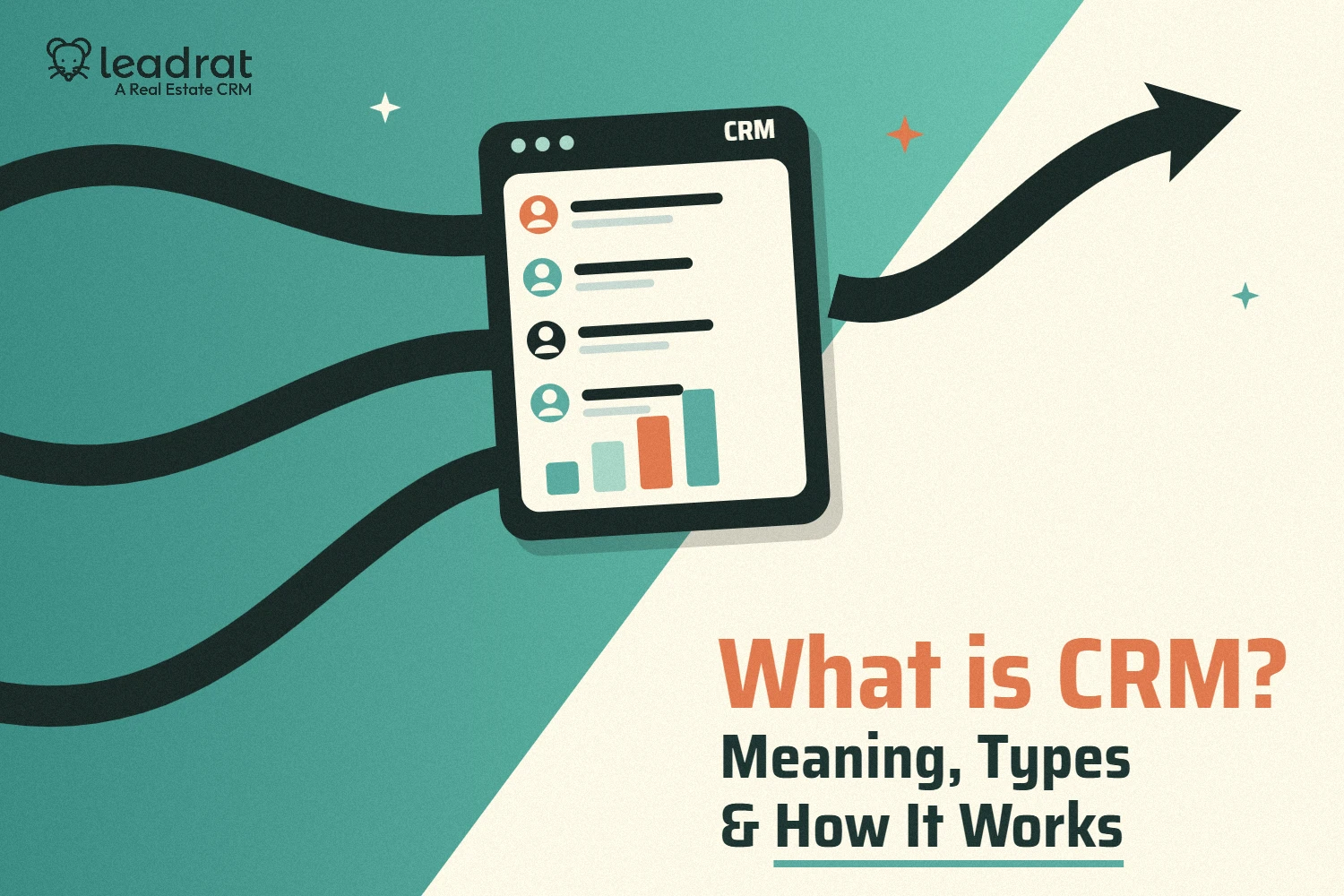
A CRM is a system that helps a business track and grow its customer relationships. It stores every lead, call, email, meeting and deal in one shared place. Instead of living in someone’s phone or a messy spreadsheet, customer knowledge belongs to the whole team.
Key Takeaways
- CRM means customer relationship management. It is software that records every customer and every conversation in one place.
- A CRM moves each lead through a clear path: enquiry, qualified lead, opportunity and customer.
- Speed is where CRM pays off most. Harvard research found that calling a lead within an hour makes you about seven times more likely to qualify it.
- A CRM serves three teams: sales, marketing, and customer service.
- Most CRM projects fail because people stop using them, not because the software is weak.
- Industry CRMs, like Leadrat for real estate, fit how that industry really sells.
What Is CRM?
CRM stands for customer relationship management. The term covers two ideas. One is a business habit: putting the customer at the centre of how you sell and serve. The other is the software that makes that habit work every day. When most people ask, “what is CRM?”, they mean the software.
CRM is not a niche tool. Gartner reports that the CRM software market grew 13.4% to reach $128 billion in 2024. It is one of the largest software markets in the world, alongside databases and security.
From Rolodex to AI: A Short History of CRM
Before software, sales teams kept customers on index cards in a Rolodex. In 1987, a tool called ACT! put contact management on the personal computer. Later, in the 1990s, firms like Siebel built large CRM systems for big companies. However, these needed servers, IT teams, and months of setup.
In 1999, Salesforce launched CRM in the cloud. As a result, any business could log in from a browser and pay monthly. Then mobile apps followed, so field teams could update deals on the go. Today, AI is the next leap. For example, a modern CRM can score leads, summarize calls, and suggest the next best step.
How Does a CRM System Work?
At its core, a CRM is a shared database with smart workflows on top. Every person is a contact. Every possible sale is a deal, with a value and a stage. Similarly, each call, email, note and meeting is an activity linked to that contact. Finally, reports sit on top and turn all of this into numbers.
Here is how a lead moves through a CRM:

- Capture. A lead enquiry arrives from a website form, an ad, a portal, a call or WhatsApp. The system then logs it at once and checks for duplicates.
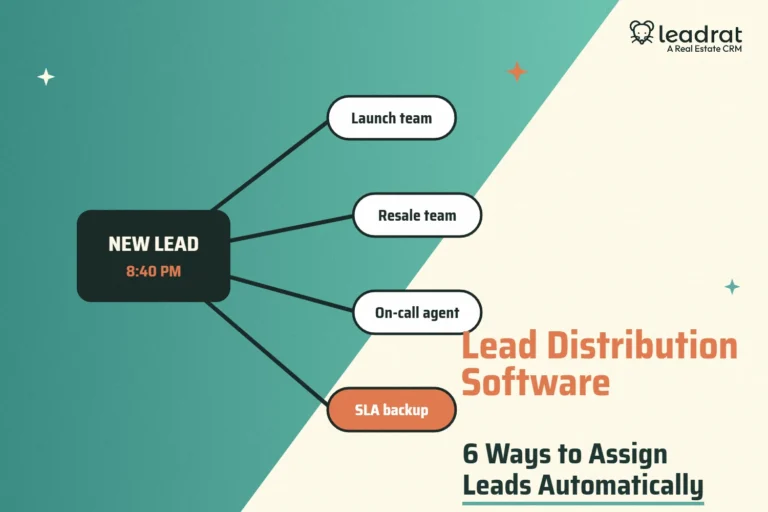
- Assign. Next, rules send the lead to the right person by location, product or workload. As a result, no lead waits in a shared inbox.
- Qualify. The rep checks budget, need and timing. The system also records the answers and may give the lead a score.
- Nurture. Not every lead is ready to buy. So the system schedules follow-ups and sends helpful messages over weeks or months.
- Close. The deal moves through stages until it is won or lost. The reason is recorded either way.
- Learn. Managers see which sources bring buyers, where deals stall and how fast each rep responds.
However, that last step is what spreadsheets cannot do. A spreadsheet shows a list. Meanwhile, the system shows how your sales engine behaves.
How CRM Helps Sales, Marketing and Service
This software is not only a sales tool. It links the three teams that face customers.
Sales. It automates the dull work, like reminders, quotes and forecasts. Reps see their pipeline on one screen and spend more time on deals that are likely to close.
Marketing. Marketers can see which campaigns bring real buyers, not just clicks. They can also group customers by need or stage and send targeted messages. When a campaign ends, they can trace which leads turned into sales.
Customer service. Service teams log every query as a case and track it to the end. In addition, many CRMs track response times against service promises. They also keep a shared library of answers. When a customer calls, the agent sees their full history and does not ask them to repeat it.
Read More: Top Real Estate CRMs in India
Types of CRM
| Type | Focus | Best for |
|---|---|---|
| Operational | Automating daily sales, marketing and service tasks | Teams that need speed |
| Analytical | Finding patterns, forecasts and best lead sources | Leaders who plan with data |
| Collaborative | Sharing customer data across teams, branches and partners | Firms with many offices or partners |
Most modern cloud CRMs combine all three. The bigger choice is between a general CRM that you customize and an industry CRM built for your field.
What Are the Benefits of CRM?
The real value of a CRM is not the software. It is what changes in how your business runs.
- Revenue stops leaking. Most businesses do not have a lead problem; they have a follow-up problem. So the software closes the gap between the first enquiry and the first call.
- Speed becomes a system, not a hero. Fast replies should not depend on one star rep. Instead, the system builds speed into the process with instant alerts and routing.
- Customers feel remembered. After all, people stay loyal to teams that remember them. A full history lets every conversation pick up where the last one ended.
- Teams stop working in silos. When sales, marketing and service share one record, handoffs stop dropping the ball. As a result, everyone works from the same truth.
- Decisions run on data, not gut feel. The data shows which sources, reps and stages drive revenue. Therefore, leaders can move budget to what works, month after month.
- Forecasts become believable. Every deal has a value, a stage and a next step. Thus, the sales forecast turns from a hopeful guess into a plan.
- Knowledge stays when people leave. Relationships belong to the company, not a salesperson’s phone. So staff changes no longer wipe out your pipeline.
- Your business becomes AI-ready. AI is only as smart as the data beneath it. A clean CRM is the base every future AI tool will need.
The Business Case: Speed and Return
Two pieces of research show why CRM matters.
First, there is speed. A Harvard Business Review study looked at 1.25 million sales leads. Firms that tried to reach a lead within an hour were nearly seven times more likely to qualify it than firms that waited even one hour longer. They were over 60 times more likely than firms that waited a full day.
Yet only 37% of firms in a related test replied within the hour. However, the right software closes that gap with instant alerts and automatic assignment.
Next, there is return on investment. Nucleus Research studied CRM projects and found an average return of $8.71 for every dollar spent. In fact, most of that comes from time saved and sales that would otherwise be lost.
Why CRM Projects Fail, and How to Avoid It
However, the software only works if people use it. These are the most common reasons rollouts stall:
- Low adoption. If entering data feels like extra work, reps skip it. Choose a simple tool with a good mobile app, and show quick wins early.
- Dirty data. For instance, duplicate and outdated contacts lead to wrong reports. Clean your lists before you import them.
- Too much custom setup. Heavy changes cost time and money and make upgrades harder. Instead, start with the core and grow from there.
- No clear owner. Someone must own the CRM, set the rules and check the reports each week.
- Weak data security. Above all, customer data is sensitive. Use role-based access so reps see only their own leads. Make sure your CRM supports privacy laws such as India’s Digital Personal Data Protection Act, 2023.
Why Real Estate Needs Its Own CRM
For any real estate business, a CRM is a must-have.
A developer or broker may get hundreds of enquiries a week from property portals, Meta and Google ads, websites, channel partners and walk-ins. The same buyer often enquires on three portals, so duplicates are common.
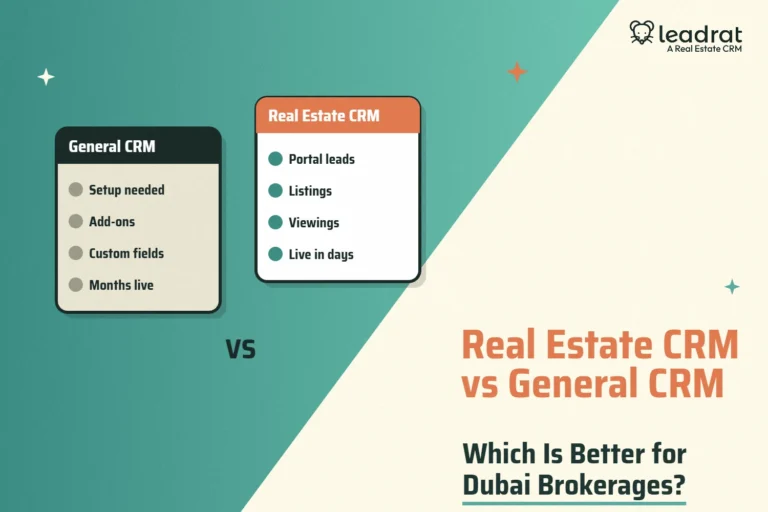
The sales cycle is also long and very physical. A typical path is enquiry, call, site visit, revisit, negotiation and booking. Moreover, each buyer has a budget, a preferred location and a unit type in mind. Teams need to match buyers to live inventory, track site visits and credit the right channel partner. A general CRM can do some of this, but only after weeks of custom setup.
Leadrat is a real estate CRM built for this cycle. First, it brings in leads from portals, ads and websites and assigns them automatically. It tracks calls, site visits and follow-ups, and manages projects and property inventory. In addition, managers get live dashboards, and field teams work from a mobile app.
Still tracking property leads in spreadsheets and WhatsApp? Leadrat captures, assigns and tracks every enquiry so your team can respond in minutes, not hours. Book your free Leadrat demo and see your pipeline in action.
How to Choose the Right CRM Software
- Industry fit. Does it already know your sales stages and lead sources?
- Ease of use. Will reps use it daily without being chased? Insist on a hands-on trial.
- Mobile access. Can field teams log calls and visits from their phones?
- Integrations. Does it connect with your portals, ad accounts, phone system and WhatsApp?
- Support. Is help fast and local when something breaks?
- Full cost. Add setup, training and add-ons to the per-user price.
The Bottom Line
A CRM is how a business keeps its promises to every customer, at any scale. It captures every lead, makes sure someone responds fast, and shows you exactly where revenue comes from.
The fastest-growing businesses are rarely the ones with the most leads. They are the ones that lose the fewest.
Ready to stop losing leads? Leadrat helps developers, brokers and channel partners capture every enquiry, automate follow-ups and close more deals from one dashboard. Get your free demo today and see why real estate teams across India are making the switch.
Frequently Asked Questions
What is the full form of CRM?
CRM stands for customer relationship management. It means both the practice of managing customer relationships and the software used to do it.
What is the main purpose of a CRM?
Its main purpose is to help a business win and keep customers. It does this by keeping all customer data in one place and making sure every lead gets a fast, consistent follow-up.
What are some examples of CRM software?
Well-known general CRMs include Salesforce, HubSpot, Zoho and Microsoft Dynamics 365. Leadrat is an example of an industry CRM built for real estate.
Is a CRM worth it for a small business?
Yes, often more than for large firms, because small teams cannot afford to lose leads. Besides, cloud CRMs let you start with a few users and grow.
How much does a CRM cost?
Most cloud CRMs charge per user, per month. In practice, price depends on users, features and support. Budget for setup, training and integrations too.
What is the difference between CRM and ERP?
A CRM manages everything that faces the customer: leads, sales and service. An ERP runs the inside of the business: finance, stock and HR. Many companies connect the two.