
Dubai’s rental market is becoming more structured, and rent renewals are no longer just a matter of landlord discretion. The RERA Smart Rental Index gives landlords and tenants a standardised benchmark for determining permissible rent increases, based on a building’s rating and rental value.
Introduced by the Dubai Land Department (DLD) in January 2025, the index brings greater transparency to rental valuations across the city. With over 900,000 rental contracts registered in Dubai in 2024, understanding how the index works is essential for anyone involved in property leasing.
This guide breaks down how the Smart Rental Index works, the legal rent increase brackets, how to calculate a rent revision, and what leasing agents need to check before every renewal.
Key Takeaways
- Decree No. 43 of 2013 caps rent increases at renewal between 0% and 20%.
- The cap depends on how far the current rent sits below the RERA rental index average for similar homes.
- If the rent is within 10% of the average, the landlord cannot raise it at all.
- The landlord must give written notice at least 90 days before the contract ends.
- Since 2025, building quality affects the index. Better-rated buildings justify higher rents.
What Is the RERA Rental Index?
The RERA rental index is the Dubai Land Department’s official record of average rents for similar homes. It sets the legal limit on rent increases at renewal.
Tenants, landlords and agents check it through the DLD website and the Dubai REST app. People often call it the RERA calculator, because it returns the allowed increase for a specific unit.
How Does the Smart Rental Index Work?
The Smart Rental Index replaced the old area-based calculator on 2 January 2025. It now rates each building on a set of criteria. These include its structure, finishes, maintenance, location and services.
To set the allowed increase, DLD combines three data points. It uses the rents already paid in the building, the area average and the building’s rating. The smart residential index covers Dubai’s main districts and free zones. DIFC follows its own rules.
“This index relies on artificial intelligence technologies and a building classification system.”
Majid Al Marri, CEO, Real Estate Registration Sector, Dubai Land Department (source)
The practical shift is simple: a landlord’s rent now depends on the building as well as the area. A well-kept tower can support a higher rent than a tired one on the same street.
How Much Can Rent Increase in Dubai in 2026?
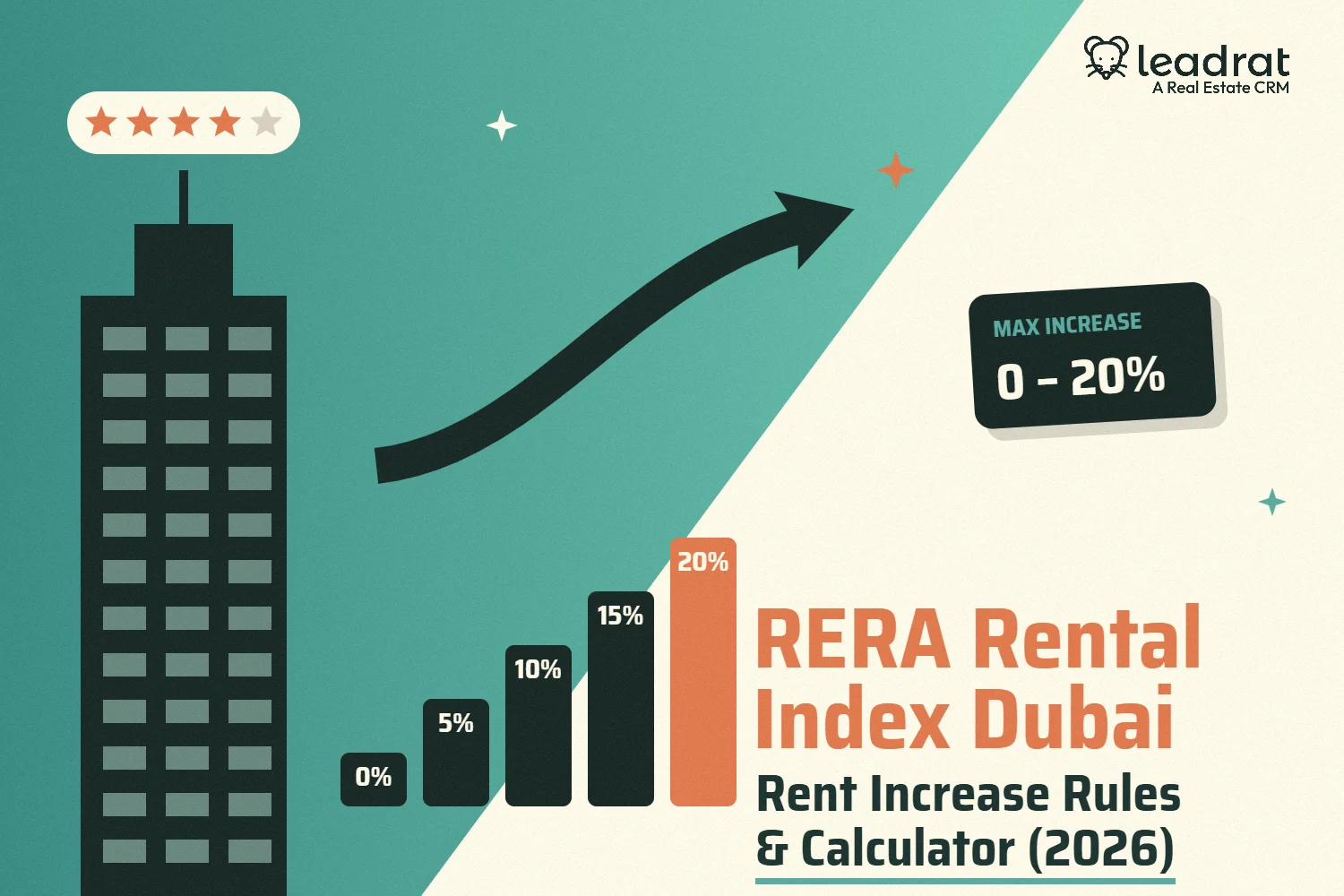
Decree No. 43 of 2013 sets five bands. The band depends on how far the current rent sits below the index average for similar units. The caps have not changed since the decree took effect.
| Current rent compared with the index average | Maximum increase at renewal |
|---|---|
| Up to 10% below the average | 0% (no increase) |
| 11% to 20% below | 5% |
| 21% to 30% below | 10% |
| 31% to 40% below | 15% |
| More than 40% below | 20% |
The cap applies only when an existing contract renews. A rent that already matches or beats the average cannot go up at all.
How to Calculate a Rent Increase in Dubai: Step by Step
- Open the RERA rental index on the DLD website or the Dubai REST app.
- Enter the property details: area, building, unit type and size.
- Enter the current annual rent from the tenancy contract.
- Read the index average for similar units and the gap to the current rent.
- Match the gap to the band in the table above. The result is the maximum legal increase.
Here is how the bands work on real numbers:
| Current rent (AED) | Index average (AED) | Gap below average | Maximum increase |
|---|---|---|---|
| 60,000 | 80,000 | 25% | 10% = AED 6,000 |
| 75,000 | 80,000 | 6.25% | 0% |
| 55,000 | 100,000 | 45% | 20% = AED 11,000 |
The first example matches the one DLD uses in its own guidance. Always run the official index for the exact unit, because building ratings move the average.
Never miss a renewal window again. Leadrat tracks every tenancy end date, reminds your team before the 90-day mark and keeps landlord and tenant chats in one place. Book a free Leadrat demo and see it on your own listings.
What Is the 90-Day Notice Rule?
A landlord who wants to raise rent must tell the tenant in writing at least 90 days before the contract ends. The rule comes from Dubai’s tenancy law (Law No. 26 of 2007, amended by Law No. 33 of 2008). DLD has confirmed that it still applies under the Smart Rental Index.
Two conditions must both be true. The landlord must give notice on time, and the index must support the increase. If either fails, the rent stays the same for that renewal. Disputes go to the Rental Disputes Centre, which uses the RERA index as its benchmark.
Why Does the Rental Index Matter More in 2026?
The market has turned. Khaleej Times reported in June 2026 that tenants are using the Smart Rental Index to negotiate lower rents. Rents are softening in communities that saw sharp peaks.
That changes the job of a leasing agent. For years, the index mostly told tenants how much more they would pay. Now it often tells landlords that the rent cannot rise, or that a lower renewal keeps a good tenant. The agent who runs the index before the landlord does controls the renewal conversation.
What Should Leasing Agents Do Before Every Renewal?
- Track every lease end date. Set reminders at 120 days, so the 90-day notice never slips.
- Run the index early. Share the result with the landlord before they name a number.
- Put the notice in writing. Keep a dated copy with the tenancy record.
- Keep both sides informed. Use WhatsApp CRM so every message sits on the client record, not a personal phone.
- Treat renewals as a pipeline. Our guide to sales pipeline management shows how to track each stage.
Renewals are also lead opportunities. A tenant who will not renew may want to buy, or move to a bigger home. Steady lead nurturing keeps you first in line. If you are new to the market, start with our guide on how to become a real estate agent in Dubai.
The Bottom Line
Dubai’s Smart Rental Index has changed the way rent renewals are negotiated. Rent increases are no longer driven by market sentiment or landlord expectations alone. Building ratings, comparable rents and legal notice periods now shape what landlords can charge and what tenants can reasonably challenge.
For leasing agents, this makes preparation as important as negotiation. Checking the index early, tracking renewal dates and maintaining clear communication with both parties can prevent disputes and protect long-term client relationships.
The real advantage lies in being one step ahead of the renewal. With Leadrat, agents can track tenancy timelines, automate reminders and keep every client conversation organised, making rental renewals easier to manage and opportunities harder to miss.
Managing hundreds of Dubai tenancies? Leadrat brings Bayut, Property Finder and Dubizzle leads, renewal reminders and WhatsApp follow-ups into one dashboard. Get your free demo today.
Frequently Asked Questions
How much can a landlord increase rent in Dubai in 2026?
Between 0% and 20% at renewal. The limit depends on how far the current rent sits below the RERA rental index average for similar homes. Rent within 10% of the average cannot go up.
Where do I check the RERA rental index?
On the Dubai Land Department website or in the Dubai REST app. Enter the area, building, unit type and current rent to see the allowed increase.
Does the RERA rental index apply to new tenancies?
No. The increase caps apply when an existing contract renews. The landlord and tenant agree the rent for a new tenancy freely.
What happens if the landlord does not give 90 days’ notice?
The landlord cannot apply the increase for that renewal. If the two sides disagree, the Rental Disputes Centre decides, using the RERA index.
Can a tenant use the index to ask for lower rent?
Yes. Many tenants now use the Smart Rental Index as evidence when they negotiate a lower renewal, especially where rents have softened.
Does the Smart Rental Index cover DIFC?
No. DIFC follows its own leasing rules. The smart residential index covers Dubai’s main districts and free zones.