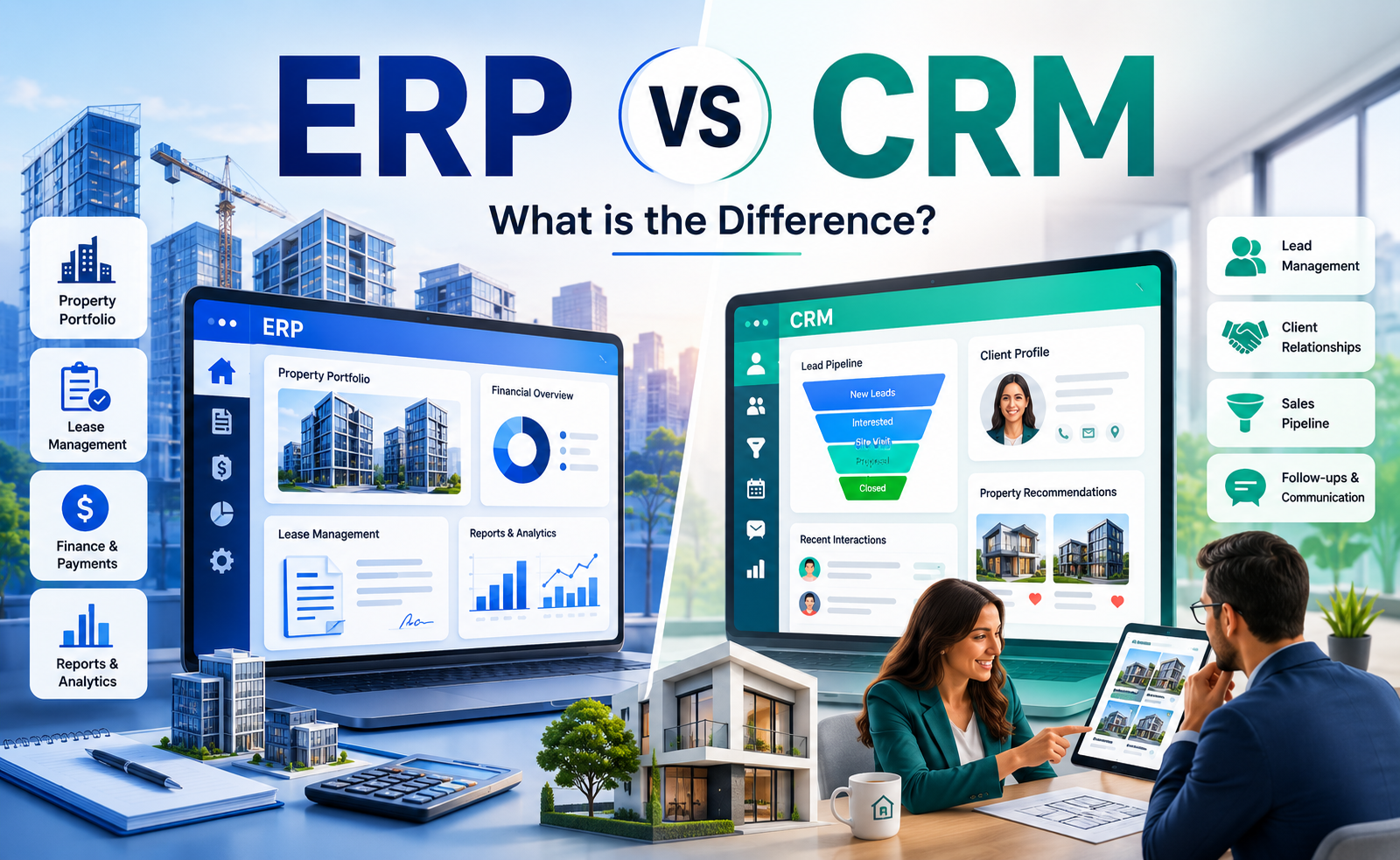
In an industry built on relationships and precision, one system focuses on winning clients and closing deals, while the other ensures your operations, finances, and projects run without friction. The choice isn’t always obvious and picking the wrong one can cost you time, money, and momentum.
The real answer depends on your business model. Let’s break it down clearly so you can make the smartest decision for where you are today.
What is a CRM in Real Estate
A real estate CRM (Customer Relationship Management) is specialized software that helps agents, brokers, and developers manage client relationships, track leads, and oversee property listings with confidence. It automates follow-ups, organizes your sales pipelines, and delivers personalized communication throughout the entire buying, selling, or renting journey.
Think of it as your central command center, a single source of truth where your whole team, from sales to customer support, can instantly see a complete history of every client interaction. This visibility turns scattered data into powerful insights, helping you drive more revenue and build genuine loyalty that lasts beyond a single transaction.
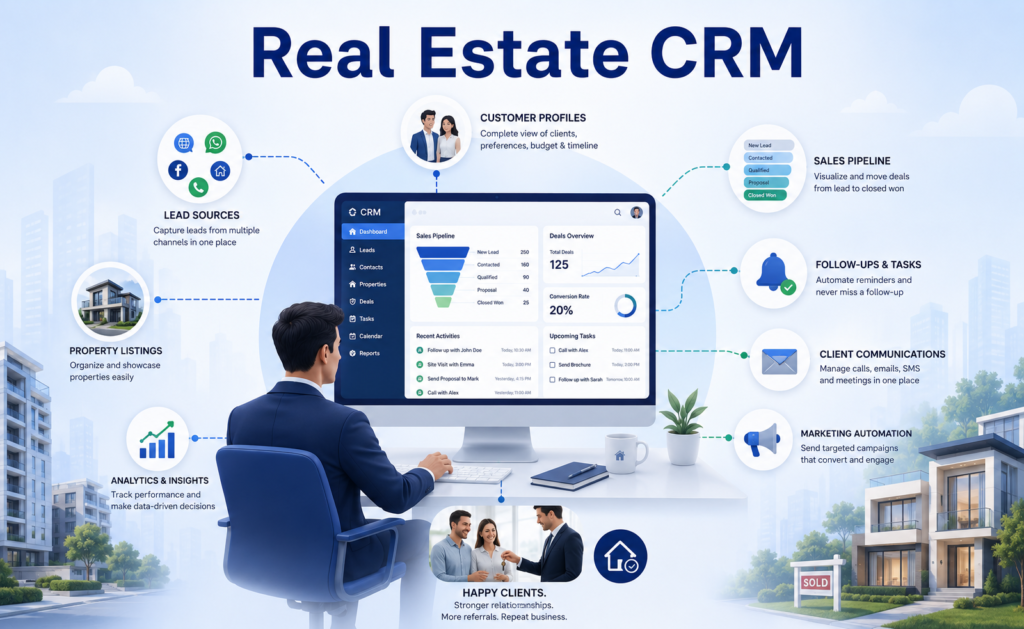
A reliable CRM maintains your customer data and analytics, tracks every interaction, and automates repetitive sales processes so you can focus on what you do best: closing deals and creating happy clients.
According to statistics, companies that fully embrace CRM see impressive results with reports showing up to 87% improvement in sales and 74% higher customer satisfaction.
For the full picture of what a dedicated real estate CRM includes beyond this summary, see our complete guide to real estate CRM.
Core Features of a Real Estate CRM
- Contact Management: You can easily capture each client’s budget, timeline, and preferred locations, building rich profiles that help you match them with the perfect properties every time.
- Transaction Management: Keep every deal organized with checklists, document uploads, and seamless sharing so nothing falls through the cracks during closing.
- Lead Management: Automatically pull leads from email, calls, SMS, and social media into one place and nurture them consistently without missing any opportunity.
- Pipeline Management: Clearly visualize and guide every lead through your sales pipeline, from first contact all the way to a closed deal.
- Client Communications: Manage follow-ups, meetings, reminders, and conversations from one simple dashboard for faster, more consistent service.
- Personalized Marketing: Send targeted emails and campaigns that truly resonate by using smart segmentation and your rich client data.
- Reporting and Analytics: Get real-time insights and performance dashboards so you always know what’s working and where to focus your efforts next.
What is ERP Software for Real Estate
ERP (Enterprise Resource Planning) software is the powerful backbone that helps developers, builders, agents, and brokers centralize all their operational data and run core business processes efficiently. It brings together real estate development, marketing and sales, tenant and property management, finance, and accounting into one unified system.
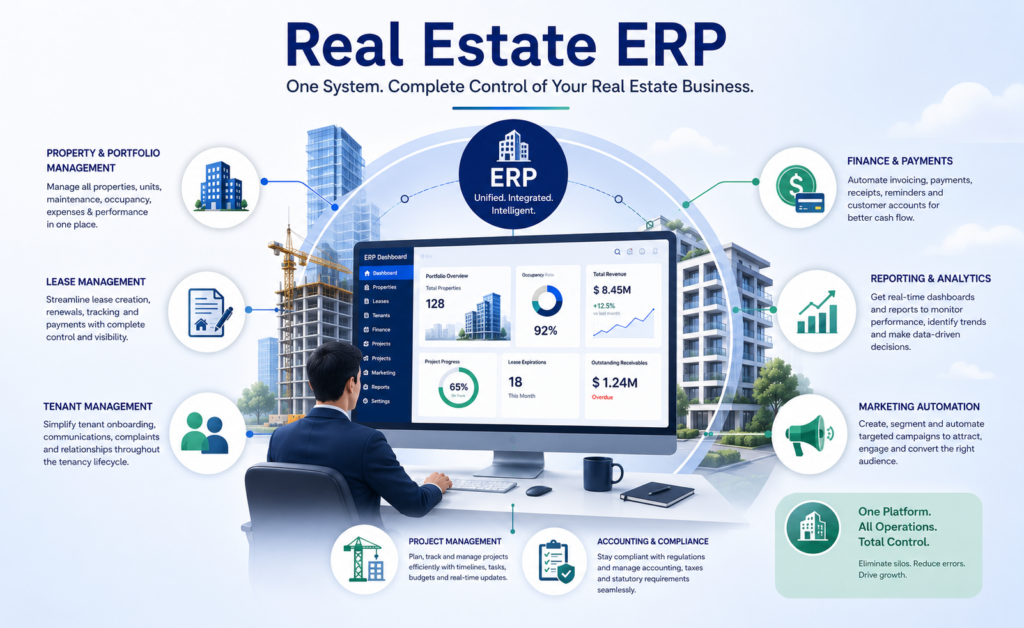
In practical terms, ERP integrates your day-to-day activities; accounting, procurement, project management, compliance, and supply chain operations; so, you eliminate silos, reduce errors, and gain clear visibility across the entire business.
Main Features of a Real Estate ERP
- Lease Management: You can streamline lease creation, tracking, renewals, and payments in one centralized system cutting errors and giving you complete control over your portfolio.
- Reporting and Analytics: Generate instant, visual reports and dashboards to monitor portfolio performance, spot sales trends, plan upcoming tasks, and better understand customer needs.
- Marketing Automation: Easily create, segment, and automate targeted campaigns using your property and customer database, saving time while improving results.
- Invoicing and Payments: Automate invoicing, receipts, reminders, and customer accounts for sharper cash flow visibility and faster collections.
- Property and Portfolio Management: Manage all your properties efficiently with complete details on maintenance, occupancy, expenses, and performance in one clear view.
- Tenant Management: Handle tenant onboarding, communications, complaints, and relationships smoothly while keeping accurate records throughout the entire tenancy lifecycle.
The best real estate businesses don’t just use tools; they choose systems that align with how they operate. CRM fuels your client-facing growth; ERP strengthens your operational foundation. Together, they create a powerful advantage.
ERP vs CRM Key Differences
A CRM helps you win and keep customers, while ERP helps you run the business efficiently. Many real estate companies use both systems (or an integrated platform) for maximum impact.
Now let’s understand the difference in depth;
| Aspect | CRM (Customer Relationship Management) | ERP (Enterprise Resource Planning) |
| Primary Focus | Customer-facing: Managing relationships, interactions, and sales | Back-office operations: Streamlining internal processes across the business |
| Main Goal | Improve customer acquisition, retention, satisfaction, and sales growth | Enhance operational efficiency, reduce costs, and integrate business functions |
| Core Users | Sales, Marketing, and Customer Service teams | Finance, Accounting, Operations, HR, and Property Management teams |
| Key Features | Contact management, Lead and Pipeline tracking, Marketing automation, Client communications, Personalized campaigns | Lease and Tenant management, Invoicing and Payments, Financial accounting, Property portfolio, Reporting |
| Data Orientation | Customer data (preferences, history, interactions, leads) | Business-wide data (leases, properties, finances, operations, assets) |
| Scope | Front-office / Customer-centric | Holistic / Organization-wide (integrates multiple departments) |
| Benefits | Better customer insights, faster deal closing, higher retention | Improved efficiency, accurate financials, reduced manual work, better cash flow |
| Typical Use Cases | Lead nurturing, sales forecasting, client follow-ups, marketing campaigns | Lease tracking, invoicing, property maintenance, accounting, portfolio reporting |
For Example,
A real estate agency uses CRM to capture real estate agent leads from their website, track their preferences (budget, location), send personalized property recommendations, and manage the sales pipeline until the deal closes.
The same agency uses ERP to manage lease agreements for rental properties, automate rent invoicing and collections, track property maintenance expenses, and generate financial reports for the entire portfolio.
ERP vs CRM by Business Value and Type
Here’s my take as someone who cuts through the tech hype: the real decision between ERP and CRM isn’t about which is “better.” It’s about which one solves your biggest headaches and drives real results for the type of real estate business you run.
ERP vs CRM for Real Estate Developers
If you’re a real estate developer, ERP is the one that usually delivers the bigger impact.
Development work is complex and capital heavy. You’re dealing with land banks, ongoing construction, material costs, vendor coordination, and tight cash flows across multiple projects. An ERP system brings order to the chaos by:
- Giving you a single, real-time view of project budgets, timelines, inventory, and financials.
- Helping you control costs, reduce delays, and avoid nasty surprises that eat into margins.
- Making reporting cleaner for investors, banks, and compliance.
CRM is nice for managing buyers, but the heavy operational and financial lifting in development makes ERP the smarter foundation.
This is especially relevant for real estate investors managing multiple properties at once – see our guide to CRM for real estate investors for the CRM side of that equation
ERP vs CRM for Real Estate Brokers and Agents
For brokers, agents, channel partners and agencies, CRM is always the better choice, it’s the tool that directly helps you win more business.
Your world revolves around people, leads, and closing deals. A strong CRM supports that reality by:
- Collecting and nurturing leads from every source, so nothing falls through the cracks.
- Keeping your sales pipeline clear and actionable with smart follow-ups and personalized outreach.
- Making client communication smooth and professional, whether you’re on site or on the go.
- Helping your team stay aligned with shared client and property records.
You can add accounting tools later, but most brokers grow faster and serve clients better when they start with a solid CRM.
- Real Estate Developers: Start with ERP (or an ERP that includes CRM) to handle complexity and protect profitability.
- Brokers and Agents: Lead with CRM to fuel your pipeline and build stronger client relationships.
The best setups I see aren’t “ERP vs CRM”; they’re smart combinations that match where your business is today. Focus on what creates the most value right now, then grow from there.
Conclusion
After exploring both systems in depth, here’s my honest take:
CRM is the better starting point for the majority of real estate professionals.
Why? Because real estate is ultimately a relationship business. Whether you’re an individual agent, a growing brokerage, or even a small developer, your revenue depends on finding leads, building trust, nurturing relationships, and closing deals consistently.
A good CRM directly powers that engine helping you stay organized, respond faster, personalize your outreach, and never let a hot lead go cold. The results speak for themselves: higher sales, better client loyalty, and more time spent on high-value activities instead of chasing paperwork.
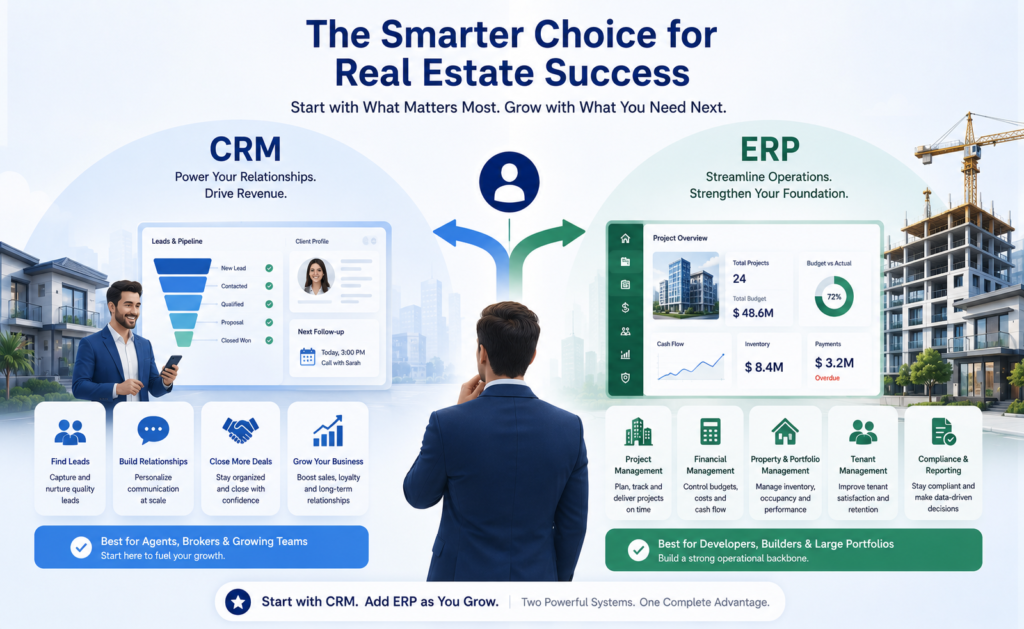
That said, ERP is better and often essential for real estate developers, builders, and larger property portfolio owners. These businesses deal with heavy operational complexity, significant capital investment, construction timelines, inventory management, and intricate financials. In these cases, ERP becomes the backbone that prevents costly mistakes, controls cash flow, and brings order to large-scale projects.
Most successful real estate companies don’t choose one over the other forever; they start with what matters most right now and integrate the second system as they grow.
If you’re an agent or broker looking to grow your pipeline, close more deals, and deliver exceptional client experiences, CRM is the smartest investment you can make.
Try Leadrat Real Estate CRM today, the powerful, easy-to-use CRM built specifically for real estate professionals like you. Start your free trial and experience the difference a truly focused system can make.
Start Free Trial with Leadrat