
Key Takeaways
- A channel partner (CP) is a RERA-registered professional who markets and sells properties on behalf of developers, not buyers. They act as an extended sales arm, not an independent broker.
- Unlike traditional brokers, CPs work under a formal agreement with specific developers, focus exclusively on new project launches, and are held accountable by both RERA and the developer in contract.
- There are five types of CPs: individual brokers, real estate agencies, NRI-focused partners, digital/prop-tech CPs, and referral partners from adjacent fields like banking or wealth management.
- For developers, CPs eliminate the need for a large, fixed sales team. They scale outreach across geographies and buyer segments on a commission-only model, paid only when a deal closes.
- Buyers pay nothing extra when going through a CP. The developer pays the commission, which typically ranges from 1% to 3% of the property’s value, sometimes up to 5% for luxury projects.
- To operate legally, CPs must register with their state RERA authority, sign a formal developer agreement, complete project training, and build a verified buyer network before they can start selling.
The Indian real estate market moves fast.
Developers launch projects in competitive markets; buyers have more options than ever, and the window to close a deal is narrow.
In this environment, relying purely on an in-house sales team is rarely enough. That is where channel partners come in, and why their role has become central to how properties get sold in India today.
Without any further ado, let’s get into the context quickly.
What Is a Channel Partner in Real Estate?
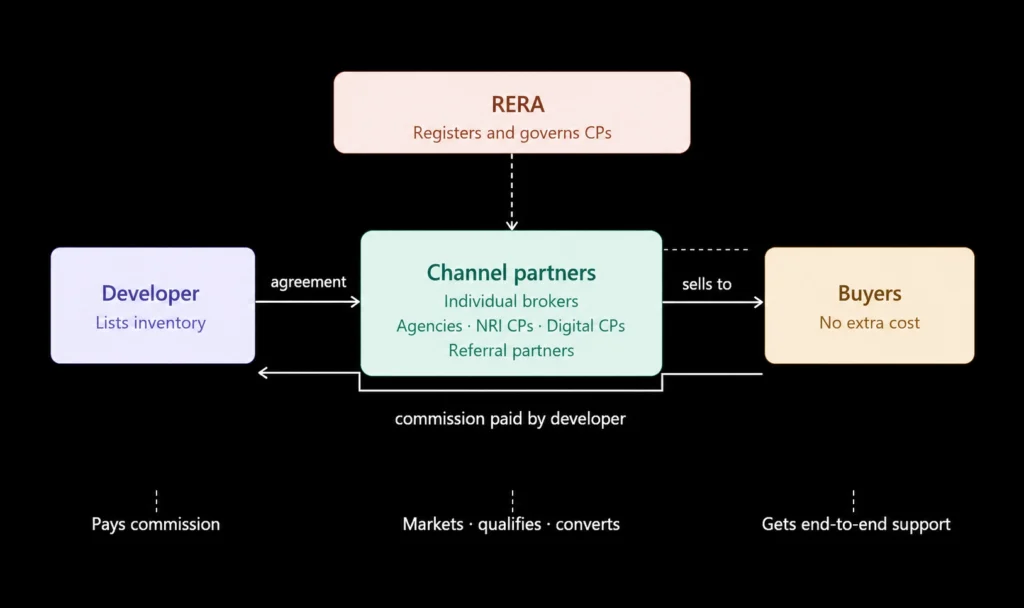
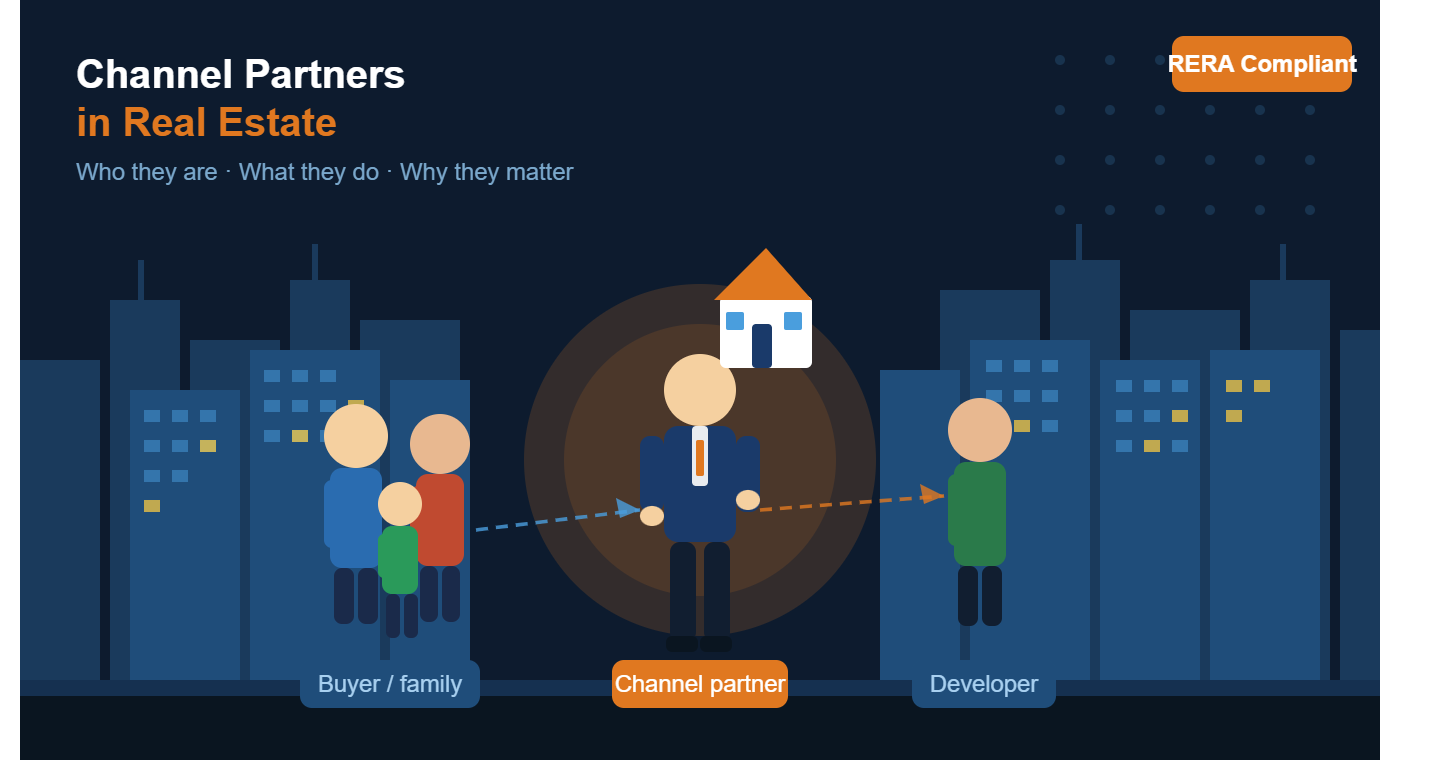
A channel partner (CP) in real estate is a RERA-registered professional or agency that collaborates with developers to market and sell properties. They are not employees of the developer. They operate independently, working under a formal agreement that defines their responsibilities, the inventory they can sell, and their commission structure.
Channel partners work on behalf of developers, not buyers. They act as an extended sales arm, bringing in leads, qualifying prospects, facilitating site visits, and guiding buyers through the purchase process until the deal closes.
This is different from a traditional broker, who may represent either party in a transaction. A channel partner’s mandate comes from the developer’s side of the table.
But, often people confuse them with Broker. So, let’s break the illusion and see how they work differently.
Channel Partner vs. Broker
People often confuse channel partners with brokers, and it is easy to see why. Both help move properties. But how they operate, who they answer to, and what the buyer can expect from each is quite different.
Parameter | Channel Partner | Traditional Broker |
RERA Registration | Mandatory | Optional in many cases |
Market Focus | New launches and primary sales | Primary and resale both |
Working Style | Tied to specific developer(s) via agreement | Works independently across clients |
Represents | Developer | Buyer, seller, or both |
Buyer Support | Documentation, loans, site visits, post-sale | Typically limited to closing the deal |
Accountability | Governed by RERA and developer contract | Informal, varies by individual |
Who Pays Commission | Developer pays, buyer pays nothing | Can be charged to buyer, seller, or split |
The practical takeaway for a buyer: Going through a channel partner on a new project costs you nothing extra and comes with more structured support. A broker gives you flexibility across the market, including resale options, but the level of service and accountability can vary widely depending on who you work with.
Types of Channel Partners in Real Estate
Not all channel partners operate the same way.
- Individual Brokers are the most common type. They are solo professionals with a local buyer network, typically working across one or a few developers’ projects.
- Real Estate Agencies and Consultancy Firms function as institutional CPs, running dedicated teams for lead generation, site visits, and post-sale support at scale.
- NRI-Focused Channel Partners specializes in reaching Indian diaspora buyers in markets like the UAE, UK, the US, and Singapore. They work with developers on curated investment pitches and virtual site tours.
- Digital and Prop-Tech CPs drive leads primarily through online channels, performance marketing, and property portals rather than physical networks. This is a growing category.
- Referral Partners are typically professionals from adjacent fields such as wealth management, banking, or insurance. They are not full-time real estate intermediaries but generate high-quality leads through their existing client relationships and earn referral commissions per transaction.
Moving ahead, why don’t we learn about their duties and responsibilities so that there is no confusion.
The Core Roles of a Channel Partner
Lead Generation and Prospecting
Channel partners tap into their own buyer databases, referral networks, and digital marketing channels to generate qualified leads for the developer’s project. This includes running targeted campaigns, attending property expos, and leveraging local contacts.
Centralizing these leads from every channel partner into a single system is exactly what a real estate CRM is built for – see our complete guide to real estate CRM to see how that tracking works in practice.
Buyer Qualification and Counselling
Not every inquiry converts. Channel partners with pre-screen buyers based on budget, intent, and eligibility, saving the developer’s internal team’s significant time. They also educate buyers on project specifications, payment plans, and legal standing.
Site Visits and Conversion
A key part of the channel partner’s role is taking prospects to the site, coordinating with the developer’s team, and managing the buyer’s experience through the viewing and negotiation stage.
Getting this handoff right is just one part of building an efficient sales process. Read our guide to optimizing your complete sales process to see how a CRM supports every stage.
Documentation and Loan Coordination
Many channel partners assist buyers with home loan applications, legal document review, and paperwork coordination. This reduces friction in the purchase process and improves closure rates.
Market Intelligence
Channel partners operate at the ground level. Their feedback on buyer objections, competing projects, and pricing sensitivity gives developers real-world insight that internal sales teams may not gather as easily.
Why Developers Work with Channel Partners
It’s not always practical for developers to build a large in-house sales team.
This is where channel partners play their role. They offer an on-the-ground sales force across markets, buyer segments and geographies without increasing the developer’s fixed costs.
Expanded Sales Reach Without Fixed Overhead
Hiring a large in-house sales team is expensive. Channel partners let developers scale their sales network across geographies, covering different cities, pin codes, and buyer segments, without adding to their fixed payroll. The cost is commission-based and paid only when deals close.
Faster Project Absorption
In markets where project timelines and cash flows are tightly managed, speed of sales matters. A network of active channel partners running parallel outreach across multiple markets accelerates inventory absorption significantly.
Access to Niche Buyer Segments
Some channel partners specialize in NRI buyers, HNI investors, or specific asset classes like commercial or luxury residential. Developers can target these segments precisely by choosing the right CP partners.
Accountability Under RERA
Since channel partners must be RERA-registered to operate legally, developers benefit from a layer of regulatory accountability that was not always present in the pre-RERA broker ecosystem. Registered CPs can be tracked, and non-performance or misconduct carries formal consequences.
Developers running a large channel partner network alongside project financials and inventory often need more than a CRM – our comparison of real estate ERP vs CRM breaks down when that’s the case.
Commission Structure of Channel Partners in Real Estate
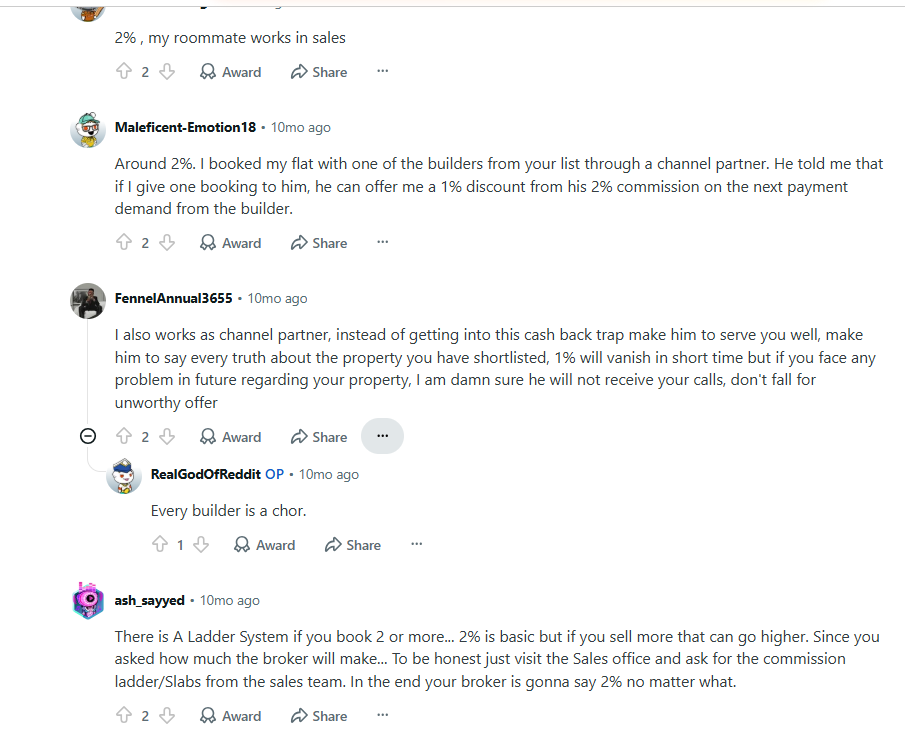
Channel partner commissions are paid by the developer, not the buyer. This is an important point that often surprises first-time buyers. There is no cost to the buyer for engaging a channel partner on a new project.
Commission rates typically range from 1% to 3% of the transaction value. This can go up to 5% depending on the developer, project type, location, and the CP’s performance history. For high-value luxury properties, commissions are often structured differently, sometimes including flat-fee components.
Beyond the base commission, many developers run incentive programmes for channel partners. These include performance bonuses, co-marketing support, early inventory access, and international trips for top performers.
The goal is to keep channel partners engaged and motivated to prioritize a developer’s projects over competitors.
5 Simple Steps to Become a Channel Partner in Real Estate
The pathway is structured but accessible. Here are a few simple steps to become a Real Estate Channel Partner;
- RERA Registration: Register as a real estate agent with the RERA authority in your state. In Maharashtra, this means MahaRERA. Each state has its own portal and requirements. Just for context, it can vary from state to state.
- Build Developer Relationships: Approach developers directly or through CP networking events. Developers prefer partners with an established buyer network and a professional track record.
- Sign a Formal Agreement: The channel partner agreement defines the inventory you are authorized to sell, the commission structure, lead registration process, and client ownership rules.
- Complete Training: Many developers run CP onboarding programmes covering project details, sales pitch, pricing, and compliance requirements.
- Activate Your Network: Begin lead generation through your contacts, digital marketing, and referrals.
Real Estate Channel Partners are an Important part of the Ecosystem
Channel partners have moved from being a peripheral sales support function to a core part of how real estate projects reach the market in India. For developers, they extend reach without adding fixed costs.
For buyers, they simplify a complex process with no added expense. Understanding who they are and what accountability they operate under makes the property buying journey considerably more transparent.
Frequently Asked Questions
Does buying through a channel partner cost more than buying directly from the developer?
No. Channel partners are part of the developer’s sales strategy, and their commission is paid by the developer from the project’s sales budget. The property price you pay as a buyer is the same whether you go through a CP or walk into the developer’s sales office directly.
In many cases, channel partners can negotiate additional benefits such as better floor selections, flexible payment plan access, or complimentary add-ons because of their relationship with the developer.
How is a channel partner different from a real estate broker?
The primary difference lies in structure and mandate. A channel partner works under a formal, RERA-compliant agreement with specific developers, selling new inventory on their behalf. A traditional broker may work independently, deal in both primary and secondary markets, and represent buyers or sellers depending on the deal.
Channel partners typically offer more structured buyer support, transparent documentation, and clearer accountability under the regulatory framework.
Is RERA registration mandatory for channel partners?
Yes. Under the Real Estate Regulation and Development Act (RERA), any person or entity acting as an intermediary in a real estate transaction must be registered with the respective state RERA authority. Operating without registration is a legal violation and can result in penalties.
Buyers should always verify a channel partner’s RERA registration number before engaging them.
How much commission do channel partners earn per sale?
Commission typically ranges from 1% to 3% of the property’s total transaction value, though it can go up to 5% depending on the project and developer. This is paid entirely by the developer.
For a property valued at Rs. 1 crore, a channel partner might earn between Rs. 1 lakh and Rs. 3 lakh per transaction. Top-performing channel partners can also earn additional incentives, bonuses, and non-monetary rewards through developer loyalty programmes.