
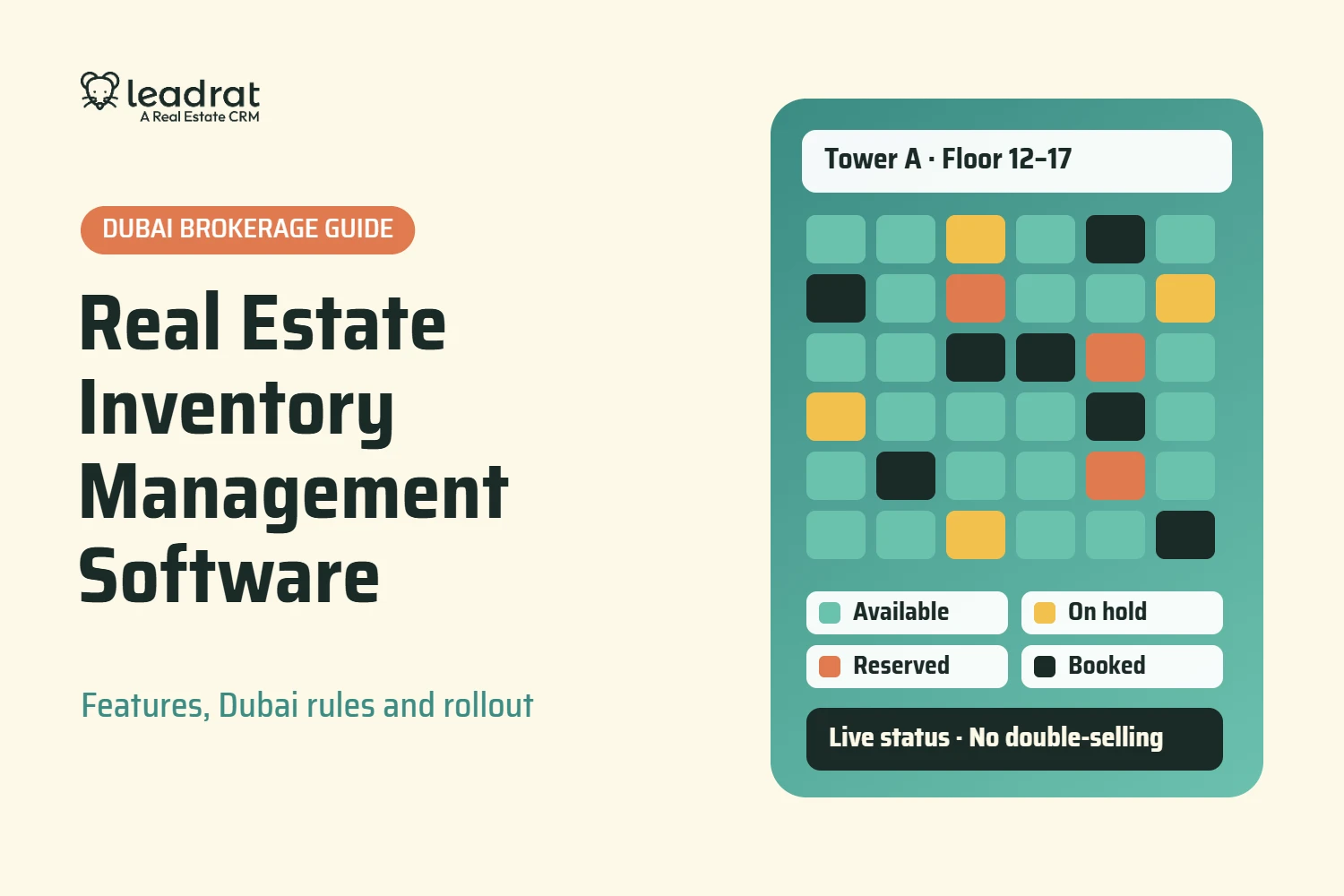
How many times has your team promised the same unit to two different buyers? If you sell off-plan in Dubai, the honest answer is probably “at least once”. One agent quotes from last week’s price list. Another has “blocked” the unit for a client in a WhatsApp group. By evening, one buyer is upset and one agent has lost a deal.
Sounds familiar?
The cause is rarely the agents. It’s the inventory record. When availability, prices and holds live in spreadsheets, PDFs and chat groups, nobody can be sure what’s actually for sale.
That’s exactly what real estate inventory management software is built to fix. Let’s look at what it does, the Dubai rules it needs to support, the features that matter and how to roll it out without disrupting your sales team.
Key Takeaways
- Inventory management software keeps one live record of every unit: status, price, payment plan, documents and the buyer attached to it.
- Developers manage project inventory. Brokerages manage listings. Both need live status, but the details they track differ.
- In Dubai, your inventory needs to support Trakheesi permits, Form A, Oqood registration and escrow-linked payment plans.
- The most valuable feature is the link between inventory and leads, so agents can match buyers to available units in seconds.
- Roll out in stages: clean the data, agree the status rules, connect the portals and then train the team.
What Is Real Estate Inventory Management Software?
Real estate inventory management software is a system that tracks every unit or listing a developer or brokerage is selling, including its availability, price, payment plan, documents and linked buyer, and updates that record in real time as units are held, booked and sold.
When it’s part of a CRM, the same system links each unit to the leads interested in it, so sales and inventory never drift apart.
How real estate inventory differs from other inventory
In general business, TechTarget defines inventory management as the part of supply chain management that “tracks and supervises noncapitalized assets” and stock on hand. Retailers count identical items on a shelf.
Real estate doesn’t work that way. Every unit is unique. Two apartments in the same tower differ in floor, view, size, orientation and price, and each one goes through its own legal steps before it changes hands. So you can’t simply count stock. You have to track each unit individually, along with its status, documents and the buyer attached to it.
Developer Inventory vs Brokerage Inventory
Let’s start with a distinction that shapes everything else. “Inventory” means slightly different things depending on who you are. The core need is the same: a single, current answer to “what can we sell right now, and at what price?”
| Developers | Brokerages | |
|---|---|---|
| What they track | Units in their own projects, often off-plan | Listings from many owners and developers |
| Main details | Unit number, floor, view, size, price, payment plan | Owner, asking price, listing permit, portal status |
| Key documents | SPA, Oqood registration, payment receipts | Form A, title deed, Trakheesi permit |
| Biggest risk | Double-selling a unit during a launch | Advertising a listing that’s sold or unpermitted |
| Who updates it | Sales admin and the sales team | Listing agents and back office |
Many Dubai brokerages do both. They hold secondary listings and also sell developer inventory as an agent. Their system has to handle both types of record side by side. Our guide to off-plan property in Dubai explains how the off-plan side works.
The Unit Lifecycle: Statuses Your Software Should Track
With that clear, let’s get to the heart of any inventory system: unit statuses. Most inventory problems come from unclear statuses. If one agent’s “on hold” means “my client is thinking about it” and another’s means “deposit received”, the record is useless. Agree the statuses first, then build the system around them.
| Status | What it means | What moves it on |
|---|---|---|
| Available | Open for sale at the current price list | An agent places a hold |
| On hold (blocked) | Reserved briefly for a specific buyer | Hold expires, or the buyer pays a booking amount |
| Reserved / EOI | Expression of interest or booking amount received | SPA is signed, or the reservation is cancelled |
| Booked | SPA signed, payment plan started | Registration with DLD |
| Registered | Off-plan sale recorded on Oqood | Handover or resale |
| Sold / handed over | Completed and transferred | Resale brings it back as a new listing |
Two rules make this work. First, every hold must have an expiry time, set by your sales policy, after which the unit returns to Available automatically. Second, only certain roles should be able to move a unit to Booked, because that step has legal and financial weight.
Dubai Rules Your Inventory System Needs to Support
Now let’s add the local layer. Dubai has a well-defined regulatory framework, and much of it touches inventory. Software that ignores it leaves your team managing compliance in spreadsheets on the side.
| Rule | What it means | What your system should store |
|---|---|---|
| Trakheesi advertising permit | Property ads in Dubai need a permit issued through the DLD’s Trakheesi system | Permit number per listing, linked to every portal ad |
| Madmoun QR code | Since 24 April 2023, approved ads carry a QR code that links to the permit card | The QR code, ready to add to brochures and ads |
| Form A | The listing agreement between the seller and the brokerage, needed before marketing a resale property | The signed Form A and its dates |
| Oqood registration | Off-plan sales are recorded on Oqood, the DLD’s off-plan register, after the SPA is signed | Registration status and reference per unit |
| Escrow and payment plans | Under Law No. 8 of 2007, off-plan buyer payments go into a project escrow account | Payment plan, instalment schedule and payments received |
The Madmoun service is worth understanding in detail. The QR code links to the listing’s permit card on the Trakheesi website, so a buyer can check that the Dubai Land Department has approved the ad. An inventory record that holds the permit and QR code for each listing makes it far easier to keep ads compliant.
On the off-plan side, Law No. 8 of 2007 governs escrow accounts for off-plan projects. Payments are tied to the project’s escrow account and construction milestones, so your system should track each buyer’s instalments against the payment plan, not just the sale price. According to Property Finder’s guide to off-plan deals, escrow funds are released to the developer only against RERA-certified construction milestones, and a retention, commonly 5%, is held for 12 months after completion. The DLD registration fee of 4% is paid at transfer. These are exactly the dates and amounts a good inventory record should hold against each unit. For the forms side of compliance, see our guide to RERA forms in Dubai.
Features That Matter in Dubai
So what should you look for when you compare tools? Here are the features that make the biggest difference for Dubai teams.
| Feature | Why it matters |
|---|---|
| Live unit status with hold expiry | Stops double-selling during busy launches |
| Project, tower and floor structure | Lets agents find units by building, floor, view and size |
| Price lists and payment plans | Agents quote the current price and plan, not last week’s PDF |
| Lead-to-unit matching | Shows which units fit a buyer, and which buyers fit a unit |
| Document storage per unit and lead | Keeps Form A, title deeds, permits and SPAs with the record |
| Permit and QR tracking | Makes sure only permitted listings are advertised |
| Portal publishing | Keeps Property Finder, Bayut and dubizzle in step with real availability |
| Map and location view | Helps buyers compare communities and locations quickly |
| Role-based permissions | Limits who can change prices or mark units as booked |
| Audit trail | Records who changed a status or price, and when |
If you can only judge one feature in a demo, judge lead-to-unit matching. Inventory software that sits apart from the CRM tells you what’s available. Software that’s linked to your leads tells you who to call about it.
Keep inventory and leads in one system. Leadrat tracks projects, units, prices and documents, and matches every unit to the right buyers. Book a free Leadrat demo.
Inventory Management Examples
Examples make this easier to picture. Let’s follow one off-plan sale from enquiry to booking, and then compare a poor and a good setup for a resale brokerage.
Example 1: From enquiry to booked unit
Here’s how a single off-plan sale moves through a connected system.
- A buyer enquires on a portal about a 2-bedroom apartment with a sea view, budget under AED 2 million, on a post-handover payment plan.
- The lead lands in the CRM and is assigned to the agent who handles that project.
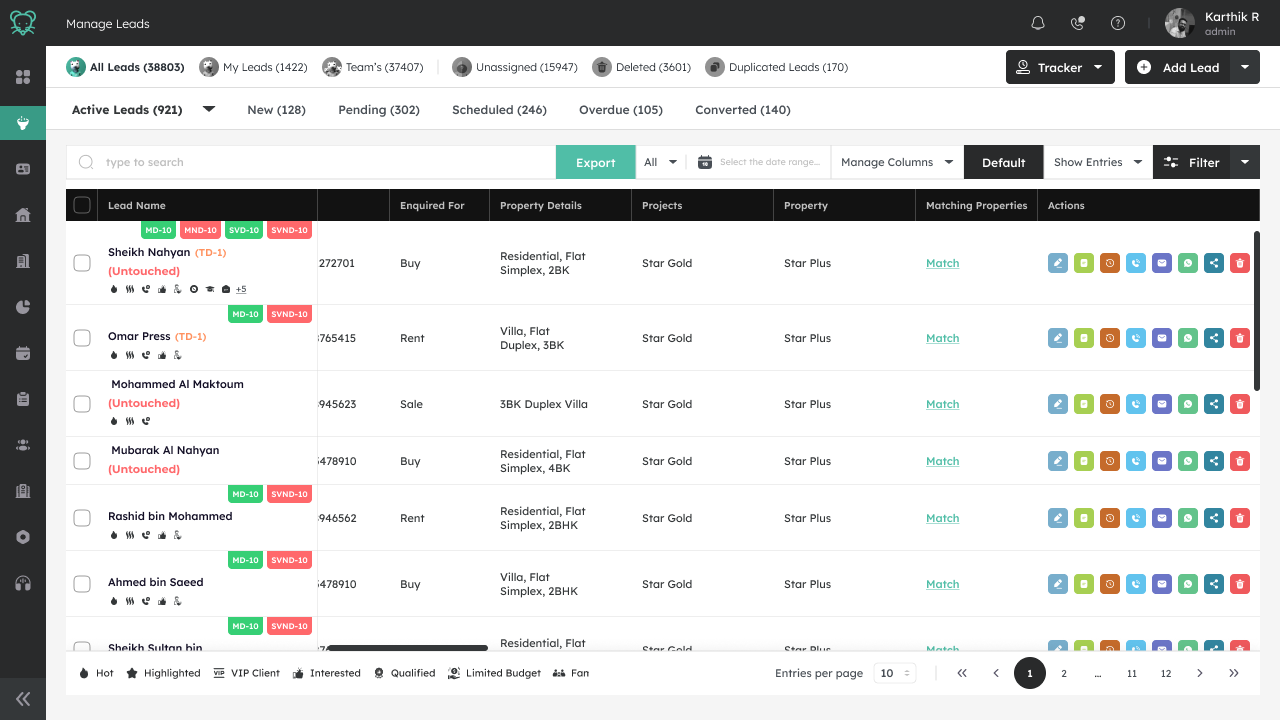
- The agent opens Matching Properties and sees the available units that fit the brief, with current prices and payment plans.
- The buyer likes two units. The agent places a hold on both. The holds expire automatically if nothing happens.
- After a site visit, the buyer chooses one unit and pays the booking amount. The unit moves to Reserved. The other hold is released.
- The SPA is signed and the unit moves to Booked. Once the sale is registered on Oqood, it moves to Registered.
- Portal listings for that unit are updated, so no other agent advertises it.
Every step is visible to the whole team. Nobody needs to ask in a WhatsApp group whether the unit is still available.
Example 2: A poor setup vs a good setup
Take a Dubai brokerage with 15 agents and around 300 active resale listings across Dubai Marina, JVC and Business Bay.
Poor setup:
- Listings are tracked in a shared spreadsheet that three people edit.
- Form A copies and permits sit in agents’ email folders.
- Portal listings are updated by hand when someone remembers.
Why it fails: sold units stay on the portals, permits expire unnoticed, and agents can’t tell which buyers suit a new listing.
Good setup:
- Every listing lives in the CRM with its owner, Form A, title deed and permit attached.
- Status changes flow to Property Finder, Bayut and dubizzle automatically.
- New listings are matched to existing buyers the moment they’re added.
Why it works: the portals always show real availability, compliance documents are one click away, and every new listing comes with a ready list of buyers to call.
How to Roll Out Inventory Management Software
Ready to move off spreadsheets? Here’s how to roll out inventory software in stages, without slowing down sales.
Clean the data first:
Pull every price list, availability sheet and listing into one file. Remove sold units and duplicates before you import anything.
Agree the statuses and hold rules:
Write down what each status means, how long a hold lasts and who can move a unit to Booked.
Set up projects and units:
Add projects, towers, floors and unit details, with price lists and payment plans.
Attach documents and permits:
Upload Form A, title deeds, permits and QR codes to the right records.
Connect the portals:
Link Property Finder, Bayut and dubizzle so listings stay in step with real availability.
Train by role:
Agents need to search, match and hold. Admins need to update prices and statuses. Managers need reports.
Retire the spreadsheets:
Once the system is live, stop updating the old files. Two sources of truth are worse than one.
For connecting the portals, our guide to Property Finder and Bayut CRM integration walks through the setup.
How Leadrat Handles Inventory
Leadrat combines inventory and lead management in one CRM, so the unit and the buyer are always linked.
- Project management: inventory, pricing, configurations, timelines and updates for each project in one place.
- Listings: secondary listings with owner details, documents and portal publishing.
- Matching Leads and Matching Properties: match buyers to units, and units to buyers, in both directions.
- Document management: store documents against each lead and property, including site visit and booking forms with photos.
- Off-plan satellite view and map view: show buyers where a project sits and what surrounds it.
- Portal integrations: Property Finder, Bayut, dubizzle and Skyloov.
- Audit trail: a tamper-proof history of every change to a lead.
Common Mistakes to Avoid
| Mistake | What happens | The fix |
|---|---|---|
| Holds with no expiry | Units stay blocked for buyers who’ve moved on | Set an automatic hold expiry |
| Price lists shared as PDFs | Agents quote outdated prices | Keep prices in the system and share from there |
| Inventory separate from the CRM | Agents can’t see which buyers fit a unit | Use software that links units and leads |
| Portals updated by hand | Sold units stay advertised | Connect portals so status changes flow through |
| Everyone can edit everything | Prices and statuses change without control | Use role-based permissions and an audit trail |
| Permits tracked in a separate sheet | Unpermitted ads slip through | Store permit numbers and QR codes on each listing |
Buyers will ask about the full purchase process once they choose a unit. Our guide to buying property in Dubai covers the steps they’ll go through.
Wrapping It Up
In a market that moves as fast as Dubai, the unit you advertised this morning may be reserved by lunch. Inventory management software keeps one live record of every unit, ties it to the right buyers and keeps your ads compliant, so your team sells what’s actually available.
Never double-sell a unit again. Leadrat keeps projects, listings and buyers in one live system, trusted by over 38,000 agents across the UAE and India. Get your free demo today.
Frequently Asked Questions (FAQs)
What is real estate inventory management software?
It’s software that tracks every unit or listing you’re selling, including status, price, payment plan, documents and linked buyer, and updates it in real time as units are held, booked and sold.
Who needs inventory management software in Dubai?
Developers selling off-plan projects, and brokerages managing secondary listings or selling developer inventory. Both need a live view of what’s available.
What is a Trakheesi permit?
It’s an advertising permit issued through the Dubai Land Department’s Trakheesi system. Property ads in Dubai need one, and approved ads carry a Madmoun QR code.
What is Oqood?
Oqood is the Dubai Land Department’s register for off-plan sales. A sale is recorded on Oqood after the SPA is signed.
How does inventory software prevent double-selling?
It keeps one live status for each unit. When an agent places a hold or a booking, the unit is no longer shown as available to anyone else.
Should inventory management be part of the CRM?
Ideally, yes. When inventory and leads sit in one system, agents can match buyers to available units instantly and every sale is tracked end to end.