
What is real estate CRM ROI, anyway?
Most brokerage owners in India can tell you what their CRM costs. Very few can tell you what it earns. That gap is where good software gets cancelled and bad habits survive.
Real estate CRM ROI is the return a brokerage or developer earns from its CRM, measured as the extra revenue and savings the CRM creates, minus everything it costs, divided by that cost.
This guide covers the formula, the metrics that move it, a worked example in rupees and, just as important, the parts of ROI that a spreadsheet won’t show you.
Key Takeaways
- CRM ROI is not the software price or the leads you capture. It’s the revenue your team wins because the CRM changed how they work.
- Measure it with a simple formula, but attribute gains conservatively and wait at least two sales cycles before you judge.
- The biggest returns are often qualitative: owning your data when agents leave, seeing leaks early and making the team less dependent on memory.
What Real Estate CRM ROI Is Not
Before getting to the formula, it helps to clear away three common mistakes. Each one makes ROI look better or worse than it really is.
It’s not cost savings alone
Yes, a CRM replaces spreadsheets, paper registers and some admin time. But a CRM that saves ₹20,000 a year in admin and misses ₹20 lakh in callbacks has a terrible return.
Savings are the smallest part of the story.
It’s not lead volume
A CRM that captures 30% more leads looks impressive on a dashboard. If none of those extra leads get a fast call, a site visit or a booking, the return is zero. More leads are an input, not a result.
It’s not the subscription price
A cheaper CRM isn’t automatically better value. The true cost includes setup, training, integrations and the hours your team spends using it. A tool nobody uses costs you the subscription and the lost deals.
So what is it? CRM ROI is the revenue your team wins, and the losses it avoids, because the CRM changed how the work gets done. Everything else is a proxy.
This means a few different things depending on where you sit:
- For an agent, it means fewer forgotten callbacks and more site visits from the same leads.
- For a sales manager, it means seeing which agent, source or stage is leaking before the month is over.
- For an owner, it means knowing which marketing rupee came back as brokerage, and which didn’t.
Why Measuring CRM ROI Is Important for Your Business
Most teams skip ROI measurement because it feels like accounting. It’s actually a management tool. Here’s why it matters, beyond the number itself.
1. It turns a software expense into a business decision
Without an ROI view, a CRM sits in the same budget line as office supplies. It gets cut when cash is tight. With one, it’s an investment you can defend, expand or replace on evidence, not on how the team feels about it this month.
2. It shows where revenue leaks, not just how much you earn
Total revenue tells you the result. ROI measurement forces you to trace that result back through the funnel: how many leads were called, how fast, how many visited, how many booked. That trace is where you find the leaks.
3. It changes how the team works
When managers review response time and site visits every week, agents start logging them properly. The act of measuring builds the discipline that produces the return.
4. It protects the marketing budget
Portal packages, Meta ads and channel partner payouts are a brokerage’s biggest variable costs. Revenue by source is the only fair way to decide which ones to renew. A CRM that tracks it pays for itself the first time you cut a channel that brings volume but no bookings.
5. It reduces your dependence on individual agents
This is the return most owners underrate. In Indian brokerages, agent turnover is a constant. When an agent leaves with a personal phone full of buyers, the business loses years of relationships. A CRM keeps every lead, call and note with the company. That’s not easy to put in a spreadsheet, but every owner who has lost a top agent knows its value.
How to Calculate Real Estate CRM ROI
The standard ROI formula, as Investopedia explains it, divides the net return of an investment by its cost. Applied to a CRM, it looks like this:
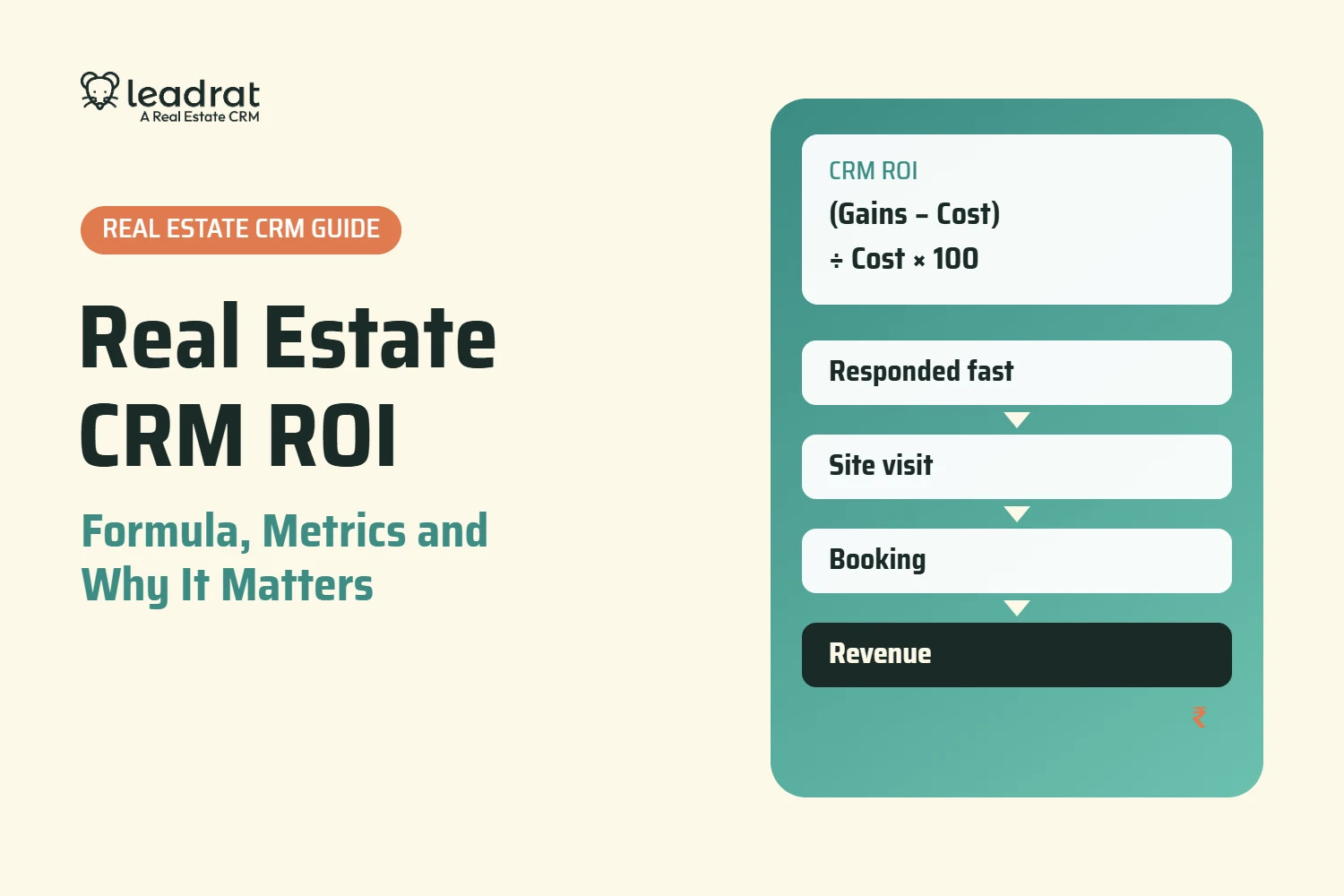
CRM ROI (%) = (Gains attributable to the CRM − Total cost of the CRM) ÷ Total cost of the CRM × 100
The formula is simple. The judgement lies in what you count on each side.
What goes into the cost
| Cost item | What to include |
|---|---|
| Subscription | Annual licence fees for all users, including GST |
| Setup and integrations | Portal, website, WhatsApp and telephony connections |
| Data migration | Cleaning and importing old leads and listings |
| Training | Trainer time and the hours agents spend learning |
| Ongoing admin | Time spent managing users, rules and reports |
What goes into the gains
| Gain | How to measure it | Hard or soft? |
|---|---|---|
| Extra bookings | Bookings after CRM minus bookings before, at the same lead volume | Hard |
| Revived leads | Deals closed from old or inactive leads re-engaged through the CRM | Hard |
| Marketing savings | Spend cut from channels that brought no bookings | Hard |
| Time saved | Admin and reporting hours no longer needed | Soft |
| Data retained | Leads kept when agents leave | Soft |
| Better decisions | Faster, evidence-based changes to process and spend | Soft |
Count only the hard gains in the formula. Report the soft gains alongside it, in plain words. That keeps the number honest and the story complete.
A Worked Example in Rupees
Here’s an illustrative example for a 12-agent brokerage. The figures are assumptions to show the method, not benchmarks.
| Item | Before CRM | After 12 months |
|---|---|---|
| Leads per month | 1,000 | 1,000 |
| Lead-to-deal conversion | 1.0% | 1.2% |
| Deals per month | 10 | 12 |
| Average brokerage per deal | ₹1,20,000 | ₹1,20,000 |
- Extra deals: 2 per month × 12 months = 24 deals.
- Extra brokerage: 24 × ₹1,20,000 = ₹28,80,000.
- Attributed to the CRM: we credit only half, ₹14,40,000, because pricing, market conditions and team changes also played a part.
- Total CRM cost for the year: ₹4,00,000, including subscription, setup, training and admin time.
- ROI: (₹14,40,000 − ₹4,00,000) ÷ ₹4,00,000 × 100 = 260%.
Notice two choices in this example. First, the lead volume stays the same, so the gain comes from conversion, not from more marketing. Second, only half the gain is credited to the CRM. Conservative attribution is what makes an ROI figure believable to a business partner or a CFO.
Now add what the formula left out: every lead and conversation from those 12 agents is still in the system, whoever stays or leaves.
See your CRM ROI on one screen. Leadrat tracks revenue by source, funnel conversion and agent performance, so you can measure return without spreadsheets. Book a free Leadrat demo.
The Response-to-Revenue Chain
When we look at where CRM returns actually come from in real estate, they follow the same chain every time. We call it the Response-to-Revenue Chain:
Lead captured → Responded fast → Qualified → Site visit → Booking → Revenue
Each link depends on the one before it. A CRM earns its return by strengthening the weakest link, and that is almost always the first two.
The research on speed is clear. The InsideSales.com and MIT study found that the odds of contacting a lead were about 100 times higher at 5 minutes than at 30. A Harvard Business Review study of 2,241 companies found that firms responding within an hour were nearly seven times as likely to qualify a lead. In other words, the cheapest place to improve ROI is the first hour after an enquiry arrives.
For a broader reference point, Nucleus Research reported in 2014 that CRM paid back an average of $8.71 for every dollar spent, up from $5.60 in 2011. Treat that as a cross-industry average, not a promise. Your return depends on how well your team uses the system, which is the whole point of measuring it.
5 Metrics That Decide CRM ROI
| Metric | What it tells you | Why it drives ROI |
|---|---|---|
| Speed to lead | Average time from enquiry to first response | The first link in the chain; slow response wastes paid leads |
| Lead-to-site-visit rate | Share of leads that visit a property | The best early signal of future bookings |
| Site-visit-to-booking rate | Share of visits that convert | Shows pitch quality and inventory fit |
| Revenue by source | Brokerage or sales value per channel | Shows which marketing spend pays back |
| Revived lead revenue | Deals from old leads re-engaged | Returns from leads you already paid for |
For a deeper look at the stage-by-stage numbers, see our guide to lead-to-booking conversion, and our explainer on the sales dashboard.
3 Reasons CRM ROI Falls Short
1. Low adoption
If agents keep working from WhatsApp and personal notebooks, the CRM sees only part of the work. It can’t improve what it can’t see. Adoption is the single biggest factor in CRM return, and it depends on the tool being simple enough to use in the field.
2. No baseline
You can’t measure improvement without a starting point. Record your conversion rates, response times and revenue by source before you go live, even roughly.
3. Measuring too early
Real estate cycles are long. A buyer who enquires in March may book in August. Judge ROI after at least two full sales cycles, not after the first month.
Where CRM ROI Measurement Is Heading
ROI used to be an annual exercise, done once to justify a renewal. That’s changing. With live dashboards, teams can now watch return build up week by week, by source, project and agent.
The next shift is attribution. Buyers touch several channels before they book, so the question is moving from “which source brought this lead?” to “which channels contributed to this booking?” Teams that track every touch will make sharper budget decisions than those that credit only the first one.
How Leadrat Helps You Measure CRM ROI
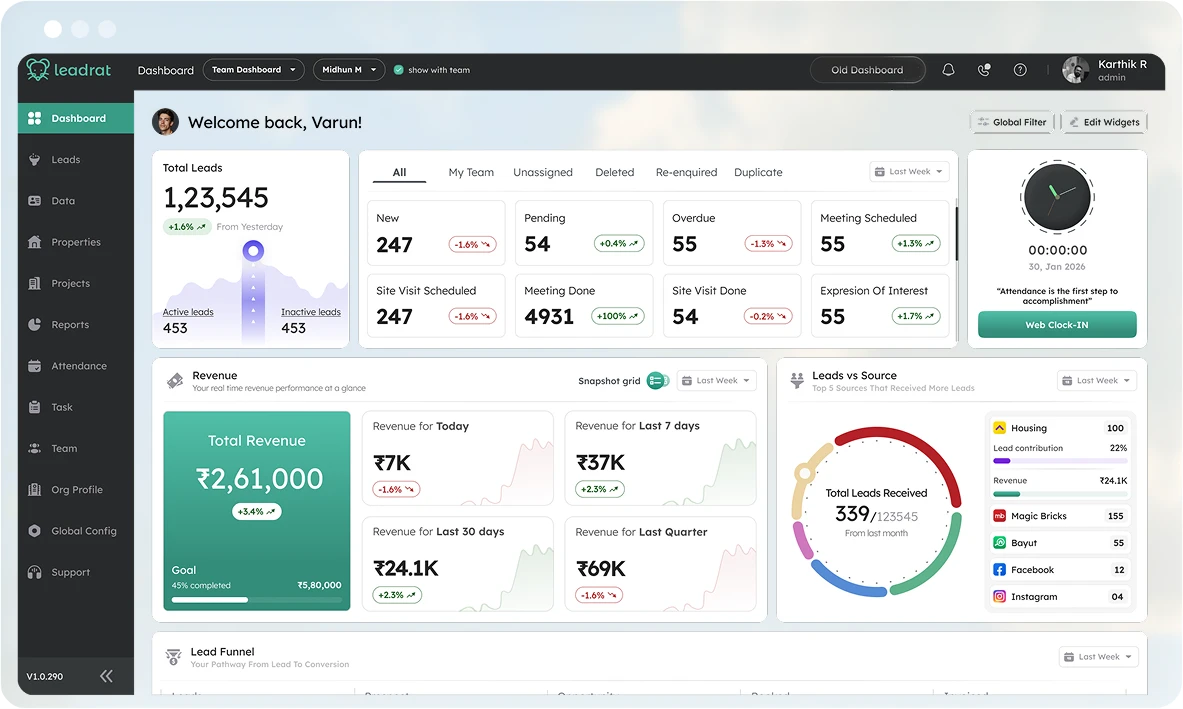
- Revenue Overview: revenue today, over 7 and 30 days and last quarter, with trend percentages.
- Leads vs Source: lead count, share and revenue for each source.
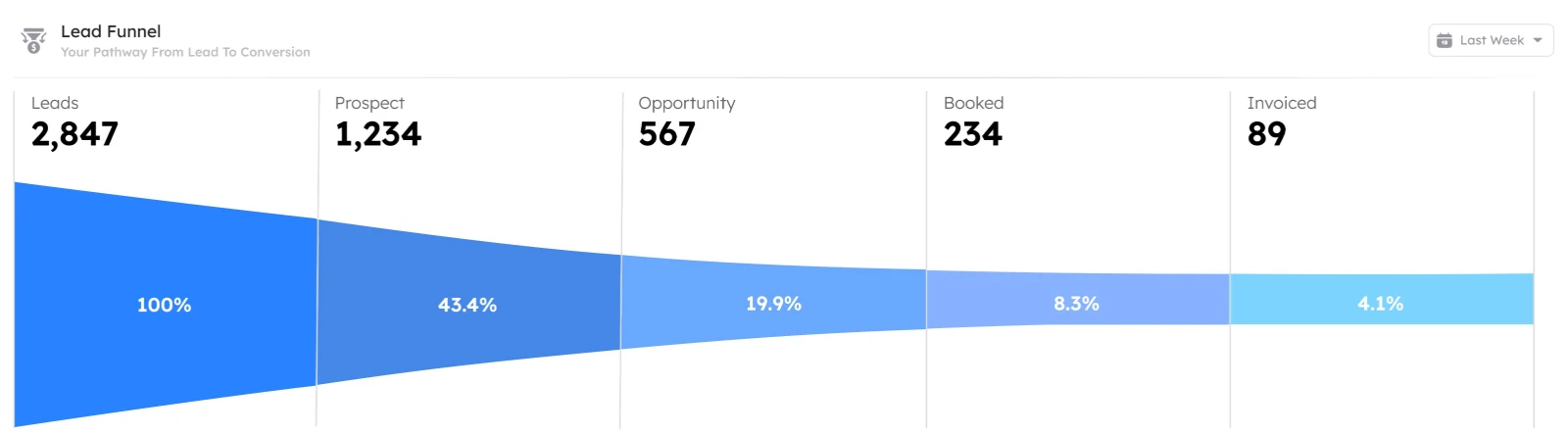
- Lead Funnel: conversion from lead to prospect, opportunity, booked and invoiced.
- Top Closers: agents ranked by brokerage earned, deal value or bookings.
- Speed to Lead and SLA Breach: response time per agent, the first link in the chain.
- Scheduled reports: ROI metrics sent by WhatsApp or email on a schedule.
Prove what your CRM is worth. Over 38,000 agents across India and the UAE use Leadrat to track every lead from enquiry to revenue. Get your free demo today.
Frequently Asked Questions
What is CRM ROI in real estate?
It’s the return a brokerage or developer earns from its CRM: the extra revenue and savings it creates, minus its total cost, divided by that cost and shown as a percentage.
How do you calculate CRM ROI?
CRM ROI (%) = (Gains attributable to the CRM − Total cost of the CRM) ÷ Total cost × 100. Count only hard gains, such as extra bookings, in the formula.
What costs should be included in CRM ROI?
Subscription fees with GST, setup and integrations, data migration, training time and ongoing admin.
How long does it take to see ROI from a real estate CRM?
Judge it after at least two full sales cycles. Early signs, such as faster response times and more site visits, appear within weeks.
What is the difference between hard and soft CRM ROI?
Hard ROI is measurable in rupees, such as extra bookings or cut marketing spend. Soft ROI covers benefits like time saved, retained data and better decisions.
Why do CRM implementations fail to deliver ROI?
Usually because of low adoption, no baseline to compare against or measuring too early in a long sales cycle.
Not everything that can be counted counts, and not everything that counts can be counted.
William Bruce Cameron, sociologist, Informal Sociology (1963)
Measure your CRM’s return in rupees. Then remember the returns that never show up in the formula.