
Real estate digital marketing in India is no longer a side activity handled by an agency once a project launches. For most builders and brokers, it is now the main source of new enquiries. Buyers look up projects on Google, compare listings on portals, watch walkthrough videos on YouTube and message sales teams on WhatsApp, often before they ever speak to anyone.
The audience is large. India had about 958 million active internet users in 2025, according to the IAMAI and Kantar Internet in India Report 2025, and more than half of them were in rural areas. That reach is both the opportunity and the problem: it is easy to spend money reaching people, and hard to know which rupees actually turned into site visits and bookings.
This playbook walks through each major channel one at a time: Google Ads, Meta ads, property portals, SEO and content, WhatsApp and video. For each one you will see what it is good for, what to watch out for and how to measure it. The last section covers the part most teams skip, which is tracking cost per lead and cost per booking in a CRM so you can move budget to the channels that sell.
If you want a deeper dive on any single channel, we link to our longer guides along the way, so this post stays focused on the full picture.
Key Takeaways
- Real estate digital marketing in India works best as a mix of channels, each with a clear job: Google for high intent, Meta for reach, portals for listings, SEO for long-term traffic, WhatsApp and video for nurturing.
- Every ad for a RERA-registered project must carry its registration number, and some states, such as Maharashtra, also require a QR code.
- Speed of response matters more than lead volume. A lead called within minutes is worth far more than one called the next day.
- Judge channels on cost per site visit and cost per booking, not just cost per lead.
- A real estate CRM that captures every source automatically is what makes that measurement possible.
What is real estate digital marketing?
Real estate digital marketing is the use of online channels such as search ads, social media ads, property portals, SEO, WhatsApp and video to attract property buyers, sellers and tenants, and to turn their enquiries into site visits and deals. It covers both generating leads and nurturing them until they are ready to buy.
How Indian Buyers Search for Property Online
Before choosing channels, it helps to understand the path a typical buyer takes. Very few people see one ad and book a flat. The journey usually looks like this:
- Discovery. The buyer starts with a broad search such as “2 BHK in Whitefield” or “new projects near Hinjewadi”, or sees a project ad on Instagram or YouTube.
- Comparison. They browse portals, check prices per square foot, read reviews of the builder and look at the location on Google Maps.
- Shortlisting. They fill a form or click a WhatsApp button on two or three projects, and often enquire about the same project through more than one channel.
- Validation. They check the RERA website, ask family, watch walkthrough videos and visit the site.
- Decision. They negotiate, compare payment plans and book.
Two things follow from this. First, the same buyer will touch several of your channels, so you need a system that recognises duplicate leads instead of counting them twice. Second, most buyers are on their phones. Landing pages, forms and brochures must load fast and read well on a small screen.
Mobile access is not limited to metros either. The same IAMAI report found that rural users now make up more than half of India’s internet population, which matters for builders selling plotted developments and projects in tier 2 and tier 3 cities.
Google Ads and Meta Ads for Real Estate Projects
Paid ads are usually the fastest way to fill the pipeline for a new launch. Google and Meta do different jobs, so most projects need both.
Google Search and Performance Max
Google Search captures people who are already looking. Someone typing “ready to move 3 BHK Gurgaon” is closer to buying than someone scrolling a feed. Start with tight keyword groups by location, configuration and project name, and send each group to a landing page that matches the search.
Performance Max campaigns can add reach across YouTube, Display, Discover and Maps. They need good conversion data to work well. Google’s own Performance Max best practices for lead generation recommend optimising towards deeper funnel goals such as a “Qualified Lead” or “Converted Lead” rather than raw form fills, and adding qualifying questions to reduce spam. In practice, that means your CRM has to tell Google which leads turned into site visits.
Meta Ads on Facebook and Instagram
Meta ads are strong for reach and for creating demand among people who are not searching yet. Instant lead forms are convenient, but they also produce more low-intent and fake leads. A few ways to improve quality:
- Add one or two qualifying questions, such as budget range or preferred configuration.
- Use the “higher intent” form type, which adds a review step before submission.
- Run click-to-WhatsApp ads, which start a conversation instead of collecting a form.
- Send lead quality data back to Meta. Meta’s Conversions API for CRM lets you share which leads moved forward in your pipeline, so the ad system can find more people like them.
Stay RERA Compliant in Every Ad
Under the RERA Act, a promoter cannot advertise or sell a project without registering it, and the project’s registration number must appear on any advertisement, as the RERA advertisement provisions under Sections 3 and 11(2) set out. Some states go further. Since 1 August 2023, MahaRERA requires a QR code next to the registration number and website address on every promotion, including social media ads. Build these into every creative template so nothing goes live without them.
For more campaign ideas across Facebook, Instagram and LinkedIn, see our Real Estate Social Media Marketing guide.
Property Portals: What to Expect from Each
Portals such as 99acres, MagicBricks, Housing.com, NoBroker and CommonFloor remain a major source of enquiries for both brokers and builders. They are where buyers go to compare options side by side, so being listed there is close to essential.
What to expect:
- Volume with competition. A portal lead has usually enquired on several listings at once. Whoever calls first has a clear advantage.
- Package based pricing. Portals sell listing packages, featured slots and project microsites. Pricing changes often and varies by city, so get current quotes from each portal and compare them on cost per site visit, not on the number of leads promised.
- Quality varies by city and segment. One portal may work well for resale in Pune and poorly for luxury launches in Mumbai. Test, measure and shift budget.
How to get more from portals:
- Keep listings fresh with real photos, accurate prices and current availability. Stale listings lose rank and trust.
- Respond inside minutes. Auto-assign portal leads to an agent and trigger an instant WhatsApp or SMS acknowledgement.
- Tag every lead with its portal and listing, so you can see which ones lead to visits.
Doing this by hand across five portals is where teams lose leads. A CRM that pulls portal leads in automatically removes that gap. [CONFIRM: list of Leadrat portal integrations, for example 99acres, MagicBricks, Housing.com]
SEO and Content for Builders and Brokers
Paid channels stop the day the budget stops. SEO keeps bringing in buyers for months and years, and the leads tend to be cheaper over time.
Local SEO and Google Business Profile
For brokers and site offices, a complete Google Business Profile is the easiest win. Add accurate address and hours, real photos of the office and projects, and ask happy customers for reviews. Many buyers search “property dealer near me” or a project name plus “site office” and call straight from the map listing.
Project and Location Pages
Create a dedicated page for each project and each micro-market you serve. A good project page covers configuration, carpet area, price range, amenities, RERA number, location advantages, a map and a clear enquiry form. Location pages such as “flats in Kharadi” can rank for high intent searches when they include useful local detail: schools, offices, metro access and price trends you can support.
Blog Content That Answers Buyer Questions
Write about the questions buyers actually ask: home loan eligibility, stamp duty in your state, what carpet area means, how to check a RERA registration, under-construction versus ready-to-move. Each article should link to relevant project pages. Our post on 11 real estate marketing ideas has more content angles you can use.
Keep the basics right: fast mobile pages, one clear topic per page, descriptive titles and internal links between related pages.
WhatsApp and Video
WhatsApp is where most real estate conversations in India actually happen. Video is where buyers build confidence before a visit. Together they do most of the nurturing work.
WhatsApp for Real Estate
Use the WhatsApp Business app for small teams, or the WhatsApp Business Platform (API) once you need shared inboxes, templates and automation. Good uses include:
- An instant reply to every new lead with the brochure, location pin and a link to book a site visit.
- Site visit reminders the day before and on the morning of the visit.
- Updates on construction progress, new offers or price changes, sent only to people who opted in.
- Click-to-WhatsApp ads that start a chat directly from Facebook or Instagram.
Keep it personal and permission based. Mass unsolicited broadcasts lead to blocks and reports, which can restrict your number.
YouTube, Reels and Virtual Tours
Short videos work well for first impressions: a 30 second drone shot, a sample flat walkthrough or a quick location tour. Longer YouTube videos help buyers who are close to a decision, such as a full walkthrough, a builder interview or a construction update. Short-form video has a huge audience in India. The IAMAI Internet in India Report 2025 found that about 588 million people watch short videos, which is roughly 61 percent of internet users.
Add a clear call to action on every video: a WhatsApp link, a site visit booking link or a phone number tracked to that channel.
Tracking Cost per Lead and Cost per Booking in a CRM
This is where real estate digital marketing either pays off or quietly wastes money. Most teams know their cost per lead from the ad dashboards. Far fewer know their cost per site visit or cost per booking by channel, and those are the numbers that matter.
The Metrics to Track
- Cost per lead (CPL): spend divided by leads, by channel and campaign.
- Lead to site visit rate: the share of leads that actually visit.
- Cost per site visit: spend divided by completed site visits.
- Site visit to booking rate: how well your sales team converts.
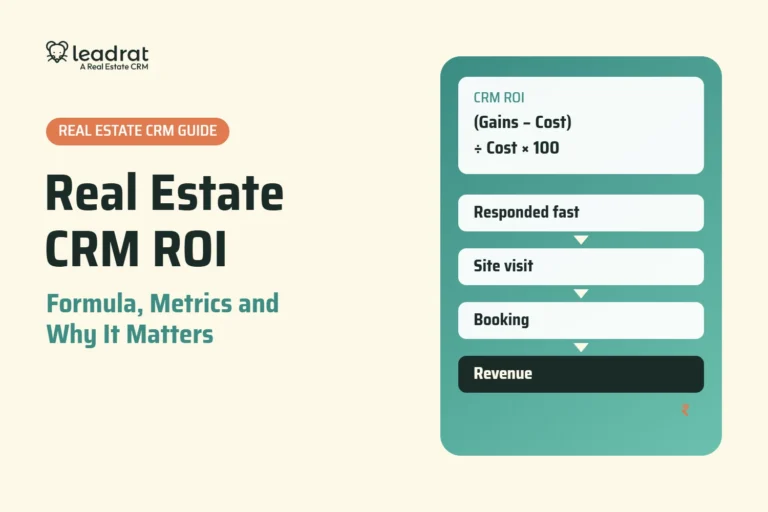
- Cost per booking: spend divided by bookings. This is the number to compare channels on.
- Response time: the time from enquiry to first call. Slow response quietly raises every other cost.
A channel with a higher CPL can still be the cheapest per booking if its leads are serious. The only way to see that is to follow each lead from source to sale.
How a CRM Makes This Possible
A real estate CRM does three things here:
- Captures every lead with its source. Portal, website form, Google, Meta, WhatsApp, walk-in and channel partner leads all land in one place, tagged automatically.
- Tracks the journey. Calls, follow ups, site visits and bookings are logged against the same lead, so you can see what happened after the enquiry.
- Feeds data back. Qualified lead and booking data can be sent back to Google and Meta so their algorithms optimise for buyers, not just form fills.
Review the numbers every week. Shift budget away from channels that bring cheap leads but few visits, and towards the ones that produce bookings. For more channels to test, see our guide to 36 proven ways to get real estate leads in India.
Why Leadrat for Real Estate Digital Marketing
Leadrat is a real estate CRM built for builders, developers and brokers in India and the UAE. It is designed to close the gap between your marketing spend and your sales results.
- Automatic lead capture from portals, your website, social media ads and other sources, with the source tagged on every lead. [CONFIRM: full list of Leadrat lead source integrations]
- Instant lead assignment to the right agent by project, location or round robin, so no enquiry waits.
- WhatsApp, call and SMS follow ups logged against each lead. [CONFIRM: Leadrat WhatsApp Business API integration details]
- Site visit scheduling and tracking, so you know which leads actually visited.
- Source wise reports that show leads, visits and bookings by channel and campaign.
- Mobile app so field agents can update leads from site.
Pricing starts at [CONFIRM: Leadrat starting price]. You can book a free demo to see how it tracks your marketing from enquiry to booking.
Conclusion
Real estate digital marketing in India works when each channel has a clear job and every lead is followed from first click to booking. Use Google for buyers who are already searching, Meta and video to build demand, portals to stay visible where buyers compare, SEO for long-term traffic and WhatsApp to keep conversations moving.
Then measure what matters. Cost per lead is a starting point, but cost per site visit and cost per booking tell you where your money really works. With every lead and its source in one CRM, you can stop guessing and put your budget behind the channels that sell.
Frequently Asked Questions
What is the best digital marketing channel for real estate in India?
There is no single best channel. Google Search usually brings the highest intent leads, Meta ads offer wide reach at a lower cost per lead, and portals are where buyers compare options. Most builders and brokers get the best results from a mix, judged by cost per booking rather than cost per lead.
How much should a real estate project spend on digital marketing?
Budgets vary widely by city, project size and price point, so there is no fixed figure. Start with a test budget across two or three channels, track cost per site visit and cost per booking in your CRM, and then scale the channels that produce bookings at an acceptable cost.
Do real estate ads in India need a RERA number?
Yes. Under the RERA Act, a registered project’s registration number must appear on its advertisements, and projects cannot be advertised before registration. Some states add more rules. For example, MahaRERA requires a QR code alongside the registration number on promotions.
How can I improve the quality of Facebook leads for real estate?
Add qualifying questions to your lead forms, use the higher intent form type, try click-to-WhatsApp ads, and call leads within minutes. Sending qualified lead data back to Meta through its Conversions API for CRM also helps the platform find better prospects over time.
Why do I need a CRM for real estate digital marketing?
Without a CRM, leads from portals, ads, WhatsApp and your website end up scattered across inboxes and spreadsheets, and you cannot see which channel produces site visits and bookings. A real estate CRM captures every lead with its source, tracks follow ups and visits, and shows true cost per booking by channel.