
Most property enquiries do not turn into site visits on the first call. A buyer fills a form on a portal, answers your telecaller once, says “send me details on WhatsApp”, and then goes quiet. A few weeks later the same buyer books a flat, often with someone who simply kept in touch.
That gap between the first enquiry and the first site visit is where lead nurturing does its work. Lead nurturing in real estate means staying useful to a buyer through calls, WhatsApp messages and emails until they are ready to visit, instead of calling five times in two days and then giving up.
Buyers do take time. ANAROCK data reported by Outlook Money put the average lead-to-buy lag at 26 days in H1 FY2025, the time from a buyer’s first enquiry to paying a booking amount. That is roughly a month in which you either stay in the conversation or lose it.
This guide shows you how to build a lead nurturing plan by buyer stage, with a sample 30-day sequence, message ideas that actually move buyers, and the numbers to track so you know it is working.
Key Takeaways
- Lead nurturing keeps you in touch with buyers who are interested but not ready, so they choose you when they are.
- Segment every lead by stage (new, exploring, comparing, ready to visit) and by intent (budget, location, timeline) before you plan messages.
- A simple 30-day sequence mixing calls, WhatsApp and email beats random follow-ups. Each touch should give the buyer something useful.
- Project updates, price changes, offers and site visit invites are the messages that move buyers forward.
- Automate the reminders and routine messages, but keep the important conversations personal.
- Measure replies, site visits and bookings, not just messages sent.
What is lead nurturing?
Lead nurturing is the process of building a relationship with a potential buyer who is not yet ready to purchase, by sending relevant information at the right time until they are ready to take the next step. In real estate, that next step is usually a site visit, and the main nurturing channels are phone calls, WhatsApp and email.
What Lead Nurturing Means in Real Estate
Lead nurturing in real estate is different from nurturing in most other businesses. The ticket size is large, the buyer usually involves family members in the decision, and the product (a home or an investment) is something most people buy only a few times in their life.
That changes how follow-up should work. A buyer comparing three projects in Whitefield does not need a “Hi, any update?” message every day. They need answers: Is the possession date on track? What is the final price including charges? Is there a 3 BHK on a higher floor? When can I see the sample flat?
Good nurturing answers those questions early. It has three parts:
- The right segment. You know where each lead is in their journey and what they care about.
- The right message. Each touch gives the buyer something useful, not just a reminder that you exist.
- The right timing. Touches are spaced so you stay top of mind without becoming noise.
It is also different from lead qualification. Qualification tells you whether a lead is worth pursuing and how soon. Nurturing is what you do with the qualified leads that are not ready yet. If you have not set up a clear qualification process, start with our guide to lead qualification and then come back to this plan.
Why cold enquiries go cold
Most enquiries do not go cold because the buyer lost interest. They go cold because of what happens on the seller’s side:
- Slow first response. Research published in Harvard Business Review found that most companies do not respond to online leads nearly fast enough. A buyer who waits a day often speaks to another agent first. Our post on speed to lead covers this in detail.
- No second, third or fourth touch. Many teams make one or two calls, mark the lead “not reachable” and move on.
- Leads stuck on personal phones. When follow-ups live in an agent’s WhatsApp, nobody else can see them, and they disappear when the agent leaves.
Segmenting Leads by Stage and Intent
You cannot nurture well if every lead sits in one long list. Before you write a single message, sort leads into groups that need different treatment.
Segment by buyer stage
A simple four-stage model works for most brokerages and developer sales teams:
- New: The enquiry has just come in. The goal is a fast first conversation to understand the requirement.
- Exploring: The buyer is interested in the area or the type of property, but has not shortlisted. They need options and information.
- Comparing: The buyer has a shortlist of two or three projects or properties. They need specifics: price breakdowns, floor plans, possession timelines, payment plans.
- Ready to visit: The buyer wants to see the property. The goal is to fix a date and time, confirm it, and make the visit easy.
Leads that say “not now, maybe in six months” form a fifth group: long-term nurture. They get fewer touches, spread further apart.
Segment by intent
Within each stage, tag leads by what they care about. Knight Frank’s Beyond Bricks 2025 survey of 1,629 homebuyers across eight Indian cities found location was the top factor in purchase decisions (50%), followed by size or layout (45%), price or affordability (45%) and builder reputation (43%). Those are good starting tags:
- Budget band, for example under ₹75 lakh, ₹75 lakh to ₹1.5 crore, above ₹1.5 crore.
- Preferred location or micro-market.
- Configuration, such as 2 BHK, 3 BHK or plot.
- Purpose: end use or investment. The survey found 25% of buyers were buying for investment, and they respond to different messages (rental yield, appreciation) than end users (schools, commute, amenities).
- Timeline: within a month, within three months, later.
With these tags in your CRM, you can send a price-drop alert only to buyers in that budget band, or a new launch invite only to buyers looking in that location.
A Sample 30-Day Lead Nurturing Sequence
Here is a sample sequence for a lead in the exploring or comparing stage. Adjust the timing and channels to your market, but keep the idea: every touch carries something useful, and the channel changes so the buyer does not feel chased.
| Day | Channel | Message |
|---|---|---|
| Day 0 | Call + WhatsApp | Call within minutes of the enquiry. After the call, send a short WhatsApp message with your name, the project they asked about and one useful item (brochure, location pin or price sheet). |
| Day 1 | Share two or three options that match their budget and location, with one line on why each fits. | |
| Day 3 | Call | A short check-in: “Did you get a chance to look at the options? Which one should I tell you more about?” Note their answers in the CRM. |
| Day 5 | A fuller comparison: floor plans, price breakdown including charges, possession dates, RERA registration numbers. | |
| Day 7 | A walkthrough video or photos of the sample flat, with a simple question: “Would this weekend work for a visit?” | |
| Day 10 | Call | Answer open questions on loans, payment plans or legal documents. Offer to arrange a home loan discussion if needed. |
| Day 14 | A project update: construction progress photos, a new tower opening, or limited inventory in their configuration. | |
| Day 18 | Area guide: schools, hospitals, metro or road connectivity, upcoming infrastructure. | |
| Day 21 | A time-bound reason to act: weekend site visit with cab pick-up, an ongoing offer, or a price revision date. | |
| Day 25 | Call | A direct ask: “Shall I block Saturday 11 am for the site visit?” If not ready, ask what is holding them back. |
| Day 30 | WhatsApp or email | If there is still no response, a polite check: “Are you still looking, or should I pause updates?” Move non-responders to long-term nurture. |
A few rules make this sequence work:
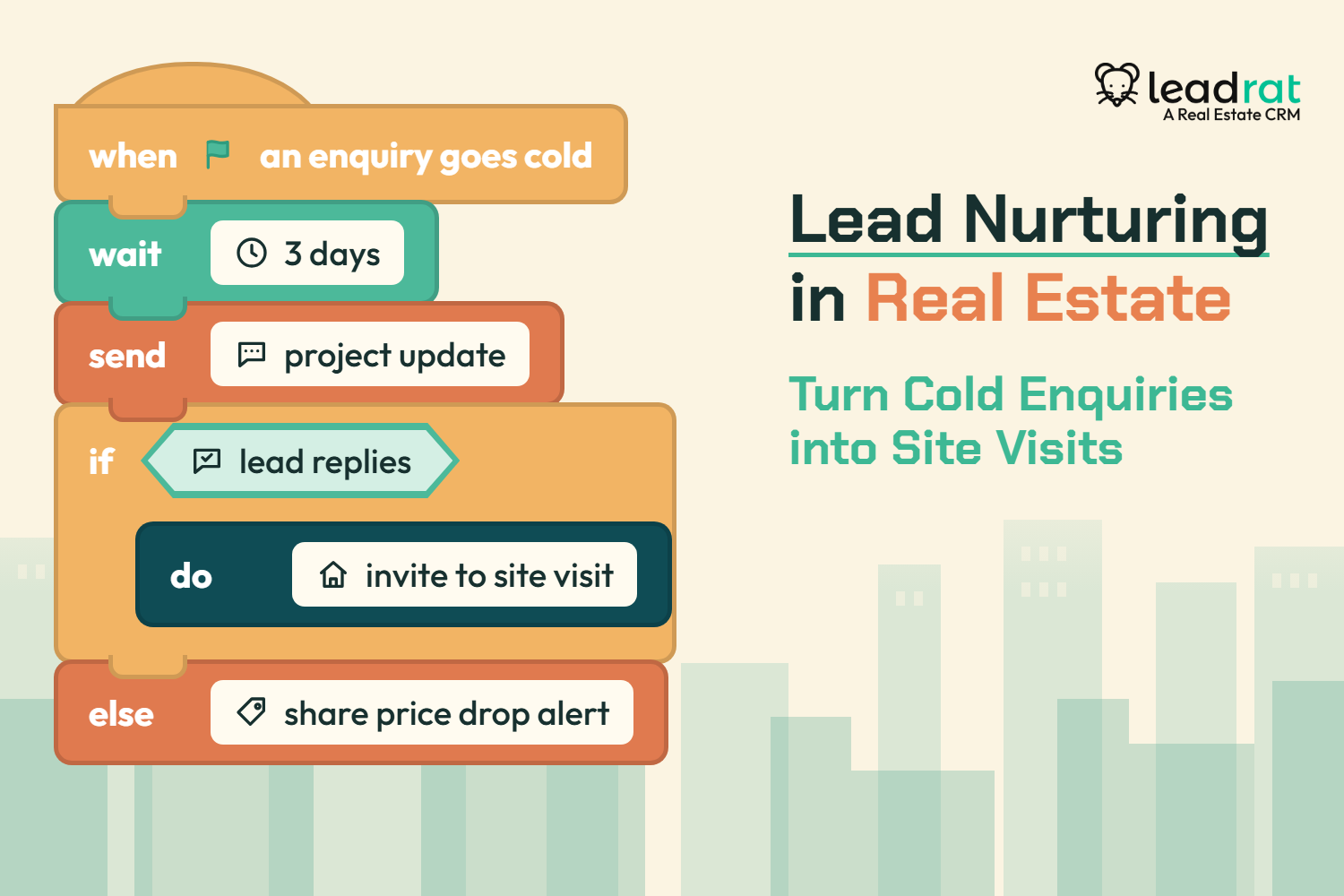
- Stop the sequence when the buyer responds. A reply means a real conversation, so switch from the plan to a personal follow-up.
- Log every touch. If a different agent picks up the lead, they should see exactly what was sent and said.
- Use your best call openers. Our 16 real estate telecalling scripts include follow-up and site visit scripts you can drop straight into the call steps.
Long-term nurture for “not now” leads
Buyers who say they will decide in six months still matter. Put them on a lighter plan: one useful message every two to three weeks, such as a new launch in their location or a price update, and a reminder to call near the date they mentioned.
Content That Moves Buyers Forward
The biggest difference between nurturing and nagging is content. Here are the message types that give buyers a reason to reply.
Project updates
Construction progress photos, a new tower launch, an approved occupancy certificate or a possession date confirmation. For under-construction projects, regular updates build trust, especially for buyers worried about delays.
Price changes and offers
A price revision date, a festive offer, a flexible payment plan or waived charges. These create a genuine reason to act now. Only share offers that are real and current, and state the end date clearly.
Inventory alerts
“Only four 3 BHK units left on floors 10 and above” or “a corner unit just opened up”. Specific, honest inventory news works far better than vague urgency.
Site visit invites
Make the visit easy. Offer two time slots, share the location pin, mention parking or cab pick-up, and say who will meet them. Send a confirmation the day before and a reminder two hours before the visit.
Helpful information
Home loan basics, booking documents, how to check a project’s RERA registration, or expected stamp duty and registration charges. This positions your team as advisors, not just sellers.
Automating Lead Nurturing Without Sounding Robotic
Automation is what makes a 30-day sequence possible across hundreds of leads. Without it, telecallers forget follow-ups and leads slip. The risk is that automated messages feel cold. Here is how to get the benefit without the robot tone.
Automate the timing, personalise the content
Let your CRM create follow-up tasks and reminders on schedule. Use the buyer’s name, the project they asked about, their configuration and their budget in every template. A message that says “Hi Priya, the 3 BHK at Green Meadows you asked about now has a Saturday slot for a site visit” does not feel automated, even if it was triggered by a rule.
Keep the important touches human
Automate the information touches: confirmations, reminders, brochures and project updates. Keep the decision touches, such as calls, price negotiations and objection handling, personal.
Follow WhatsApp’s rules
WhatsApp is the most effective nurture channel for many Indian teams, which is why we wrote a full guide to WhatsApp CRM for real estate. If you send messages through the WhatsApp Business Platform, know the basics:
- Meta’s opt-in guidelines say businesses need a person’s opt-in before messaging them, and the opt-in must clearly name your business.
- When a buyer messages you, a 24-hour customer service window opens, during which you can send free-form replies. Outside that window, you can only send pre-approved template messages.
In practice, this means your nurture sequence needs a set of approved templates (project update, site visit invite, price alert) for the days when the buyer has not messaged you recently.
Respect consent and preferences
Nurturing only works if buyers trust you. In India, TRAI’s Telecom Commercial Communications Customer Preference Regulations govern promotional calls and SMS and allow businesses to reach customers who have opted in or set preferences that allow such messages. The Digital Personal Data Protection Act, 2023 also requires consent to be free, specific and informed, and says people must be able to withdraw consent as easily as they gave it. Record consent in your CRM, honour “stop” requests at once, and take legal advice for your specific setup.
Measuring Lead Nurturing: Replies, Site Visits and Bookings
A nurture programme that is not measured slowly turns into a message blast. Track a small set of numbers every week.
The metrics that matter
- Reply rate: The share of nurtured leads that respond to at least one message. This tells you if your content is relevant.
- Site visits scheduled and completed: The main goal of nurturing. Track both, since a scheduled visit that does not happen is a signal to tighten reminders.
- Time from enquiry to site visit: If this is getting shorter, your nurturing is working.
- Bookings from nurtured leads: Leads that booked after at least one nurture touch, compared with leads that booked on first contact.
- Opt-out rate: If many buyers ask you to stop, you are sending too often or the messages are not useful.
Review and improve monthly
Once a month, check which messages get the most replies and which segments convert best. Replace weak messages, adjust timing, and share winning scripts with the whole team.
Why Leadrat
Leadrat is a real estate CRM built for brokers, channel partners and developers in India and the UAE. It brings the pieces of a nurture plan into one place, so follow-ups stop depending on memory and personal phones.
- Every lead in one place. Leads from your website, Facebook, Google Ads and portals such as MagicBricks, 99acres and Housing.com flow into one system, each with its source.
- Instant ownership. Manual and automatic lead assignment gives every new enquiry an owner straight away, which keeps your first response fast.
- WhatsApp built in. Leadrat is a WhatsApp-first CRM, with auto-replies so no buyer waits in silence and conversation history saved against the lead rather than on a personal phone. [CONFIRM: scheduled WhatsApp template sequences or drip campaigns are supported, and how they are set up]
- Follow-up tasks and reminders. Tasks with deadlines and priorities, so every step of your 30-day sequence lands on the right agent’s list on the right day.
- Site visit tracking. Record site visits against each lead, property and project, so you can see who visited and who still needs an invite.
- Reports that show what works. Track leads generated, leads converted and site visits by source and by agent, so your monthly nurture review runs on real data.
Want to see how a nurture sequence would look for your projects? Book a free demo and a Leadrat expert will walk you through lead stages, WhatsApp follow-ups and site visit tracking for your team.
Conclusion
Most of your future bookings are sitting in your lead list today as “follow up later”. Lead nurturing is how you turn them into site visits. Segment leads by stage and intent, run a simple sequence that mixes calls, WhatsApp and email, send messages that give buyers something useful, and measure replies, site visits and bookings every week.
You do not need a large marketing team for this, just a clear plan and a CRM that reminds your team what to do next. Start with one project and one segment this month, review the results, and expand from there.
Frequently Asked Questions
What is lead nurturing in real estate?
Lead nurturing in real estate is the process of staying in touch with property buyers who have enquired but are not ready to buy yet. It uses calls, WhatsApp messages and emails to share useful information, such as project updates, price changes and site visit invites, until the buyer is ready to visit and book.
How long should a real estate lead nurturing sequence run?
A focused sequence of about 30 days works well for active buyers, since many decide within a few weeks of their first enquiry. Buyers who say they will decide later can move to a lighter long-term plan with one useful message every two to three weeks.
Which channel works best for nurturing property leads in India?
WhatsApp is often the most responsive channel for Indian buyers, but the best results come from mixing channels. Use calls for conversations and decisions, WhatsApp for quick updates and site visit invites, and email for detailed comparisons and documents.
How often should I follow up with a real estate lead?
In the first week, two to four touches across different channels is reasonable for an active buyer. After that, space touches every three to five days. Stop the planned sequence as soon as the buyer replies and switch to a personal conversation.
How do I measure whether lead nurturing is working?
Track reply rate, site visits scheduled and completed, time from enquiry to site visit, bookings from nurtured leads and opt-out rate. Review these monthly, keep the messages that get replies and replace the ones that do not.