A pipeline full of leads can look impressive right up until you realize half of them aren’t moving.
Your CRM might show hundreds of enquiries, follow-ups, and opportunities. But how many are actually progressing? Which ones need attention today? Which ones have gone cold? And which ones are most likely to move closer to a sale?
That’s where sales pipeline management makes a difference.
A sales pipeline gives your team a clear view of every opportunity from the moment a prospect enters your business to the moment they become a customer. More importantly, it helps your team understand what has happened, where an opportunity stands, and what needs to happen next.
Here’s a practical guide to understanding how a sales pipeline works.
What Is a Sales Pipeline?
A sales pipeline is a visual representation of the different stages a prospect moves through before becoming a customer.
Instead of keeping track of leads through memory, spreadsheets, WhatsApp messages, emails, and scattered notes, the pipeline puts opportunities into a structured journey.
For example:
New Lead → Qualified → Meeting → Proposal → Negotiation → Closed → Won
Each opportunity sits at a particular stage based on its actual progress.
A new enquiry might still need qualification. Another prospect may have already attended a meeting. Someone else may be reviewing a proposal.
The pipeline brings all of this into one view, so salespeople can quickly understand what needs attention and what can wait.
What Is Sales Pipeline Management?

Having a pipeline is one thing. Keeping it useful is another.
Sales pipeline management is the process of tracking, updating, prioritizing, and moving leads and opportunities through the sales journey.
It helps sales teams answer practical questions:
- Which opportunities are active?
- Which deals are stuck?
- What happened during the last interaction?
- What does the buyer need next?
- Who owns the opportunity?
- When is the next follow-up?
- Which opportunities should no longer be in the active pipeline?
The goal isn’t to keep the pipeline full.
The goal is to keep it real.
A pipeline with 100 opportunities means very little if 60 of them haven’t moved in weeks.
The 7 Stages of a Sales Pipeline
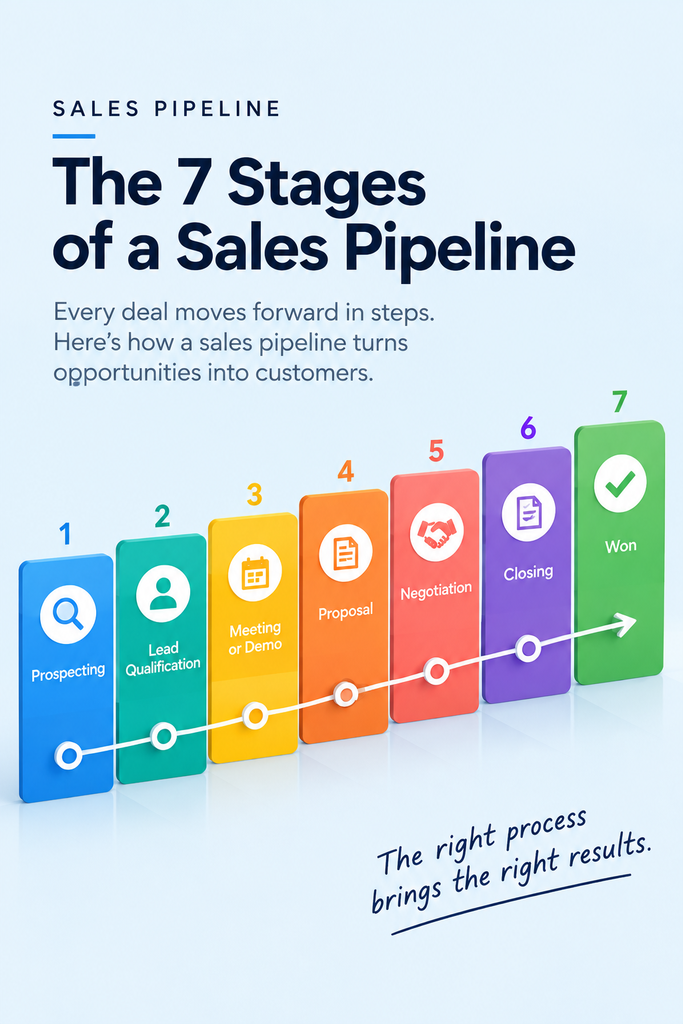
Not every business follows the exact same sales process. The stages should reflect how your customers actually make buying decisions.
Let’s break it down step by step.
1. Prospecting
Every sale starts with an opportunity. Prospecting is the process of finding potential customers through channels such as referrals, website enquiries, campaigns, social media, outbound calls, emails, events, or property portals.
More leads don’t automatically mean more sales. The goal is to bring relevant opportunities into the pipeline rather than simply collecting names and numbers.
2. Lead Qualification
Not every enquiry is ready to buy and that’s completely normal. Lead qualification helps salespeople understand whether the prospect has a genuine requirement, whether the offering fits their needs, and whether there is a realistic possibility of moving forward.
In real estate, this could mean understanding:
- Preferred location
- Property type
- Budget
- Buying timeline
- Specific requirements
The objective isn’t to remove leads as quickly as possible. It’s to understand where your time is most valuable.
3. Meeting Or Demo
Once a prospect is qualified, it’s time to have a deeper conversation. Depending on the business, this could be a sales call, product demo, consultation, meeting, or property site visit.
This is where the salesperson moves beyond basic qualification and starts understanding the customer’s actual needs. It’s about answering questions, addressing concerns, understanding expectations, and agreeing on what happens next.
4. Proposal
Once there is a clear opportunity, the next step is to present the solution. A proposal should do more than list features and prices. It should make the customer think, “This actually fits what I need.”
The clearer the connection between the customer’s needs and the proposed solution, the easier it becomes to move the conversation forward.
5. Negotiation
A proposal doesn’t always lead straight to a yes. Customers may have questions about pricing, timelines, payment terms, scope, or other conditions.
Negotiation isn’t simply about getting the customer to agree.
It’s about understanding their concerns, discussing possible changes, and finding terms that work for both sides.
6. Closing
This is the moment the pipeline has been building toward.
Once both sides agree on the terms, the necessary agreements, approvals, contracts, or payments can be completed.
The opportunity moves from:
7. Post-Purchase
A signed agreement isn’t necessarily the finish line; it’s the beginning of the customer relationship. The post-purchase stage can include onboarding, support, follow-ups, fulfilment, and understanding whether the customer needs anything else.
A good sales process doesn’t just focus on getting the deal. It also focuses on what happens after the deal.
How to Build a Sales Pipeline
Building a sales pipeline isn’t about filling it with as many leads as possible. It’s about keeping a steady flow of opportunities moving through the sales process. A common theme in the experiences shared by salespeople is consistency. One Reddit user describes the pipeline as needing a balance between short-term opportunities that can close soon and larger, long-term opportunities that may take more time.
Keep Prospecting Consistently
A pipeline can dry up quickly when new prospects stop coming in. One salesperson shared a simple approach: making prospecting a daily habit, including setting aside time for cold calling to keep the top of the pipeline active. The idea is simple: don’t wait until your pipeline is empty to start looking for new opportunities. Keep adding potential customers while you’re already working on existing deals.
Keep Track of Every Opportunity
Once prospects enter your pipeline, you need to know where they are and what is happening with them. Use a CRM to track where prospects are in the sales process. This gives salespeople a clearer view of their opportunities instead of trying to remember every conversation and follow-up.
It also helps you see which opportunities are progressing and which ones may need more attention.
Follow Up and Keep the Conversation Going
Getting a prospect into your pipeline doesn’t mean they are automatically going to become a customer. Follow-ups can make a bigger difference than expected. One salesperson shared that some of their deals closed only after the fifth or sixth follow-up and stopping after just a couple of attempts could have meant losing those opportunities.
That doesn’t mean following up endlessly with every prospect. It means understanding that some opportunities take time and that a conversation shouldn’t necessarily be considered lost just because it didn’t close immediately.
CRM sales pipeline management
A CRM is supposed to make sales easier, not give your sales team another task to worry about. But when the system is complicated, requires too much data entry, or doesn’t match the way the team actually works, people stop using it properly.
The best CRM is not necessarily the one with the most features. It is the one salespeople can use without slowing down their day.
Make Every Pipeline Stage Clear
A pipeline only works when everyone understands what each stage means. A stage like “Contacted” can mean different things to different salespeople. For one person, it might mean they sent an email. For another, it might mean they spoke to the prospect.
Clear stage definitions remove this confusion. Each stage should represent a real step in the sales process, so the team knows when an opportunity should move forward and when it still needs attention.
Pay Attention to Stalled Opportunities
A deal sitting in the pipeline doesn’t always mean it is progressing. An opportunity that has been sitting in the same stage for two days is very different from one that has been sitting there for two weeks. Looking at time in stage and the last interaction can help sales teams identify opportunities that may have stopped moving.
This is important because a pipeline can look full on paper while still having very little real movement.
Losing a deal doesn’t mean the opportunity has no value left.
When a CRM records why an opportunity was lost, the sales team can start identifying patterns. Maybe prospects are repeatedly dropping out because of pricing, timing, competition, or another common reason.
Over time, these details can help the team understand where the sales process needs improvement.
Choose a CRM Your Team Will Actually Use
A CRM can have every feature imaginable, but it won’t help much if the sales team doesn’t use it consistently. Choose a system that fits the team’s actual workflow rather than forcing the team to change everything just to fit the software.
The same applies when introducing a new CRM. Getting leadership involved, having respected team members use the system first, and testing the process with a real deal can make adoption easier.
Also learn: Top real estate CRM of India
Accelerate Your Sales Pipeline with Leadrat
Move leads faster from enquiry to site visit to booking with one real-estate CRM built to keep your pipeline moving.
From a real estate perspective, sales pipeline management is about handling everyday challenges such as managing leads, keeping up with follow-ups, tracking conversations, and knowing which opportunities are moving forward. Leadrat brings these activities together in one real estate-focused CRM, helping teams manage their pipeline from the first enquiry to the final sale.
Also learn: How CRM software optimize overall sales process
Sales Pipeline Strategy
Managing a sales pipeline is more than moving deals from one column to another. A pipeline only becomes useful when it reflects what is actually happening with the buyer.
Based on the sales discussions and practical experiences shared in the Reddit communities you provided, a few strategies stand out.
1. Define Clear and Simple Pipeline Stages
A pipeline becomes difficult to manage when there are too many stages or when each salesperson interprets them differently. The important part is deciding what actually qualifies an opportunity to move from one stage to another. A deal should move because the buyer has taken meaningful action, not simply because the salesperson feels that the deal is progressing.
2. Always Have a Clear Next Step
One of the easiest ways for a promising opportunity to lose momentum is to end a conversation without deciding what happens next.
After a call, meeting, demo, or proposal, there should be a clear next action. This makes the pipeline more realistic because it records an actual buyer-side action rather than just another task for the salesperson.
3. Don’t Let Ghosted Deals Sit in the Pipeline Forever
Every salesperson has deals that suddenly go quiet. The problem isn’t that prospects go silent. The problem is allowing those opportunities to remain in active pipeline stages indefinitely. A deal that has had no movement for weeks can make your pipeline look full while giving the sales team very little real opportunity to work with.
4. Automate Follow-Ups and Reminders
Not every opportunity needs a salesperson to manually remember the next follow-up. Some prospects need time. They may be comparing options, waiting for approval, discussing the purchase internally, or simply not be ready yet.
This is especially useful when salespeople are handling dozens or hundreds of conversations at once. Automation shouldn’t replace the salesperson’s relationship with the buyer. It should make sure important opportunities don’t get forgotten.
5. Keep the CRM as the Single Source of Truth
When sales information is spread across a CRM, Excel sheets, WhatsApp conversations, personal notes, and emails, nobody has the complete picture.
CRM usage points to a practical solution: understand what the spreadsheet or other tools are doing better, identify those gaps, and improve the CRM process instead of maintaining multiple competing systems.
6. Track Buyer Signals, Not Just Sales Activities
A pipeline can contain plenty of activity and still have very little real movement.
A stronger signal could be:
- Meeting confirmed
- Documents requested
- Proposal reviewed
- Site visit scheduled
- Procurement started
- Budget approved
- Decision-maker involved
These actions provide a better indication that an opportunity is actually progressing.
This is why pipeline health shouldn’t be judged only by the number of calls, emails, or activities completed. What matters is whether those activities are creating meaningful movement from the buyer’s side.
7. Review the Pipeline Regularly
Pipeline reviews shouldn’t become meetings where everyone simply reads out deal names and says, “It’s still in progress.”
The review frequency can also depend on the sales cycle. Faster-moving businesses may review their pipeline weekly, while businesses with longer sales cycles may use a monthly or quarterly rhythm.
8. Make Sales Managers Focus on Coaching, Not Just Reporting
Pipeline reviews can also be an opportunity for managers to help salespeople think through difficult deals. At the same time, sales operations can help by keeping the underlying data clean and making sure managers are looking at reliable information.
9. Keep the Pipeline Clean
A healthy pipeline isn’t necessarily the one with the most opportunities. It’s the one where the opportunities are accurate, current, and actionable.
Regularly clean up:
- Duplicate opportunities
- Old or inactive deals
- Missing next steps
- Outdated close dates
- Opportunities with no recent movement
- Deals that no longer meet qualification criteria
This makes forecasting more meaningful and helps salespeople spend their time on opportunities that actually deserve attention.
10. Build the Pipeline Around How Your Buyers Actually Buy
One of the strongest ideas running through these discussions is that a pipeline should reflect the customer’s journey, not simply the salesperson’s internal checklist.
The exact stages will therefore vary between businesses. What matters is having clear definitions for each stage and knowing what evidence shows that an opportunity is ready to move forward.
Sales Pipeline Best Practices
1. Understand Your Buyer
Build your stages around how customers actually make decisions. If a site visit is essential, include it. If a manager needs to approve the purchase, account for it. If procurement needs to complete a step before closing, make that visible.
Your pipeline should reflect the buyer’s journey not just the salesperson’s checklist.
2. Prioritize High-Intent Opportunities
Not every opportunity deserves the same amount of attention. Someone who has requested a proposal or scheduled a meeting is showing a stronger buying signal than someone who simply downloaded a brochure. Prioritization helps salespeople spend their time where there is clearer intent.
3. Keep Marketing And Sales Aligned
A lead means different things to different teams unless you define it clearly.
Marketing and sales should agree on:
- What counts as a lead
- When a lead becomes qualified
- When sales takes ownership
- What information should be passed across
- What happens when a lead isn’t ready.
4. Review The Pipeline Regularly
A pipeline review shouldn’t be a meeting where everyone simply gives a status update.
- What is blocking this opportunity?
- Has the buyer taken the next step?
- Is the close date still realistic?
- What needs attention?
- Should this opportunity remain active?
The review frequency can depend on the sales cycle. Faster-moving teams may review weekly, while longer sales cycles may require a monthly or quarterly rhythm.
5.Prioritize High-Value and High-Intent Prospects
Not every lead deserves the same amount of time. Some prospects are actively looking for a solution and are ready to have a serious conversation. Others may only be exploring their options. Sales teams should identify opportunities that show higher intent and stronger potential value and give them the attention they require.
6. Disqualify False Leads Early and Often
A full pipeline can look impressive but only until you look closer. Some leads will never become customers. They may not have the right requirements, budget, timeline, or level of interest. Instead of keeping these opportunities in the pipeline indefinitely, identify them early and move them out when they no longer qualify.
7. Align Marketing and Sales on Definitions and Handoffs
Marketing and sales need to work from the same understanding of what a lead actually means.
Define clearly:
- What counts as a lead
- When a lead becomes qualified
- When sales should take ownership
- What information needs to be passed along
- What happens when a lead isn’t ready
A smoother handoff means fewer opportunities fall through the cracks between marketing and sales.
8. Use Automation to Reduce Administrative Work
Salespeople should spend their time talking to customers not constantly updating spreadsheets and remembering follow-up dates.
Automation can help with repetitive tasks such as:
- Follow-up reminders
- Lead assignment
- Notifications
- Data updates
- Task creation
- Nurturing inactive prospects
The idea isn’t to automate the relationship. It’s to automate the routine work around the relationship.
9. Use AI Assistants to Coach and Accelerate Execution
AI can also support sales teams by helping them work faster and make better use of the information already available in the pipeline.
For example, AI assistants can help salespeople identify opportunities that need attention, summarize conversations, suggest follow-up actions, or highlight deals that appear to be slowing down.
10. Forecast With Scenarios, Not Just Single-Point Estimates
Sales forecasts are never perfectly predictable. Instead of relying only on one expected revenue number, look at different scenarios based on how opportunities may progress.
For example:
- Conservative: Only the strongest opportunities close
- Expected: Opportunities progress at the current rate
- Optimistic: More qualified opportunities convert successfully
Conclusion
A healthy sales pipeline is not about collecting the longest list of leads. It is about understanding which opportunities are genuine, which are progressing, which are stalled, and what needs to happen next. Keep your sales stages simple, define what meaningful progress looks like, and pay attention to buyer actions. Every active opportunity should have a clear next step.
Remove outdated deals, automate repetitive tasks, and keep your CRM organized, so your pipeline reflects reality. Ultimately, a well-managed pipeline does more than support sales; it reduces confusion and helps your team focus on the opportunities that matter.